NASA
Deception PointNASA is the United States’ space agency and the central institution in the novel’s collision of scientific inquiry, national prestige, and electoral politics. Its satellite instrument appears to locate a meteorite beneath the Milne Ice Shelf, and the agency prepares to announce a fossil-bearing discovery that could transform its public standing. Yet the discovery is ultimately exposed as a fraud: the supposed find was planted, and claims about the instrument’s software and the evidence surrounding the object have been manipulated. NASA’s arc therefore runs from a hoped-for hour in the sun to a public reckoning over the gap between scientific authority and institutional conduct.
Institution Under Political Pressure
NASA enters the story already vulnerable to criticism. Its recent failed missions and enormous budget overruns have made it a prominent target for Senator Sedgewick Sexton, who uses the agency as an emblem of government spending and inefficiency. The attack is politically unusual because NASA is also a conspicuous symbol of American pride, but Sexton has the political instincts of Gabrielle Ashe to help frame the issue. His criticism is not merely about a single project: the dispute concerns whether the government should finance space exploration through NASA or make room for private aerospace companies.
The argument becomes explicit when Sexton challenges the agency’s role in the proposed U.S. space station. He presents NASA as an obstacle to competition, claiming that it prices services below market value and crowds private businesses out. In a debate over the agency’s future, the question of whether space can be explored for less than NASA currently spends becomes a test of whether the institution should continue to exist at all. The meteorite discovery thus arrives in an atmosphere where scientific results are also potential political ammunition.
The agency’s institutional pride is personified by Administrator Lawrence Ekstrom. He tells Rachel Sexton that her father has made it his personal mission to destroy NASA, and resents that skepticism has forced the agency to share its anticipated moment of glory with civilian scientists and the daughter of its most prominent political opponent. His defensiveness reflects real pressure on NASA personnel, but it also reveals how readily the coming announcement is understood as a contest for recognition and legitimacy, not only as a scientific report.
PODS and the Discovery
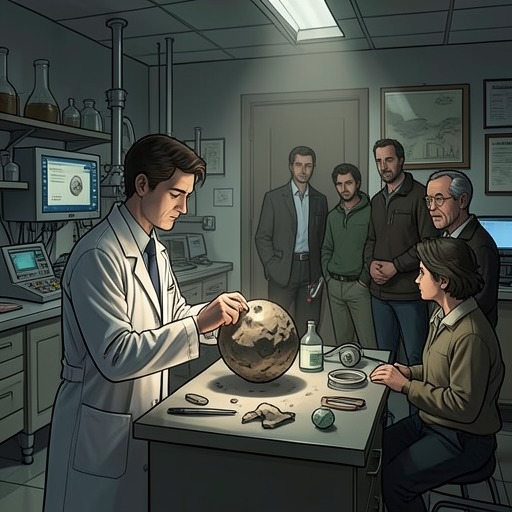
NASA’s Polar Orbiting Density Scanner, or PODS, supplies the technical basis for the discovery. Two weeks before the announcement, it passes over the Milne Ice Shelf on Ellesmere Island and registers a density anomaly about two hundred feet beneath the surface. The object appears to be an amorphous mass roughly ten feet across, embedded in solid ice. In the public account, the instrument’s unexpected reading leads NASA to a buried meteorite and, eventually, to fossils interpreted as evidence of life beyond Earth.
PODS is also described as a system for processing large quantities of ice-density data. Its software was supposed to scan thousands of acres, flagging areas outside the range of normal density. The primary aim was to identify soft spots relevant to global-warming research, while other density irregularities would also be marked for investigation. That distinction matters: the system’s technical purpose was broader than finding a meteorite, and its output depended on software that interpreted measurements and selected anomalies for human attention.
Independent examination initially strengthens NASA’s case. Norah Mangor drills her own ice cores, conducts her own tests, and arrives at the same impact date, 1716, that NASA had calculated before the expedition. The agreement provides a check beyond the satellite’s reading. At the extraction site, Mangor surveys the work area and urges the assembled scientists to begin raising the buried object. The operation is treated as a collective scientific achievement, giving NASA’s account both instrumental data and independent fieldwork behind it.
But the evidence is not self-interpreting. Rachel points out that laboratory measurements and PODS measurements are not identical kinds of observation, while the investigators examine whether an object could have reached its apparent position through a fissure in the glacier. Ekstrom rejects that possibility, insisting that the glacier has no fissures and that PODS scans confirmed the object was sealed in solid ice. The disagreement exposes a central weakness in the original presentation: confidence in the instrument and the ice conditions cannot substitute for testing how the object came to be there.
Ground-penetrating radar offers a different view of the ice. Its electromagnetic pulses return differently from freshwater and seawater because their frozen crystal structures differ: freshwater forms a flatter, shingled lattice, while sodium in seawater produces a more meshed or forked one, making the returned reflections more erratic and reducing their number. This capability makes the radar better suited than PODS to detecting brine ice. The distinction between the two instruments becomes consequential as the investigation shifts from celebrating the meteorite to questioning the physical structure beneath it.
The Announcement and the Hoax
NASA’s public presentation is staged as a moment of institutional vindication. In the agency’s habisphere on Ellesmere Island, Ekstrom sits at the center of a symposium table with senior officials and scientists while the crew gathers around monitors to watch President Zachary Herney’s live address. The arrangement binds NASA’s announcement to the presidency: the agency’s scientific claim is delivered as national news, and its hoped-for recognition is shared with the administration.
Ekstrom’s confidence is not limited to the public performance. He had been skeptical when Herney proposed using Michael Tolland, but Tolland’s documentary changes his mind. By combining a spirited account with interviews of the civilian scientists, Tolland makes the discovery intelligible to ordinary viewers without speaking down to them. NASA’s reliance on that accessible presentation underscores the importance of public communication to the agency’s standing. Ekstrom believes his personnel deserve the acclaim, unaware of the calamity ahead.
The later investigation overturns that narrative. A ground-penetrating radar printout shows the extraction pit and what appears to be a body-shaped outline in the shaft; more decisively, it shows a second shaft directly beneath the meteorite’s position, as if the stone had been inserted upward through the ice. Sedgewick Sexton recognizes the implication as he examines the sheets: the NASA meteorite is fake. The image does not merely raise a dispute about the object’s interpretation. It supplies a physical sign of deliberate placement that contradicts the story of a meteorite naturally sealed within the ice.
The software account also proves compromised. Chris Harper, the PODS section manager, privately realizes that Sexton knows he lied about the software. Harper says Ekstrom forced him to claim it had been fixed, and that the administrator had arranged additional pressure in case he reconsidered and stopped cooperating. The distinction between a sensor reading, software performance, and an official statement collapses into an organizational problem: what NASA presented as a reliable discovery was entangled with a fabricated repair claim and coercion within the agency.
The fraud must not be confused with proof that every person or institution around the discovery knowingly participated. William Pickering tells Rachel that the President and NASA are innocent: they believe the meteorite is authentic, and disclosure of the evidence would make them appear complicit. The deception therefore damages NASA even where its leaders and scientific staff may themselves have been misled. It also shows how a false result can acquire institutional authority before those responsible for publicizing it know that its foundation has been compromised.
Public Consequences and Significance
The announcement’s reversal leaves NASA exposed to a particularly sharp public disappointment. President Herney later takes responsibility for telling the world that the meteorite was not what it had appeared to be; Rachel and the others offer to stand beside him, but he insists on carrying the burden alone. The moment contrasts with the earlier broadcast, when NASA’s officials and scientists watched with excitement as the President announced the discovery. The same public platform that had seemed to promise vindication becomes the setting for an admission of error.
A television analyst describes the outcome as NASA finding no signs of life from space after all, and notes that this is the second time in the decade that the agency has incorrectly classified a meteorite as showing signs of extraterrestrial life. This time, respected civilian scientists were also fooled. The consequence reaches beyond NASA’s internal credibility: the failed claim implicates the reliability of scientific judgment as it is communicated to the public, while the involvement of outside experts demonstrates that independent participation alone cannot guarantee that a staged premise will be detected in time.
NASA’s story is shaped by the distance between what its instruments register and what its leaders announce. PODS identifies an anomaly; software is meant to organize the data; scientists interpret the signal; officials turn the interpretation into a public account. Independent cores, ground-penetrating radar, and the eventual discovery of the second shaft show why these stages cannot be treated as interchangeable. The agency’s political vulnerability makes the announcement valuable, but that value also raises the stakes of careful verification. In the end, NASA’s public standing depends not simply on whether it can make a spectacular discovery, but on whether its methods, claims, and corrections can be trusted.