Rachel Escapes the Sinking Triton
Deception PointRachel Escapes the Sinking Triton is the rescue sequence in which Rachel escapes a jammed submersible as it sinks away from the Goya. Tolland’s improvised attempt to release the viewing dome gives her a chance, but the escape depends on her recognizing his plan and acting from inside the failing vessel. The Triton’s descent turns a confined mechanical emergency into a test of mutual trust and individual survival.
Causes and Immediate Danger
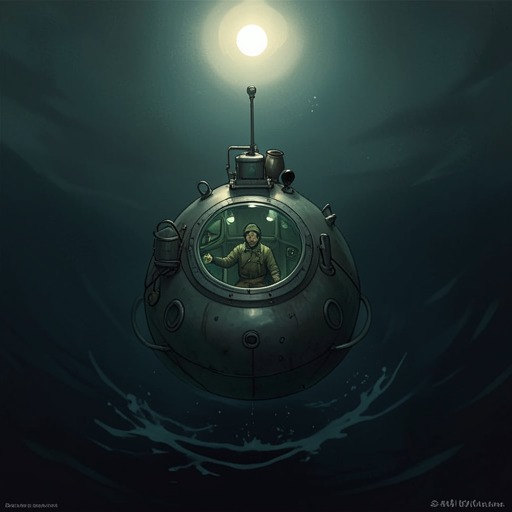
After the violence aboard the Goya, Rachel is alone inside the Triton. The sub moves along the lower dive deck, then begins sinking; water rises across the window as its ballast system takes on water. Rachel tries to open the overhead hatch so she can climb onto the sub and reach the nearby dive deck, but the hatch is bent and will not move. The short distance to safety is therefore no help: the exit she can reach is sealed.
The Triton drifts free of the Goya’s damaged hull and into open sea. On deck, Tolland sees that it is riding abnormally low in the water and notices that the hatch remains shut. He understands the danger and looks for a way to reach Rachel, but gunfire from William Pickering forces him behind the anchor spool. The rescue now has two simultaneous obstacles: the sub is sinking, and Tolland cannot safely cross the exposed deck.
Tolland investigates the Triton’s ballast system underwater. Its vent valves are closed, but he finds bullet holes in the negative tank—the tank that, when filled, takes the sub down. Because the tank has been perforated, water is entering it; the Triton is effectively being forced into a dive. The cause is not a routine valve problem but damage inflicted during the preceding attack, and its consequences continue after the immediate violence has moved elsewhere.
Tolland’s Attempt to Open the Dome
Tolland finds Rachel behind the dome, banging on the glass, while the sub sinks beyond the Goya’s underwater lights. He is struck by the prospect of losing her as he once lost Celia, and his determination to rescue Rachel is bound up with the fear of surviving another such loss. But the damaged ballast tank leaves little time for a conventional rescue. Tolland decides to use the Triton’s own pressure system: if he can raise the cabin pressure, perhaps the damaged seal around the viewing dome will give way.
The plan turns on a specific feature of the submersible. Its hull is built to withstand pressure from the surrounding water, not comparable pressure from within. Tolland reroutes the high-pressure cylinder’s charging hose to an emergency ventilation regulator and opens the valve. The cylinder is marked for 3,000 PSI. He knows that the cabin pressure could seriously harm Rachel, but hopes the dome will come loose before the pressure becomes fatal. The rescue is thus an improvised gamble in which the mechanism intended to help Rachel escape also places her in immediate danger.
Inside, Rachel experiences the sudden pressure as pain and disorientation. She sees Tolland outside the dome, signaling, but cannot at first make sense of what he wants. When he leaves to return to the surface, she believes he has abandoned her. The water on the floor and the darkness around the sub sharpen the separation between them: Tolland has initiated the plan, but Rachel must decipher and complete it without him beside her.
Rachel Forces an Exit
As the Triton lists, Rachel falls against the dome. The impact briefly pushes the loose acrylic outward, releasing some cabin pressure around its seal. That change lets her understand Tolland’s intention: he is trying to blow the window out. When the pressure begins building again, Rachel presses against the dome from inside, then climbs onto the cockpit chair as the vessel tilts toward a near-horizontal position.
The chair becomes a platform for her final attempt. Remembering her mother’s advice to use her feet, Rachel draws back her legs and kicks the center of the acrylic dome. The seal gives way on the left, and the large lens swings partly open. The opening is not a safe or controlled exit: water rushes into the cockpit, overturning Rachel and carrying her through the space as the sub begins its rapid descent. The hatch has remained unusable; the dome, loosened by pressure and her own force, becomes the way out.
Rachel is eventually free of the Triton, but the sequence does not end with her reaching safety. In the surrounding darkness she cannot distinguish up from down, and her lungs already ache for air. The escape resolves the immediate confinement while leaving survival in open water uncertain. Its ending makes clear that getting out of the sub is only the first stage of rescue, not its completion.
Consequences and Narrative Significance
The escape depends on two forms of action working together across the dome. Tolland identifies the bullet-riddled negative tank, devises a pressure-based method, and communicates his intention from outside; Rachel recognizes the plan and supplies the force that releases the dome. Neither can accomplish the escape alone: his technical intervention creates the possibility, while her response turns that possibility into an opening.
The scene also reverses Rachel’s initial position. At first she is trapped by a jammed hatch and can only attempt to force it; after understanding Tolland’s plan, she becomes the person who acts decisively inside the sub. Yet the reversal is incomplete. The Triton is still sinking, its cockpit is filling, and Rachel emerges into water without a clear sense of direction. The sequence therefore delivers escape without certainty, preserving the larger danger even as it marks Rachel’s resourcefulness and the pair’s coordinated effort.