Wallops Island
Deception PointWallops Island is a long-established NASA launch site that becomes the secluded setting for Zach Herney’s attempt to make Rachel Sexton understand a discovery before he announces it to the world. Its runways, launchpads, and closed hangar give the encounter a double character: this is a working aerospace facility, but also a controlled threshold where the President can separate evidence from public spectacle.
Setting and NASA’s Hidden Base
Rachel approaches the island by helicopter after crossing the Chesapeake in less than seven minutes. The pilot banks north around a narrow peninsula, and the view resolves into a distinctly institutional landscape: six launchpads, charred rocket towers, military-looking buildings, and three runways running the length of the strip of land. The name WALLOPS ISLAND, painted in enormous letters on a rooftop, confirms her location.
Wallops is described as one of NASA’s oldest launch sites. It remains in use for satellite launches and experimental-aircraft testing, yet serves as NASA’s base away from the spotlight. That distance from the agency’s most visible public face matters to the scene: the island offers infrastructure and isolation, placing a major announcement’s preparation far from the familiar political stage in Washington.
Herney Brings Rachel to the Island
The President has an office on Wallops Island, a fact that initially strikes Rachel as implausible. The helicopter lines up with the three runways and descends toward the far end of the center runway; only then does the pilot tell her that she will meet the President in his office. The unexpected location unsettles her understanding of the meeting before its purpose becomes clear.
After speaking with Rachel aboard Air Force One, Herney leads her down its glistening gangway into the bleak March air. He explains that four civilian scientists, independent of NASA and using their own equipment, have confirmed the discovery. He plans to announce it at a White House press conference at eight that evening, but refuses to disclose what it is: Rachel, he says, needs to see it for herself before they discuss her role. Wallops is thus not just where the President happens to be; it is where he stages a passage from claims and credentials to firsthand evidence.
The Hangar as a Threshold
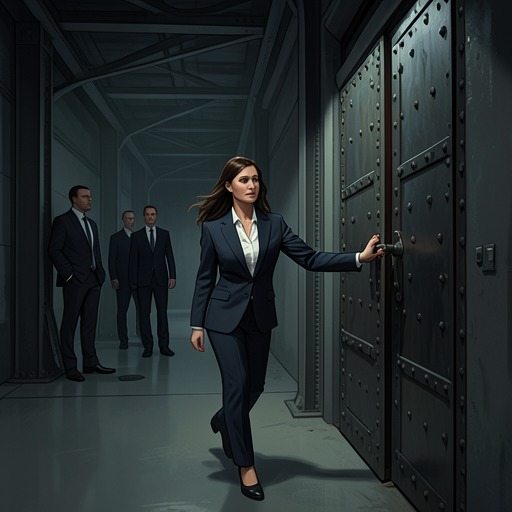
Herney walks Rachel toward a windowless airplane hangar with towering bay doors sealed shut. A small side entrance stands ajar. He stops a few feet from it, tells Rachel that his part ends there, and leaves her to go inside alone. He then returns to the PaveHawk helicopter that brought her and takes off without looking back.
The staging turns an ordinary facility entrance into a boundary. Rachel stands alone at the threshold, peering into the darkness; a cool, musty breeze flows outward from the cavernous interior, and her tentative call meets silence. The scene’s suspense depends on a deliberate break in access: the President has brought her as far as the evidence, but neither accompanies her nor substitutes his authority for what she is about to see.
Discovery, Publicity, and Political Stakes
The encounter at Wallops precedes a discovery that NASA’s PODS system has detected an unusual object embedded two hundred feet beneath an ice shelf. The anomaly is about ten feet in diameter and harder than the surrounding ice. The novel later makes clear why that claim cannot be kept within the sheltered context of the island: Herney warns Rachel that a NASA triumph will immediately become a political football, even if the evidence and outside endorsements seem conclusive.
The contrast between the hangar’s sealed doors and the announcement’s mass distribution gives Wallops a specific role in the story’s information chain. At the White House, the Communications Office prepares to push the announcement through fax broadcasts, bulk email, telephone autodialers, a breaking-news website, and promised live feeds for major networks. Rachel, meanwhile, later warns Marjorie Tench that the meteorite data are wrong and that the object was inserted from beneath the ice shelf. The discovery’s staged presentation has become a potential public crisis; what began behind an isolated hangar door now demands an urgent correction.
At the story’s close, Herney prepares to address the public again and tells Gabrielle Ashe that there is no substitute for the truth. The movement from the isolated site to presidential broadcast completes Wallops Island’s narrative function: it is the remote setting where Rachel is first asked to confront evidence directly, before the claims made in its name are tested in public.