Xavia
Deception PointXavia, the Goya’s marine geologist, turns a joke at Michael Tolland’s expense into a decisive contribution to the investigation: her expertise helps show that NASA’s supposed meteorite is an ocean rock, not a meteorite. Her dry candor first appears as comic relief, but when the evidence is tested, that same professional precision becomes essential to recognizing the hoax.
Identity and Introduction
A respected marine geologist, Xavia has a reputation for speaking her mind with caustic honesty. She is also distinctly unsentimental about the scientists around her: in a message left for Tolland, she calls his colleagues hoodlums and describes her own role aboard the Goya in blunt, self-mocking terms. The message establishes a voice that is funny because it refuses ceremony, but also credible because it does not flatter its audience.
Xavia is left aboard the Goya while Tolland is away. A recording explains that she has agreed to look after the ship and that the crew has asked her to keep its celebrated host from becoming conceited. She says Tolland has made a small mistake in his documentary, then immediately undercuts the warning with jokes: only a handful of marine geologists would notice, and she is mentioning it chiefly to spoil his evening. She expects the press to call him and says she will explain the point when he returns. The apparent triviality of the correction makes the message memorable—and gives Tolland a reason to seek her out.
Onboard Life and Relationship with Tolland
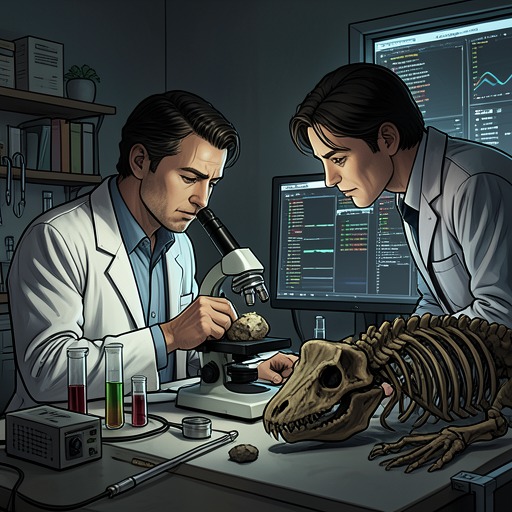
When Tolland and Corky Marlinson return to the Goya, they find Xavia in the hydrolab, reclining in front of a blaring television. She does not turn around when she calls out, assuming that the men have come back because they have run out of beer money. Tolland identifies himself and tells her he has received her message. The familiar teasing is therefore not an obstacle between them but the register in which their professional rapport operates.
Tolland asks to discuss the mistake. Xavia laughs and says she was only pulling his chain: NASA must have given him old data, and the oversight is inconsequential, something perhaps three or four marine geologists in the world would even notice. Yet Tolland is not satisfied with reassurance. He asks whether the oversight concerns chondrules, directing the conversation from the joke toward the scientific question that will matter to the investigation.
Geological Evidence
Xavia’s notes introduce a competing geological explanation for structures that had been treated as evidence of a meteorite. She recounts the work of Lee Pollock, a young geologist at Drew University, who used a new marine robot to collect deepwater crust samples in the Mariana Trench. In one loose ocean rock, Pollock found tiny metallic bubbles that resembled chondrules. He called these features plagioclase stress inclusions and proposed that extreme pressure in an ultradeep ocean could rehomogenize metals within a pre-existing rock.
The distinction does not rest on appearance alone. Xavia cautions that she is not a chemical petrologist, then points to the chemical differences between Pollock’s rock and genuine meteorites. Her notes identify the titanium-to-zirconium ratio as one such difference: the chondrules in the ocean sample are ultradepleted in zirconium, with only two parts per million. Corky reacts that meteorites contain thousands of times more. The numerical contrast gives the proposed oceanic origin a measurable test, not merely a resemblance between two kinds of rock.
Discovery and Narrative Significance
Later, as doubts about NASA’s claim intensify, Xavia hurries in holding a computer printout. Her face is ashen and her voice breaks as she tells Tolland that the titanium-to-zirconium ratios in the sample make the conclusion obvious: NASA’s meteorite is an ocean rock. Tolland and Rachel Sexton exchange a look but say nothing. The ratios give scientific confirmation to suspicions that had been gathering, turning uncertainty into recognition.
Xavia’s arc is compact but consequential. She begins by presenting the error in Tolland’s documentary as a minuscule professional quibble and even jokes that the people likely to notice it are humorless geologists like herself. The detail proves anything but inconsequential: it leads back to a geological mechanism capable of explaining the supposed chondrules and culminates in a test that exposes the sample’s origin. Her role connects sharp interpersonal observation to careful scientific discrimination; the warning that sounded like a prank becomes one of the investigation’s most important leads.