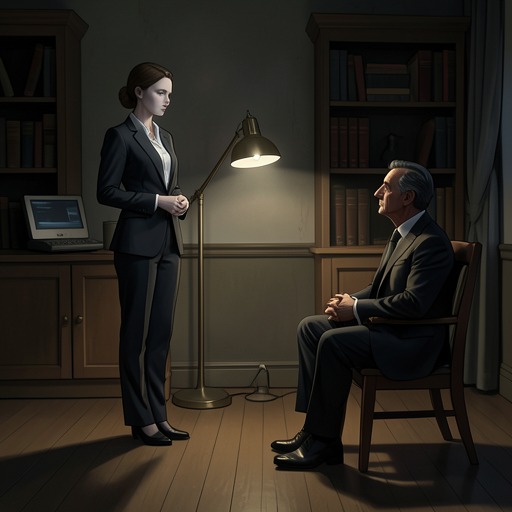
Yolanda Cole
Deception PointYolanda Cole is a veteran ABC News content editor, known in the newsroom as “Mother,” whose professional instincts and personal loyalty make her a trusted guide to Gabrielle Ashe. She offers Gabrielle both refuge and hard questions: when the scandal around Senator Sexton threatens to engulf her, Yolanda helps her separate what she knows from what she merely fears, then supports her again after the President’s announcement transforms the political story.
Identity and Background
Yolanda has worked as a content editor with ABC News in Washington for sixteen years. Colleagues affectionately call her “Mother,” a name that reflects her matronly presence and good humor, while her experience also gives her a street-savvy determination to get a story. The newsroom’s frenetic pace is part of her working world; when Gabrielle arrives, Yolanda is out on the production floor rather than in the quieter glass-walled offices usually occupied by decision makers.
Gabrielle first met Yolanda at a Women in Politics mentoring seminar, soon after arriving in Washington. They talked about Gabrielle’s background and the challenges facing women in the capital, then discovered a shared enthusiasm for Elvis Presley. Yolanda took Gabrielle under her wing and helped her make connections. Gabrielle continued to visit her about once a month, making the relationship an enduring personal connection rather than a one-time professional introduction.
Counsel in a Political Crisis
When Gabrielle comes to ABC News in distress, Yolanda recognizes that something is wrong and brings her into the privacy of her glass-walled cubicle. There Gabrielle confides that she had a one-night affair with Sexton and that Marjorie Tench possesses photographic evidence. Yolanda is not shocked; she treats the revelation as a familiar kind of Washington complication, responding with humor before turning to the consequences Gabrielle is actually worried about.
Yolanda’s reassurance is grounded in her long experience with the White House and the media. She doubts that Zach Herney has summoned the global press to discuss Sexton’s alleged affair or campaign-finance problems: in her view, such matters are more likely to be leaked than made the subject of a presidential address. She also cautions Gabrielle against treating the senator’s meeting with private aerospace interests as proof of wrongdoing. Campaign-finance questions can be complex, she argues, and the meeting may have been legal. Her point is not that Sexton is beyond suspicion, but that Gabrielle should not confuse a troubling appearance with established facts or expose herself on national television without being sure.
That distinction becomes more consequential when the President announces NASA’s discovery. As the news changes the political balance and the newsroom erupts into activity, Gabrielle stands stunned amid the production-floor commotion. Yolanda sees the immediate risk that reporters may identify Gabrielle and question her about what the announcement means for Sexton’s campaign. She guides Gabrielle back into her office, seats her, and gives her water. The gesture returns their relationship to its familiar shape: amid public upheaval, Yolanda makes a private space in which Gabrielle can regain her bearings.
Political Advice and Personal Loyalty
Yolanda’s influence on Gabrielle reaches beyond the immediate crisis. At a later confrontation with Sexton, Gabrielle recalls Yolanda’s maxim that the best defense is a good offense and uses it to challenge his accusation about her conduct in his office. The advice becomes a practical tactic: Gabrielle turns the accusation into a pointed account of how implausible it would be to suspect her of disabling the alarm, entering the office, taking nothing, restoring the alarm, and then calmly leaving. Yolanda is not present, but her counsel shapes Gabrielle’s response under pressure.
After Gabrielle loses her job, Yolanda offers her another one at ABC News. Gabrielle has already turned down that offer, along with a proposed tell-all biography from St. Martin’s Press that came with a substantial advance. The refusal indicates that the available routes back into public work are not necessarily routes she wishes to take. Even so, Yolanda’s offer confirms the practical and personal support she extends to Gabrielle beyond the moments when she needs immediate shelter.
Narrative Role and Significance
Yolanda’s newsroom experience supplies a grounded counterpoint to the novel’s political spectacle. She understands that a presidential broadcast, a campaign scandal, and a damaging allegation do not carry the same news value or evidentiary weight. By asking Gabrielle whether she is sure enough to risk public exposure, Yolanda presses her to consider both uncertainty and consequence rather than simply accept the most alarming interpretation.
Her role also connects Gabrielle’s private vulnerability to the machinery of public news. In the production room, reporters race to explain a story that fuses science, history, and political drama; Yolanda’s priority is to keep Gabrielle from becoming an unexpected subject of that coverage. Across their meetings, she is at once mentor, confidante, editor, and potential employer. Her counsel does not decide the political outcome, but it helps Gabrielle face the crisis with greater caution and agency.