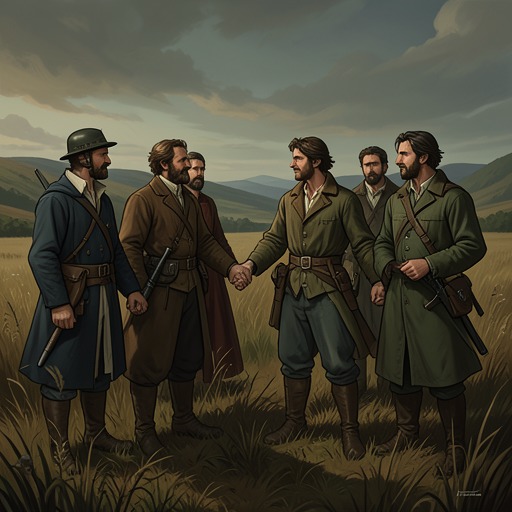
Abindarráez and Jarifa's Secret Marriage
DianaAbindarráez and Jarifa's Secret Marriage is a private union formed under the pressure of separation and family authority. Its consequences reach beyond the lovers: when Abindarráez is captured on his way to Jarifa, their marriage gives his return a double meaning, as both a pledge to his captor and a test of the couple’s fidelity. Their decision to face captivity together ultimately prompts forgiveness from Jarifa’s father and an act of generosity from Rodrigo de Narváez.
Background and Separation
The marriage takes place within the embedded history of Abindarráez, a young man of the Abencerrajes of Granada. He recounts that the family, once celebrated for courage, generosity, and service, was brought low after some members were accused of conspiring against the king. Whether the alleged plot was real or fabricated, the accused were executed, and the family’s fortunes collapsed. Abindarráez presents this inherited misfortune as the background to his own vulnerability: he learned to expect hardship from the fate of his lineage.
He was born in Granada and raised in Cártama, where Jarifa lived with her father, the governor of the fortress. The two fell in love, and Jarifa came to regard Abindarráez’s character as a greater source of worth than wealth or rank. Their position changed when the king ordered Jarifa’s father to leave Cártama and take up a post in Coín, while Jarifa remained behind under another governor’s authority. The order divided the lovers before they could openly establish a household. In their farewell, Jarifa promised that she would send for Abindarráez when an opportunity arose, and he held to that promise through the separation.
The Private Union
When Jarifa’s father was summoned to Granada, she sent a trusted attendant to call Abindarráez to Coín. He set out at night, dressed to meet her, intending to see her and marry her. On the journey, Rodrigo de Narváez and his men intercepted him. Abindarráez fought bravely but was wounded and captured. Narváez allowed him to go free for three days on the condition that he return to Álora and resume his captivity. Abindarráez accepted the terms as a knightly promise.
He reached Coín and entered the fortress secretly, using the agreed signal at a concealed door. Jarifa received him with joy. She explained that she had called him not merely for a meeting: she had arranged for him to become her husband and to share her person and her father’s estate under the status of marriage. Her decision was made without her father’s consent; she knew that he would have preferred a wealthier match because he did not know Abindarráez’s worth as she did. In her account, the secret marriage answers both emotional commitment and the limits imposed on her choice by paternal authority.
Abindarráez welcomed her decision, but their reunion was clouded when he remembered the promise he had made to Narváez. Jarifa noticed his sudden grief and asked whether she had disappointed him or whether he loved someone else. He explained that he had been released only on condition that he return to Álora within three days. His distress came from the prospect of leaving his new wife, not from regret about marrying her. Jarifa first offered to send Narváez whatever ransom he demanded from her father’s wealth. Abindarráez refused: now that he was her husband, he felt more—not less—bound to keep his word personally.
A Shared Obligation
Jarifa would not treat his return as a duty belonging to him alone. She declared that she would go with him, because she considered herself his fellow captive and feared her father’s reaction to their unauthorized marriage. Before dawn, they left Coín in secret, with Jarifa’s face covered to avoid recognition. At Álora, Abindarráez presented her to Narváez as the second prisoner he had promised to bring back. Their arrival turns the private bond into a visible act of mutual responsibility: Abindarráez keeps his word, and Jarifa chooses to share the consequences of the marriage.
Narváez received them courteously rather than treating their return as an occasion for harsh punishment. After Abindarráez’s wounds were tended, the couple asked him to help resolve their position. Abindarráez explained that Jarifa’s father had not known of the marriage and appealed for his intervention. Narváez wrote to the king of Granada, describing the couple’s secret marriage, Abindarráez’s capture and release, and Jarifa’s decision to return with her husband. He also defended Abindarráez’s family, insisting that the young man and his father had been innocent of the conspiracy attributed to the Abencerrajes.
Forgiveness and Recognition
The king trusted Narváez and granted his request. He ordered Jarifa’s father to go to Álora, forgive the couple, and take them home. The father received them without reopening the dispute over the past and acknowledged that Jarifa had chosen a better husband than he would have selected for her. This recognition changes the marriage’s standing: what had been undertaken privately, against the father’s anticipated wishes, is accepted within the family after Narváez’s appeal and the king’s command.
Narváez then released Abindarráez without demanding a ransom. The couple returned to Coín with him, and celebrations followed. Jarifa’s father later proposed sending four thousand doblas as payment for Abindarráez’s release. Abindarráez also sent six richly equipped horses, shields, and lances, while Jarifa sent Narváez a letter and a cypress chest containing fine linen. Narváez returned the money, treating it not as a necessary price for his prisoner but as a contribution toward the wedding expenses; he kept Jarifa’s gift and shared the horses and weapons with the men who had accompanied him. The exchange completes the movement from secret union to acknowledged marriage, with generosity answering the couple’s fidelity.
Narrative Significance
Felismena tells the story at the home of Wise Felicia, where it appears within the larger pastoral narrative as an example of love tested by separation, obligation, and family power. The marriage is not presented simply as a private triumph over parental authority. Jarifa makes her choice without her father’s permission, yet the story’s resolution depends on a sequence of public acts: Abindarráez honors his pledge to Narváez, Jarifa joins him in captivity, Narváez intercedes, and the king orders reconciliation. Personal consent and loyalty thus gain recognition through negotiations with the authorities that had constrained the couple.
The episode also sets a Muslim lover and a Christian captor within a shared language of honor and generosity. Narváez does not erase the religious and political divisions between them, but he recognizes Abindarráez’s courage and keeps faith with the couple’s appeal. Abindarráez, in turn, refuses to use his marriage as an excuse to break his word. The private marriage becomes the point at which these competing obligations meet: its secrecy creates danger, while the lovers’ conduct makes their relationship legible to others and enables its eventual acceptance.