Dingo's European Tour and Animal Attacks
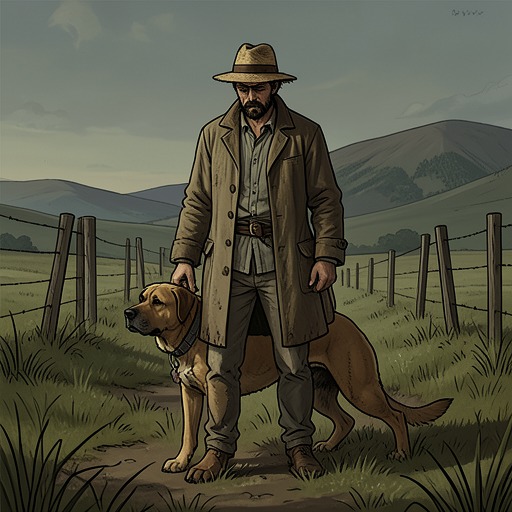
DingoDingo's European Tour and Animal Attacks turns the narrator's hope of reforming Dingo into a sequence of reversals. Travel initially promises novelty, exercise, and a way out of the dog's constrained Paris routine. Instead, Dingo proves both an exceptionally capable explorer and a persistent predator: his intelligence helps him master unfamiliar places, while the cities reveal animals that the narrator had assumed would be scarce. The journey ends not in gradual reform but in flight from the consequences of another mass attack.
Causes and Expectations
By the time the narrator decides to travel, he has begun questioning whether Dingo alone is responsible for their troubles. In Paris, the dog has been left idle and often at home while the narrator attends to his own social obligations. Dingo's attack on a locked collection of furs also prompts the narrator to see the human luxury of keeping animal skins as a provocation, rather than treating the incident as simply another instance of canine wrongdoing. Travel follows from this reassessment: the narrator hopes that changing scenes and the incidents of the road will soften Dingo's hunting instincts and help shape his youth.
The plan has a history behind it. At Ponteilles, Dingo had shown intense excitement when sheep passed the narrator's gate, and an earlier poultry-yard raid left one hundred hens dead. These episodes make the narrator's hopes ambitious, even as he imagines that a city journey might remove the temptations that had surrounded Dingo in the countryside. The trip tests that assumption across a succession of settings, rather than resolving it at the outset.
The Traveler and His Reception
The narrator and Dingo travel through Switzerland, Italy, and Germany. At first, Dingo appears to justify the experiment. His appearance, good bearing, and gentleness with children attract attention from foreigners. In the towns they visit, the narrator receives flattering calls from police officials, artists, scientists, showmen, photographers, and other admirers. Reporters interview him, and some of their accounts appear in Paris newspapers. The attention is directed chiefly at Dingo, but it nonetheless enhances the narrator's reputation as a writer. The episode gives the narrator a comic glimpse of the publicity he might have exploited, had he chosen to turn the attention into a public career.
Dingo's independence becomes clearest in the way he learns each city. While the narrator discusses a room with an innkeeper, Dingo slips away and begins exploring. He proceeds cautiously at first, stopping at major intersections to scent the air and register landmarks. He then widens his circuits from the hotel toward the countryside, before working his way back along narrower routes. After about two hours he returns with the city mapped well enough to guide the narrator through its streets. The same self-directed capacity that makes him an impressive companion, however, also lets him locate animals without the narrator's knowledge.
Attacks Across the Journey
The narrator assumes that animals will be rare and hidden in cities, and that distance from temptation will quiet Dingo's predatory habits. That confidence fails. The narrator declines to list every attack, but recounts a series of incidents in different towns. In a dark lane near the castle at Nuremberg, Dingo kills two golden pheasants kept by an elderly shoemaker. In Frankfurt, he kills a young gazelle in the back room of a dealer's shop; the animal's young caretaker is left grieving. At a small restaurant in Altona, he kills a kangaroo. The narrator also recalls parrots in Dresden, two ospreys in Düsseldorf, and a boar in Munich.
The journey's dangers extend beyond animals kept in shops or enclosures. At Lucerne, a railway inspector tries to lead Dingo to the dog van, and the narrator intervenes forcefully; without that intervention, he fears the inspector could have paid for the attempt with his life. At Cologne's acclimatization garden, Dingo gets into an aviary containing flamingos and kills them. Other rare birds escape in the commotion and strike the wire enclosures. The attack there becomes the decisive crisis: the narrator offers to pay twice or three times whatever compensation is demanded, but payment cannot protect Dingo from the pound or the threat of death.
Abandonment of the Trip and Its Meaning
That evening, the narrator flees with Dingo and returns to Paris, abandoning the journey. The retreat ends the experiment without evidence that travel has softened the dog's instincts. Instead, each new place has provided its own unsuspected animals, while Dingo's ability to explore has repeatedly brought him within reach of them. The narrator's readiness to compensate those harmed contrasts with his final decision to escape rather than leave Dingo to institutional custody or death.
The return also reveals the limits of the narrator's human-centered plan. He had treated travel as a means of educating Dingo into a more manageable life, yet Dingo's intelligence appears most vividly in abilities and priorities that do not serve that design: he reads streets through scent and landmarks, ranging on his own, and remains alert to the animals the narrator fails to anticipate. After the return to Paris, Dingo again becomes listless amid crowded streets and buildings. In spring, fearing that he will fall ill, the narrator rents a rustic house at Veneux-Nadon, beside the forest of Fontainebleau. Dingo becomes active and content there and lives mostly in the forest. That later change does not undo the tour's damage or validate its original purpose; it sharpens the contrast between a dog's need for space and the human arrangements that repeatedly confine or redirect him.