Agafia Fotievna
Doctor ZhivagoAgafia Fotievna, the wife of Pamphil Palykh and mother of their children, is a displaced civilian whose family’s precarious place near a partisan camp gives human form to wartime insecurity. Her account of her husband’s fear that they will be separated links a threatened administrative relocation to the family’s distress and to Pamphil’s worsening condition.
Identity and Background
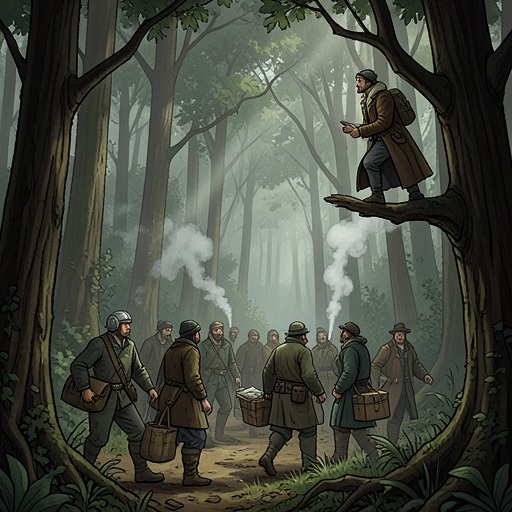
Agafia appears as part of Pamphil’s family, which includes two daughters and a young son. The family has spent the summer fleeing along dusty roads, exposed to the open sky and haunted by what they have endured and what may still come. The children’s appearance bears the effects of sun and travel, while Agafia’s face has taken on a rigid, defensive expression: the strain of fear is described as having narrowed her lips and fixed her features.
Her circumstances are not those of a settled household. The family has endured repeated displacement, and its continued proximity to the camp depends on a situation that may change at any moment. Agafia’s small domestic responsibilities—caring for the children and later tending a cow—take place against that larger uncertainty.
Family Life and Pamphil’s Condition
Pamphil is deeply attached to his wife and children. When his family arrives, he becomes more cheerful and begins to recover. His affection is expressed in a practical, tender act: using a corner of his sharpened ax blade, he carves toy rabbits, cocks, and bears for the children. The toys mark a moment in which family presence appears to restore him, however temporarily.
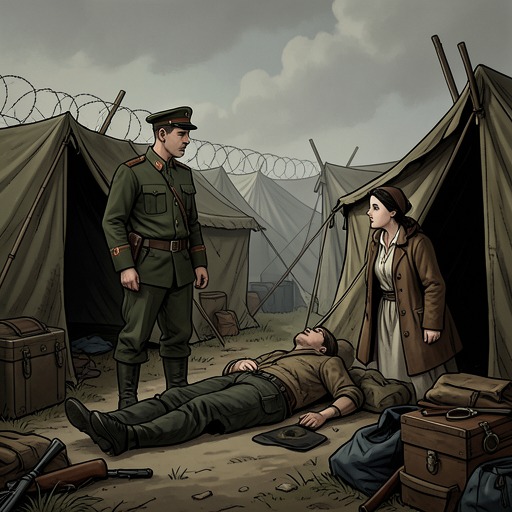
That improvement is fragile. News spreads that families are considered harmful to camp discipline and may be escorted to winter quarters some distance away, relieving the camp of civilian refugees. The plan is discussed more than it is prepared for, and the doctor doubts it will actually be carried out. Yet the possibility alone weighs on Pamphil: his spirits fall, and his hallucinations return. The passage thus makes the threatened separation consequential before it happens; uncertainty itself is enough to undo some of the steadiness his family had brought him.
The Sick Cow and Agafia’s Fears
Later, Agafia brings her sick cow to Kubarikha. The animal has been separated from the herd and tethered to a tree, while Agafia sits beside its forelegs and Kubarikha examines it from behind. The cow is one among an exhausted herd, crowded into a forest clearing after the privations and endless wandering endured by both animals and their owners. In this setting, tending a single sick animal becomes part of the family’s struggle to preserve a fragile livelihood amid displacement.
The doctor is struck by how much Agafia has changed: within a few days she has aged markedly, with eyes and neck that make her look almost unrecognizable. She tells Kubarikha that the cow is not giving milk. Kubarikha identifies an anthrax scab on its udder and offers an herbal ointment, along with a promise to cast a spell. The practical problem is plain, but the conversation soon reveals that the animal is not Agafia’s only concern.
When asked about her husband, Agafia clarifies that she is not afraid he will stray. Her fear is the reverse: Pamphil clings to her and the children, and the prospect of separation is breaking his heart. She imagines the family being sent one way and Pamphil another, leaving them exposed to Bassalygo’s men without anyone to defend them. She is afraid that, in his distress, Pamphil will take his own life. Her account gives the threatened camp policy a personal consequence and shows how closely she reads her husband’s state of mind.
Narrative Significance
Agafia’s role is brief but structurally important. She is not presented as a partisan decision-maker; instead, through her, the consequences of the camp’s approach to civilian families enter the story at the household level. The proposal to move families is discussed as a question of discipline and the removal of a burden, while Agafia understands it as the possible rupture of the bond on which Pamphil’s recovery depends.
The scene also sets the sick cow beside the threatened family without making them equivalent: both are vulnerable to conditions beyond Agafia’s control, but it is her husband’s attachment and fear that she names as the deeper trouble. Her appeal makes visible a chain of consequences that policy talk can obscure: displacement heightens fear, the possibility of separation weakens Pamphil, and his decline becomes another danger Agafia must anticipate. The novel leaves her concerns unresolved in the supplied episode, emphasizing the uncertainty under which she and her family continue to live.