Alexander Alexandrovich Gromeko
Doctor ZhivagoAlexander Alexandrovich Gromeko is a professor of chemistry, husband to Anna Ivanovna, and father of Tonia, whose home gives Yurii Zhivago and Misha Gordon shelter during their youth. He embodies a cultivated domestic world of music, conversation, and hospitality, but that world is not sealed off from history: political quarrels enter his study, shortages reach his household, and practical work becomes part of family survival. His warmth and habits of thought make him a consequential figure in the domestic life that surrounds Yurii and Tonia.
Identity and Household
Alexander is one of two Gromeko brothers who are professors of chemistry: he teaches at Peter's Academy, while his unmarried brother Nikolai Alexandrovich teaches at the University. He is married to Anna Ivanovna, née Krueger, daughter of the ironmaster Ivan Ernestovich Krueger, whose large estate lies in the Urals near Yuriatin and contains abandoned, unprofitable mines. Their daughter Tonia grows up in a household that also includes Yurii and Misha, the son of a lawyer, who live with the Gromekos as young people.
The Gromekos' two-story house stands at the corner of Sivtsev Vrazhok and a smaller street. Its upper floor holds the family bedrooms, schoolroom, Alexander's study and library, Anna's boudoir, and rooms for Tonia and Yurii; the ground floor is arranged for receiving guests. The rooms are described through their furnishings and colors: pistachio curtains, the shining piano, olive-green upholstery, an aquarium, and potted plants evoke a green, gently swaying sea bed. The house is at once a family residence, a place of study, and a setting for social and musical life.
Music and Hospitality
The Gromekos are cultivated and hospitable, with a strong love of music. Their receptions and chamber-music evenings bring together performances of piano trios, violin sonatas, and string quartets. For a January 1906 evening, the program includes a new violin sonata by a young pupil of Taneiev and a trio by Tchaikovsky. Preparations begin the preceding day: furniture is shifted in the ballroom, the piano tuner repeatedly tests a chord, and the kitchen is busy with food for the guests. Such details present hospitality not as an abstraction but as a coordinated household activity, carried out alongside the Gromekos' intellectual and artistic interests.
At one concert, Yurii, Tonia, and Misha sit in the third row. When the old servant Egorovna urgently signals that she needs to speak to the master, Yurii alerts Alexander, who is sitting directly in front of him. Alexander eventually tells the audience that the cellist Tyshkevich has received bad news and must leave; he will accompany him because the musician may need help. He asks Yurii to have Semion bring the carriage around and assures the guests he will return. The interruption briefly turns a public evening into an act of care: Alexander takes responsibility for a distressed guest without abandoning the courtesy owed to the room.
Political Argument and Personal Manner
Alexander's domestic sociability includes sharp political disagreement. His brother Nikolai Nikolaievich has returned from Switzerland, is pro-Bolshevik, and speaks approvingly of left-wing Social Revolutionaries. Alexander rebukes him for his political associates and their perceived lack of conscience, while Nikolai corrects him when he mangles the names of the journalist Miroshka Pomor and the pamphleteer Sylvia Koteri. The exchange exposes their differing temperaments as well as their disagreement: Nikolai argues for upheaval to replace an unjust social order, whereas Alexander attacks the inconsistency and moral character of those who advocate it.
Alexander's argument is characteristically physical and domestic. When he insists that Nikolai's reasoning is defective, he searches for a newspaper article to support his point, banging desk drawers and using the bustle as an accompaniment to his speech. He likes having something to do while talking; he becomes especially loquacious when looking for a lost object, standing with a towel at the bathroom door, or pouring wine for guests. The narrative links his mannerisms to his voice and appearance: his soft, familiar old-Moscow singsong and purring Gromeko r's delight Yurii, while his small cropped mustache and protruding butterfly tie contribute to a touching, childishly trusting look. His politics are therefore presented through the texture of ordinary behavior, not as detached doctrine.
Family, Work, and Material Survival
Alexander becomes part of the practical work of keeping the household going as revolutionary scarcity intensifies. When firewood has run out, Yurii secretly removes a heavy beam from a pile guarded by a sentry and carries it home. The beam is chopped and stacked; Yurii lights the stove while Alexander draws his armchair closer and warms himself. The episode places the professor not above the household's privations but within them: warmth depends on a risky act and the labor of turning salvaged timber into fuel.
Professional service also becomes a means of obtaining necessities. Alexander is asked to consult for the Higher Economic Council, while Yurii treats a dangerously ill government official; both receive credit slips for goods at a newly opened distribution center. At an old army warehouse near Simonov Monastery, they enter a vaulted cellar and present their slips. The storekeeper asks for containers, and the two men hold out pillowcases as flour, cereals, macaroni, sugar, suet, soap, matches, and a paper-wrapped parcel of Caucasian cheese are weighed out. They leave carrying sacks over their shoulders, moved not only by the food but by the sense that their work has made them useful and earned their family's thanks. Alexander's professional standing thus has a direct material consequence for the household.
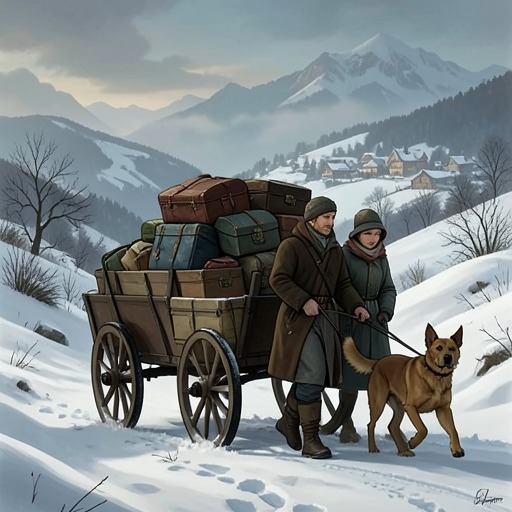
His family role also brings him into a difficult decision about leaving Moscow. As the Zhivagos prepare to depart, their tenants are told that the apartment is undergoing spring cleaning for Easter to disguise the move. Alexander joins Yurii and Tonia at a family council. Yurii reiterates his doubts and asks whether the others still insist on going; Tonia argues that the family cannot endure the immediate shortages simply by waiting for land conditions to improve and hoping for a future vegetable garden near Moscow. Alexander backs her, calling reliance on such prospects sheer madness. The exchange places him on the side of immediate household survival, even as Yurii questions the plan.
Narrative Role
Alexander's significance lies in the durable, imperfect domestic world he helps sustain. His home gives the young Yurii a place within a family, a library and schoolroom, and a life shaped by music and conversation. Later, the same household becomes a site where political arguments, fuel shortages, rationed goods, and decisions about departure are faced together. The movement from chamber music and carefully prepared receptions to salvaged firewood and food distribution does not erase the Gromekos' culture; it shows that culture and family obligation continue under pressure, dependent on ordinary gestures of hospitality, labor, and care.