Anfim Efimovich Samdeviatov
Doctor ZhivagoAnfim Efimovich Samdeviatov is a lawyer, Social Democrat, and resourceful provincial intermediary whose help becomes a material support for life around Varykino. He moves among official demands and local needs with unusual ease, but Yurii Andreievich Zhivago cannot settle whether this practical generosity arises from conviction, personal temperament, or a need to keep life from becoming dull. Samdeviatov’s significance lies in that unresolved mixture: he is at once a declared supporter of the revolution and a man adept at surviving its contradictions.
Identity and Background
Samdeviatov first introduces himself to the crowded train in the aftermath of Zhivago’s encounter with Strelnikov. Yurii notices the mismatch between the name’s suggestion of an old Russian ballad and the traveler before him: a man with graying curls, mustache, goatee, and the air of a local Arts Club. The comic contrast makes his first impression difficult to reduce to a single type. He does not arrive as a legendary figure or a conventional official, but as a socially observant provincial whose manner invites several readings.
He explains that his father kept an inn and had seven troikas on the road, while he himself went to university. He identifies as a Social Democrat, and Antonina Alexandrovna warns Yurii to watch his tongue around him because he is a Bolshevik. The two descriptions do not cancel each other: his political affiliation is clear, but so is his education and his connection to a family business built on travel and transport.
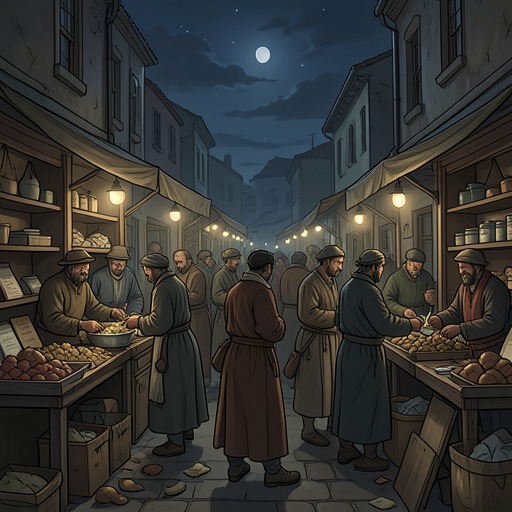
Samdeviatov knows the district through repeated journeys rather than distant authority. He says he knows the surrounding area within a hundred-mile radius, and has spent twenty years practicing law while traveling on business. His work includes unfinished deals, business operations, and breaches of contract—even though, as Yurii points out, such activities are supposedly abolished. Samdeviatov’s career is thus rooted in the gap between proclaimed arrangements and the continuing practical business of living.
A Guide Through a Disrupted Region
On the journey toward the Urals, Samdeviatov gives the Zhivagos local information that shapes their route. They cannot change trains at Yuriatin because part of the town is burning and the bridge has been blown up. Instead, their train will be switched onto another line, one that happens to take them toward Torfianaia; the advantage is that they can avoid transferring their baggage, though the train will be shunted about for hours before it gets under way. His knowledge makes disorder legible in concrete terms: a burned town, a destroyed bridge, a diverted line, and a long delay.
When the burning outskirts have receded and the train passes woods and low hills, Samdeviatov tells Yurii that he must get off soon and warns him not to miss the next station. The attention is casual rather than ceremonious, but it belongs to the same practical role: Samdeviatov knows the route, understands its inconveniences, and shares what another traveler needs to know.
His usefulness extends beyond the railway. He expects to visit Varykino about timber, but cannot get there without a horse, and his own horse is lame. Even this small obstacle reveals the material conditions underlying his mobility: for all his reach across the province, movement still depends on a working animal. He says he may be useful to Yurii there because he knows the Mikulitsyns well, placing himself between the newcomer and the people and arrangements of the district.
Work Between Theory and Practice
Samdeviatov describes the new economic order not as a coherent system but as competing demands. Enterprises have been nationalized in theory, while the municipal soviet needs fuel and the Provincial Economic Council needs transportation. Each institution makes claims that may conflict with the others, while ordinary people still need to live. He calls the period transitional and argues that it requires shrewd, resourceful people like himself. His work occupies the unsettled space where official policy meets immediate need.
That position carries both risk and leverage. Samdeviatov remarks that half the province depends on him for its livelihood, and speaks with the blunt practicality of a man accustomed to navigating pressure. His father’s maxim, as he recounts it, is that an occasional punch on the jaw does no harm; alongside it he offers the darker counsel that a man is blessed if he does not see too much. The remarks suggest a code adapted to a precarious world, not a clean distinction between legality and lawlessness.
Yurii later explains that he has stopped practicing medicine openly and does not tell people he is a doctor, because he wants to preserve his freedom. People nevertheless travel twenty miles to consult him, bringing chickens, eggs, butter, or other goods, and his informal practice brings in a little despite his reluctance to accept payment. But Yurii calls Samdeviatov the chief mainstay for both his household and the Mikulitsyns. The contrast is telling: the doctor can offer care and receive small provisions, while Samdeviatov connects the household to a wider network of supplies and services.
Varykino and the Limits of Legality
The Zhivagos’ life at Varykino rests on arrangements that Yurii openly describes as illegal. The land is used without authorization; the household conceals its activity from the state; and the wood they cut is stolen, even if the property once belonged to Krueger and even if they are stealing from the state itself. They can continue partly because Mikulitsyn is tolerant and lives in much the same way, and partly because they are far from town, where their activities have not yet become known.
Samdeviatov is a central part of this informal economy, but Yurii stresses that he could act otherwise. With the powers entrusted to him by the Yuriatin Soviet, he could requisition Varykino’s timber without consulting Mikulitsyn or the Zhivagos, who would have little ground to protest. Or, if he chose to rob the state, he could enrich himself without needing to bribe anyone or share the proceeds. His position grants him both the authority to take and the opportunity to profit; his decision to keep helping people therefore cannot be explained simply as compulsion.
Instead, he repeatedly travels about and obtains things to bring to the people around him, including the Mikulitsyns and the stationmaster at Torfianaia. His activity joins places and households that political disruption might otherwise leave isolated. In Yurii’s account, the same man who could confiscate timber or pocket state resources uses his reach to sustain a network of local dependents.
Character and Narrative Significance
Yurii calls Samdeviatov fantastically complicated and admits that he cannot make him out. He is a genuine supporter of the revolution and deserves, Yurii says, the confidence placed in him by the Yuriatin Soviet. At the same time, his everyday conduct is too mixed to fit a simple political label: he works among abolished business practices, navigates overlapping demands from public bodies, and has the means to exploit his official powers but instead repeatedly brings supplies to others.
His intellectual life further resists a narrow portrait. Yurii observes that Samdeviatov is as familiar with Dostoevsky’s The Possessed as with the Communist Manifesto, and can talk about the two equally well. Revolutionary doctrine and literary knowledge sit together without resolving the question of what chiefly motivates him. Yurii’s tentative answer is that, if Samdeviatov did not complicate his life so needlessly, he would die of boredom. The explanation remains an impression, not a final diagnosis, and that uncertainty is essential to his characterization.
Samdeviatov’s narrative role is consequently practical and interpretive at once. He explains a disrupted journey, knows the local families, and helps make life at Varykino possible, but he also embodies the distance between the declared structure of power and the improvisations on which people rely. His assistance does not erase the illegality of the Zhivagos’ arrangements or the coercive possibilities of his own position. It shows instead how, in a transitional society where official demands collide and necessities persist, survival may depend on people capable of moving through the contradiction without becoming fully legible to those around them.