Angelar
Doctor ZhivagoAngelar, a former prisoner of war with some medical training, becomes one of Yurii Andreievich Zhivago’s principal medical assistants among the partisans. His work is defined by practical care amid military violence; most consequentially, he helps Zhivago rescue and secretly shelter Seriozha Rantsevich, even though the young man intends to return to the opposing army.
Identity and Medical Work
Angelar is a Croat and a former prisoner of war. He has some medical training, though the account does not specify its extent. He serves alongside Kerenyi Lajos, a Hungarian Communist and former doctor in the Austrian army, among the newly appointed medics and chief assistants working with Zhivago. Lajos and Zhivago speak German; Angelar understands Russian more or less, placing him within a multilingual medical team assembled in the partisan force.
The scale of that work keeps changing. During the eighteen months Zhivago has spent with the partisans, their army grows tenfold, while disease and renewed fighting continually add to the medical burden. In winter, typhus fills the doctor’s workload; in summer, dysentery does, and wounded people arrive in increasing numbers. Angelar’s role is thus part of an improvised service required to meet both epidemic illness and battle casualties as the force expands.
Service Amid Combat
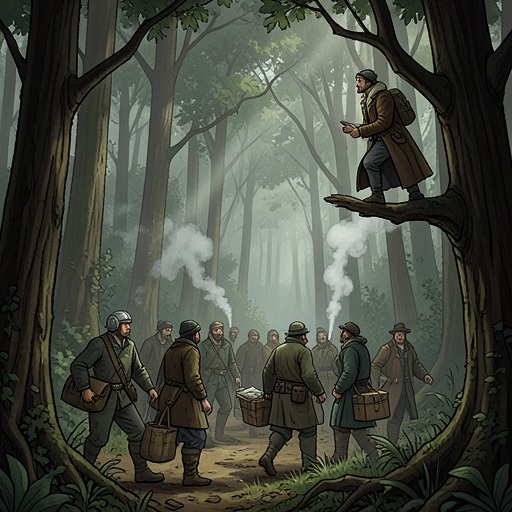
Angelar’s medical duties bring him close to fighting without making him a combatant. When a battle breaks out in the field, he later joins Zhivago in the clearing with two medics carrying stretchers. Zhivago directs him to attend to the wounded while he checks on a fallen telephonist. Their arrival connects the work of treatment to the immediate aftermath of combat: medical personnel must reach the casualties even as the battle’s consequences remain at hand.
That scene also establishes the conditions under which Angelar works. The medical team moves among the wounded in a war where the distinction between care and danger is precarious. Zhivago’s own presence in the engagement is exceptional and imposed by events; Angelar’s appearance with the stretcher-bearers instead marks his continuing place in the medical response.
Helping Zhivago Save Seriozha Rantsevich
The most consequential act attributed to Angelar follows the battle. Zhivago discovers that the dead telephonist is wearing an amulet containing a worn paper with passages from the Ninety-first Psalm. The dead man’s clothing could provide a disguise for Seriozha Rantsevich, a young soldier on the opposing side, but helping him is dangerous: in a conflict marked by severe treatment of prisoners and wounded enemies, the boy might not survive if identified as an opponent.
Zhivago confides in Angelar, and the two exchange the dead telephonist’s outer clothing for the boy’s. Their action allows them to pass Seriozha off as a recently enlisted ally. Angelar is therefore not merely present at the rescue: he is the trusted colleague who helps make the concealment possible, using the circumstances of the fighting to protect a wounded enemy soldier.
The two men nurse Seriozha back to health. Once he has recovered, they release him, although he is open about his intention to return to Kolchak’s army and continue fighting against the Reds. His release makes the episode an act of care without political conversion: Angelar and Zhivago protect the young man without demanding that he change sides. In the wider portrait of partisan medicine, Angelar’s assistance gives clinical work an ethical consequence that crosses the lines dividing the armies.