Anna Ivanovna Gromeko
Doctor ZhivagoAnna Ivanovna Gromeko is the wife of Professor Alexander Alexandrovich Gromeko and the mother of Tonia. Her final illness and death shape the young Yurii Zhivago’s bond with the Gromeko family: in a moment of physical distress, she joins his and Tonia’s hands and declares them meant for one another, turning an emerging intimacy into an acknowledged engagement. Her death soon afterward leaves Tonia devastated and makes Anna’s blessing both a family injunction and a formative memory.
Identity and Family
Anna is married to Alexander Alexandrovich Gromeko, a professor of chemistry, and is Tonia’s mother. Her maiden name is Krueger; her father, Ivan Ernestovich Krueger, was an ironmaster and landowner. His extensive estate lay in the Urals near Yuriatin and included several abandoned, unprofitable mines, linking Anna’s family background to a substantial but declining property.
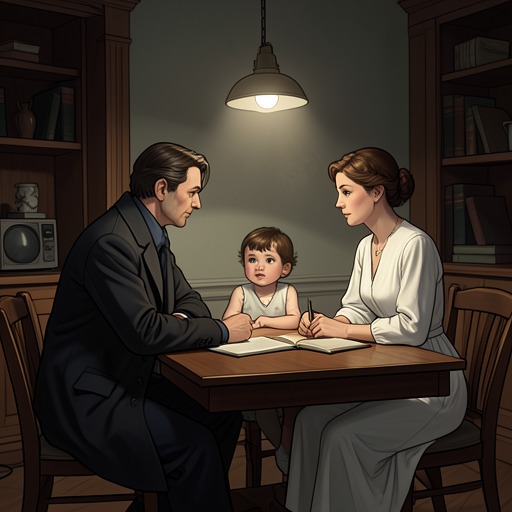
The Gromekos’ home stood at the corner of Sivtsev Vrazhok and a smaller street. The family’s cultivated, hospitable household was a place of music and sociability, with chamber-music evenings featuring piano trios, violin sonatas, and string quartets. Its upstairs rooms included Anna’s boudoir and the rooms of Tonia and Yura, who lived with the Gromekos while young. This setting gives Anna’s family life a distinctly domestic and cultural frame, in contrast to the upheavals that will later separate and displace the younger generation.
Illness and the Engagement
At the end of November, Yura returned late from university to hear that Anna had suffered convulsions that afternoon. Several doctors had attended her; at one point they advised her husband to send for a priest, but later reconsidered. Though she had regained consciousness, Anna asked that Yura be brought to her as soon as he came home. He went upstairs immediately. The room still bore the marks of the emergency: a nurse was quietly rearranging the night table, used compress towels lay damp and crumpled, and pinkish water, broken ampoules, and cotton wool remained in the slop basin.
Despite her weakness, Anna was concerned that Yura and Tonia might forgo an upcoming party because of anxiety about her health. She insisted they should go, chided Yura for being a doctor and worrying, and returned to a story about Bacchus, a figure whose supposed iron innards she treated as a folk tale rather than a literal possibility. The scene presents her as alert to the young people’s lives even while she is gravely ill: she refuses to let her crisis become a reason for them to withdraw from ordinary pleasures.
A prolonged coughing fit interrupted her. Yura and Tonia hurried to her bedside at the same time and stood shoulder to shoulder; their hands touched. Anna, still coughing, caught both hands and held them together for a while. When she could speak, she told them that if she died they should stay together, that they were meant for one another, and that they should marry. She then pronounced them engaged and burst into tears. Her blessing arises from a concrete gesture before it becomes a spoken judgment: the hands she physically joins make visible the future she urges them to share.
Death and Its Consequences
Anna’s hope that her children would remain together is quickly tested by her death. When Yura and Tonia reached her room, she had been dead for ten minutes. The cause was suffocation resulting from acute pulmonary edema that had not been diagnosed in time. The abruptness of the loss stands against the temporary reprieve after her convulsions: the doctors had changed their judgment, and Anna had spoken to the young couple, but the illness still proved fatal.
Tonia’s response was immediate and overwhelming. For the first hours she screamed, sobbed convulsively, and recognized no one. The next day she had calmed enough to answer her father and Yura by nodding, but when she attempted to speak, grief overtook her and she screamed again. Between the funeral services, she knelt for hours beside her mother’s coffin, clasping its corner as it stood on a dais covered with wreaths. She seemed oblivious to those around her, yet when she met the eyes of friends she hurried from the room and upstairs, holding back her sobs until she could bury her despair in a pillow.
Yura’s experience of the funeral is also marked by the cost of mourning. Long hours of sorrow and standing, sleeplessness, the singing, the candles burning day and night, and the cold he had caught combined to fill his soul with what the narrative describes as a fever of grief and ecstasy. Anna’s death therefore affects the two young people differently: Tonia is left almost unable to speak, while Yura’s grief becomes an intense, inward experience bound to the funeral’s physical and ritual details.
Narrative Significance
Anna’s role is brief but consequential. She is not merely the mother whose death precipitates mourning: before she dies, she recognizes and names a bond between Tonia and Yura. Her declaration gives their developing relationship familial sanction and an explicit future, while the condition attached to it—if she dies, they must stay together—makes their union inseparable from bereavement. The engagement is thus formed at the bedside of a dying woman, in a gesture that is at once tender, practical, and irreversible in its emotional force.
The Gromeko household’s ordered cultural life also sharpens the scene’s significance. Music, hospitality, study, and the familiar rooms of home frame the young people’s life before its losses and dislocations. In that setting, Anna’s clasped hands and final instruction become a small domestic act with lasting consequences: Tonia and Yura are bound not by an abstract announcement but by touch, by the imminent loss of a mother, and by the promise she asks them to keep.