Anna Ivanovna Gromeko’s Death and Funeral
Doctor ZhivagoAnna Ivanovna Gromeko’s Death and Funeral is both a family bereavement and a threshold in the lives of Tonia and Yura. During a severe coughing fit, Anna takes their hands and joins them, urging them to stay together and marry if she dies; shortly afterward, acute pulmonary edema kills her before Yura can reach her. The funeral’s measured procession and Yura’s response to it turn private grief into a reflection on art: he understands creation as a meditation on death that nevertheless makes life anew.
Deathbed Wish
Anna’s final exchange with Tonia and Yura grows out of a worsening illness. When they caution her that talking is bad for her, she brushes off their concern, insists that they should attend a party, and resumes a story about Bacchus. A coughing fit interrupts her. This one lasts far longer than the previous one, and she cannot catch her breath.
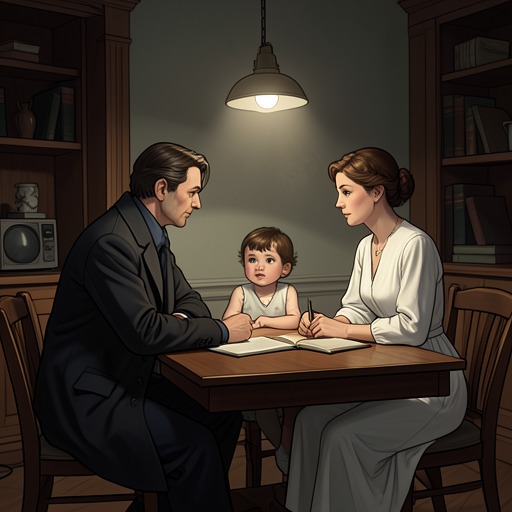
Tonia and Yura hurry to Anna’s bedside together and stand shoulder to shoulder. Their hands touch. Still coughing, Anna catches both hands in hers and keeps them joined for a while. When she can speak again, she tells them to remain together if she dies, says they are meant for each other, and urges them to marry. She declares them engaged, then bursts into tears. The gesture makes her wish tangible: her hands join the two young people before her words give that closeness a future.
Death and Grief
Yura, imagining the worst, runs to fetch his things, but he and Tonia do not find Anna alive. By the time they reach her room, she has been dead for ten minutes. The immediate cause is an attack of suffocation brought on by acute edema of the lungs, which had not been diagnosed in time. The missed diagnosis makes the death not only sudden but preventable in retrospect, a medical failure arriving at the precise moment when Yura’s professional identity cannot help him reach Anna in time.
Tonia’s first response is overwhelming: for several hours she screams, sobs convulsively, and recognizes no one. The following day she grows calmer, but cannot answer Yura or her father except by nodding. Whenever she tries to speak, grief overcomes her and she begins screaming again. At the funeral services, she kneels for hours beside Anna’s coffin, clasping a corner of it while it stands on its flower-covered dais. She seems oblivious to those around her; if she catches the eye of a friend, she rises and hurries upstairs, holding back her sobs until she can bury them in a pillow.
The funeral affects Yura differently, though no less deeply. Sorrow, hours of standing, lack of sleep, the low singing, the candles burning day and night, and a cold he has caught combine in him as a feverish confusion of grief and ecstasy. The loss does not resolve into a single emotion: the funeral’s ritual weight and his own physical exhaustion open into a state in which sorrow presses him toward thought and making.
Funeral Procession
As Anna’s coffin is carried out, the service’s words seem to remain suspended in the street. “Holy God, holy and mighty, holy and deathless” drifts softly down the road, while the scene appears to sway: the wreaths, passers-by, plumed horses’ heads, the priest’s swinging censer, and the white ground. The procession’s solemnity gathers the living and the objects around the coffin into a single, unsettled movement, giving the funeral a life that seems to persist even as it marks death.
The mourners make their slow way to the cemetery at the other end of town. The frost has broken; the day is still and heavy, and the thaw seems to have taken life with the cold. Dirty snow appears to shine through crêpe, while the wet, dark firs behind the churchyard railings look like tarnished silver in mourning. In that same churchyard lies Yura’s mother, whose grave he has not visited in recent years. He glances toward it and whispers, “Mother,” briefly bringing his earlier bereavement into the present one.
The burial place also recalls a scene from Yura’s childhood. The monastery grounds have changed with new buildings, but he recognizes the corner where a blizzard once raged on the night when, as a child, he wept. Hoarfrost clings to crosses and monastery walls; in the yard, shirts, tablecloths, and sheets hang sodden and crookedly fastened from lines stretching between the walls. The ordinary laundry beside the sacred funeral setting connects the altered present to the remembered storm, placing intimate memory inside the landscape of mourning.
Art and the Continuance of Life
Yura walks ahead alone, stopping from time to time to let the others catch up. The distance between him and the mourners becomes a space for inward work: in answer to the desolation of those following the coffin, he feels irresistibly drawn to dream, think, find new forms, and create beauty. He recognizes more clearly than ever that art has two enduring concerns: it meditates on death and, in doing so, creates life. Great, genuine art, he thinks, resembles and continues the Revelation of St. John.
That insight takes practical form in his plan to set aside a day or two alone, away from the university and his home, to write a poem in Anna’s memory. Rather than preserve her through a formal portrait alone, he intends to gather the varied things life has sent him: Anna’s best characteristics, Tonia in mourning, incidents in the street on the way back from the funeral, and the washing hanging where the blizzard once raged. The poem he imagines would make remembrance from the particular and seemingly incidental. Anna’s death thus sets in motion an act of composition that would hold together the dead woman, the bereaved daughter, the funeral’s public scene, and Yura’s own childhood memory—not by undoing death, but by giving its traces a continuing form.