Cattle
Doctor ZhivagoCattle are at once a moving reserve of food and a living part of the civilian world displaced by war. The Forest Brotherhood’s accompanying families travel with several thousand animals, chiefly cows; later, the herd’s abundance promises milk and meat through winter, even as crowding and privation wear down the animals and their keepers. In a more intimate scene, Agafia brings her sick cow Beauty to Kubarikha for help. Together, these appearances show how the herd links military survival to the practical, dependent work of caring for animals.
The herd on the move
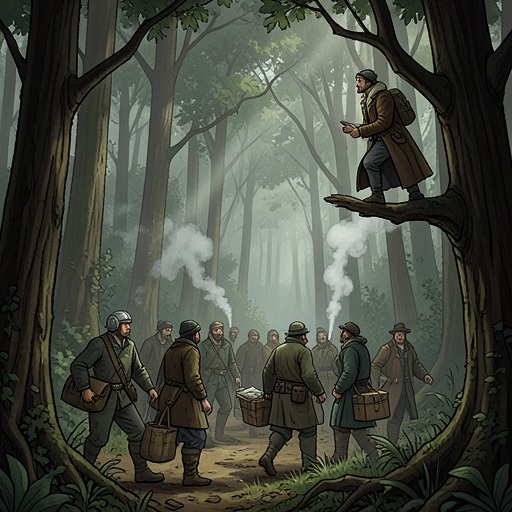
The Forest Brotherhood’s families follow the main partisan force with their children and belongings. Behind their wagons comes a vast herd, numbering several thousand cattle, mostly cows. This procession makes the civilians’ presence visible in the movement of the irregular army: families do not travel alone, but with the animals on which their material survival depends.
The herd also brings a specialist into the camp. Kubarikha, a soldier’s wife, works as a cattle healer and veterinarian, while also being regarded as a witch. Her arrival makes animal care part of camp life, alongside the military and domestic tasks imposed by displacement. The partisans expect to move on after scouting for winter quarters, but unforeseen developments keep them in the same campground for the winter.
Food and winter survival
When the Forest Brotherhood is encircled by the Whites and forced to abandon plans to shift camp, the quartermaster reports shortages of flour and potatoes. Cattle, by contrast, are plentiful, and he expects milk and meat to become the staple foods over winter. The herd thus offers a material answer to one immediate crisis, though it cannot supply everything the camp lacks: winter clothing is short, and many partisans are inadequately dressed.
That calculation does not make the animals an abstract store of provisions. The cattle are exhausted too, after privation, continual wandering, and intolerable crowding. Their condition binds the camp’s food supply to the same strained circumstances that wear down the people who depend on it. The herd’s abundance is real, but it has been carried into the winter at a cost to animals and owners alike.
Animals in the crowded clearing
In a clearing hemmed in by forest, the cattle are packed together. Most are black and white cows of a Swiss breed popular in Siberia. With little room, they rub against one another and behave in ways the narrator presents as consequences of the crush: cows rear and climb over other animals, while heifers break away and run into the forest. Old men and children who serve as herdsmen pursue them.
The scene gives the herd its own physical presence within the landscape, rather than reducing it to a count of provisions. Its disorder parallels the pressure of the camp’s conditions without making the cattle merely a symbol: they are living animals caught in the same constricted space as the displaced people. The scale shifts from the several thousand animals trailing the convoy to the immediate difficulty of managing a crowded glade.
Beauty and the work of care
Within that larger herd, Agafia Fotievna brings her sick cow to Kubarikha. The animal has been separated from the rest and tethered to a tree by a rope tied around its horns. Agafia sits beside its forelegs while Kubarikha examines it from a milking stool near its hind legs. The arrangement is practical and close: the animal’s illness brings both women together around the work of tending it.
Agafia first worries that the cow may be in calf because it has not given milk. Kubarikha identifies a scab of anthrax on its udder and offers an herbal ointment, as well as a spell. When asked for the cow’s name, Agafia answers, “Beauty.” Kubarikha replies that half the herd bears that name, then begins the spell with a blessing. The exchange joins diagnosis, household concern, and folk practice without suggesting that the cow’s illness is resolved. The available account records the attempt to treat Beauty, not its outcome.
Narrative significance
Cattle connect the broad movements of wartime displacement with the small, recurring demands of daily life. As the families travel behind the partisans, the herd is part of their burden and their means of endurance; as winter closes in, the animals become a projected source of milk and meat. In the clearing, however, their exhaustion and crowding complicate that promise, and Beauty’s illness makes the dependence on individual animals unmistakable.
The scenes therefore hold provision and care together. The herd matters to the camp because it can feed people, but the cows are not presented only as supplies: they are tired, vulnerable, named, examined, and difficult to manage. Through them, the novel gives material form to the pressures of prolonged wandering and to the labor of keeping life going under conditions that leave little room for either people or animals.