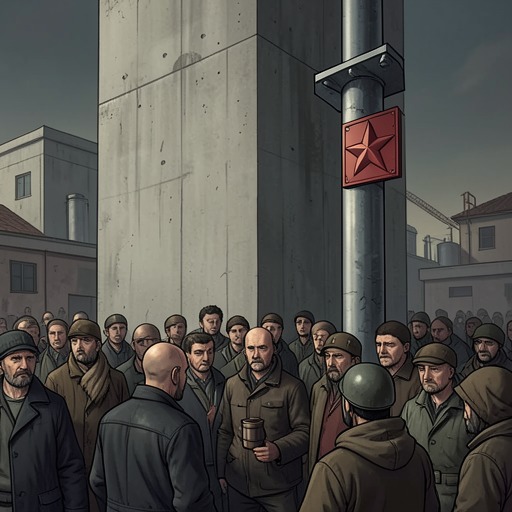
Commissar Gints
Doctor ZhivagoCommissar Gints is a young revolutionary officer whose effort to bring deserters back into military service exposes the distance between political ideals and the exhausted people they are meant to persuade. At Biriuchi, his confidence that he can reach the soldiers gives way to threats; when he tries to address them again at the station, he is killed.
Identity and Introduction
Gints, also called Gintse, is described as thin, graceful, and barely out of his teens, yet aflame with high ideals. Reports say he came from a good family—some believed he was a senator’s son—and that in February he was among the first to march his company to the Duma. The doctor, Yurii Andreievich Zhivago, has not quite caught his name when he is introduced to him.
Gints’s formal presence seems partly constructed. In his tight-fitting tunic, he hunches his shoulders beneath stiff epaulettes, keeps his hands deep in his pockets, and adopts a sneer and artificial stoop, apparently to disguise his youth. The pose gives him the silhouette of a cavalryman, while his precise speech carries a correct Petersburg accent and a slight Baltic intonation.
The Attempt to Persuade the Deserters
At the meeting about the deserters at Biriuchi, Gints is restless and continuously talking, while the other men lounge in exaggerated poses. The commandant explains that a loyal Red Cossack regiment will be called out to surround and disarm the rebels. Gints accepts that he cannot cancel the order, since operational matters are covered by an agreement with High Command, but insists on going to the soldiers’ camp himself.
He calls the deserters the people and describes them as children whose psychology must be understood. He believes that the right approach can reach their most sensitive chords, and confidently predicts that a heart-to-heart conversation will send them back to their positions. His appeal is not simply a refusal of military authority: he hopes to use personal understanding to accomplish what armed pressure is expected to do.
Speech, Threat, and Reversal
The Cossacks surround the men of the 212th Infantry in a clearing. Horses make the encircling force seem taller and more formidable among the woods, and the Cossacks draw their swords. Gints mounts a pile of timber and speaks about soldierly duty, the fatherland, and other elevated ideals, but the soldiers meet his words with indifference and hostile boredom. Exhausted by the war and long exposed to competing political appeals, they are unreceptive; his foreign-sounding name and Baltic accent further alienate them.
As he realizes that his speech is failing, Gints grows angry and abandons persuasion for threats. He invokes revolutionary courts-martial and demands that the deserters disarm and surrender their ringleaders on pain of death. He warns that refusal will mark them as traitors and an irresponsible rabble. The shift is stark: the officer who had urged others to understand the people now speaks to them in a tone they resent, and the crowd’s murmurs rise around him.
At the station, Gints makes another attempt to stop the advancing soldiers. Standing on the lid of a covered water butt beneath the station bell, he delivers an incoherent but gripping speech. His unnatural voice and boldness—so close to the door that he could have taken shelter—astonish the men, and they lower their rifles. But Gints pushes in the lid; one leg slips into the water while the other hangs over the edge. Seeing him awkwardly astride the butt, the soldiers laugh, and the man at the front shoots him in the neck. By the time the others reach him, they are thrusting bayonets into his body.
Narrative Significance
Gints’s fate turns the gap between revolutionary language and lived exhaustion into a physical confrontation. The ideals he invokes cannot answer the soldiers’ experience of war, and his own change from sympathetic mediator to bearer of a death threat makes the failure more complicated than a simple clash between good intentions and bad faith. The lowering of the rifles briefly suggests that speech might interrupt violence; the accident on the water butt, the laughter, and the shot abruptly overturn that possibility.
His death at Biriuchi is thus both the end of his personal effort and a measure of the crisis around him: authority arrives with Cossacks and drawn swords, but neither those instruments nor Gints’s appeal can restore trust. His youthful idealism remains visible in his willingness to go among the deserters, even as the scene shows how quickly the language of understanding can become entangled with coercion.