Far Eastern Republic Government
Doctor ZhivagoThe Far Eastern Republic Government is a planned coalition administration in Russia’s Maritime Province whose nominal independence serves the Soviet Government’s strategic purposes. Conceived as a buffer between Red Siberia and the outside world, it offers a narrow prospect of refuge while carrying within its design the expectation that Moscow will eventually bring it to heel. The government enters the story not as an established political order but as a secretive, provisional project—and as the means by which Victor Komarovsky tries to move Yurii Andreievich Zhivago and Larisa Feodorovna Antipova eastward, away from danger.
Proposed Government and Political Design
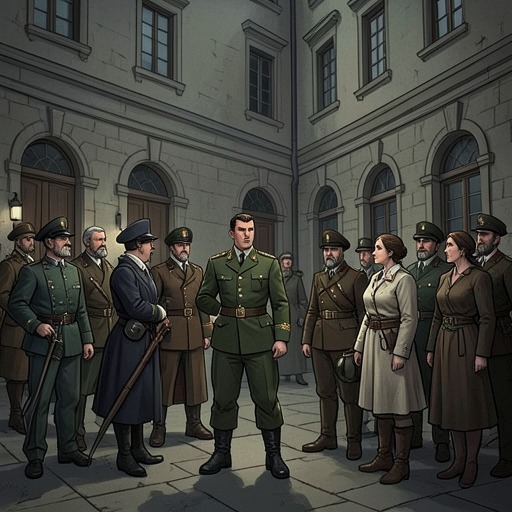
The forces gathering on the Pacific coast are described as loyal to the Provisional Government and the disbanded Constituent Assembly. Their ranks include Duma deputies, prominent members of the old zemstvos, other public figures, businessmen, industrialists, and the remnants of armies that fought against the Reds. The proposed republic is therefore a coalition of displaced political and military interests rather than a new order arising from a single party or constituency.
Its independence is conditional from the beginning. The Soviet Government tacitly approves the scheme because a buffer between Red Siberia and the outside world would suit its immediate interests. Moscow is also to insist that Communists receive more than half the seats in the coalition government. The arrangement is thus designed to preserve an appearance of political plurality while leaving the balance of power tilted toward Soviet influence.
The projected next step makes that contradiction explicit: when circumstances suit Moscow, the Communists are to stage a coup and bring the republic to heel. The plan offers a breathing space to its participants, not a settled guarantee of sovereignty. Its autonomy is both a political objective for those gathering in the Maritime Province and a temporary instrument tolerated by the government it may eventually resist.
Komarovsky’s Appointment and Mission
Victor Komarovsky tells Zhivago and Antipova that he had worked before the revolution on the affairs of banks and trading firms in Vladivostok, whose owners knew him. An emissary acting for the shadow cabinet then approached him with an offer to become Minister of Justice in the future government. Komarovsky accepted. He says the appointment and the plan as a whole have Soviet approval, but only tacitly; the arrangement is not so public that it is safe to discuss freely.
His position gives the proposed administration an immediate, personal function in the narrative. Komarovsky is not merely describing a distant political project: he is traveling east to take up a place in its emerging government, and he uses that journey to offer passage to others. He says he can take Zhivago and Antipova with him, from where they could find a boat and join Zhivago’s family overseas. The offer is made against the knowledge that Zhivago’s family has been deported from Russia, and against Komarovsky’s warning that Zhivago is marked for destruction.
Komarovsky also says he has promised Antipova to save Strelnikov. As a member of a government Moscow recognizes as independent, he proposes to search for Strelnikov in eastern Siberia and help him cross into the republic’s autonomous region. If escape proves impossible, he will propose exchanging him for someone in Allied custody who is valuable to the Moscow Government. The republic’s projected jurisdiction thus appears as a potential haven, but its usefulness depends on negotiation with the Soviet authorities and on Komarovsky’s access to both political and personal networks.
The Eastbound Train and the Offer of Refuge
The government’s plans acquire material form at Yuriatin, where an official train belonging to the Far Eastern Government’s Ministry of Communications is standing under steam. It has arrived from Moscow and is due to leave for the East the following morning; half its carriages are sleeping cars. Komarovsky says that several places have been set aside for his assistants and urges Zhivago to reconsider accompanying him and Antipova. The train makes the proposed republic more than an abstraction: it offers transport, institutional backing, and a departure window that is about to close.
The offer does not resolve the danger or the personal choice facing the characters. Antipova says that she will not go without Zhivago, while Zhivago has already made up his mind not to leave with them. Komarovsky asks him to reconsider, at least to travel as far as Yuriatin, but the urgent opportunity remains dependent on Zhivago’s decision. The republic can provide a route and a possible refuge; it cannot compel those it might save to take it.
Political Meaning and Limits
The proposed government’s importance lies in the gap between its public form and its political conditions. It is to be a coalition, yet Moscow has secured a Communist majority; it is to be autonomous, yet the plan anticipates a coup to subordinate it. The Soviet Government’s tacit consent allows the republic to take shape as a buffer, while preserving Moscow’s option to end that independence when it becomes convenient.
For the characters, this compromised arrangement still has real stakes. It offers Komarovsky a ministerial post, Antipova a possible way to protect Strelnikov, and Zhivago and Antipova a chance to escape toward the east and eventually join his deported family overseas. The government therefore joins the novel’s political upheaval to private choices of flight, loyalty, and separation: its uncertain autonomy is not simply a constitutional question, but the condition on which a handful of threatened lives may depend.