February Revolution in Petersburg
Doctor ZhivagoThe February Revolution in Petersburg enters the narrative not as a battlefield scene in the capital but as news that breaks into a wartime hospital. With communications repeatedly failing and political talk spreading, the reported defection of the Petersburg garrison turns distant upheaval into an announcement heard among patients already living through war.
Background and Uncertainty
The hospital scene unfolds amid unstable reports from General Headquarters and alarming rumors from the interior. Telegraphic communications with Petersburg are cut repeatedly, leaving people to piece together events through incomplete news. Politics has become a subject of conversation at every corner, but the narrative does not supply a continuous account of the uprising or confirm every report independently.
The News in the Hospital
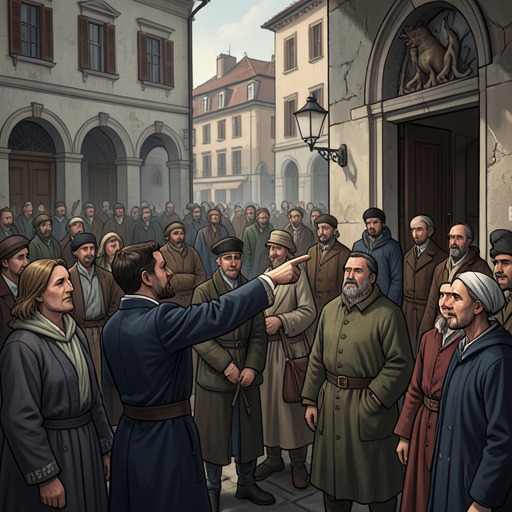
The announcement comes from the patients themselves. Those able to move rush in from other rooms, on crutches, with canes, or on foot, and compete to proclaim the news: street fighting has broken out in Petersburg, the garrison has joined the insurgents, and there is a revolution. The collective rush and overlapping shouts turn a political development into an immediate communal event inside the hospital.
The announcement follows an already strained atmosphere. Wounded men are being brought into an overcrowded Moscow hospital, where the effects of fighting reach the wards as bodies and the limits of available space. Against that continuing emergency, news of revolution does not replace the war; it adds a new political dimension to a place organized around care for its casualties.
Consequences and Narrative Significance
The report marks a change in what the hospital community understands to be happening beyond its walls: the crisis is no longer only military, but revolutionary. Yet the scene remains bounded by the uncertainty of wartime communication. The characters hear that the garrison has joined the insurgents, but the episode offers no fuller account of how the fighting proceeds or what political order follows.
By placing the announcement among patients whose movement is visibly restricted by their injuries, the narrative gives a national upheaval a local and collective scale. The Revolution arrives through shared speech, not through an official dispatch or a view of the capital itself; the scene’s force lies in the sudden passage from rumor and broken communication to a declaration that history has changed.