Food collection policy
Doctor ZhivagoFood levies are a policy of extracting grain from the countryside that becomes a test of authority in revolutionary Russia. The novel presents the policy not as an abstract economic measure but through its consequences: armed resistance, swift military repression, and the deepening conflict between officials and villagers over food and survival.
Policy and enforcement
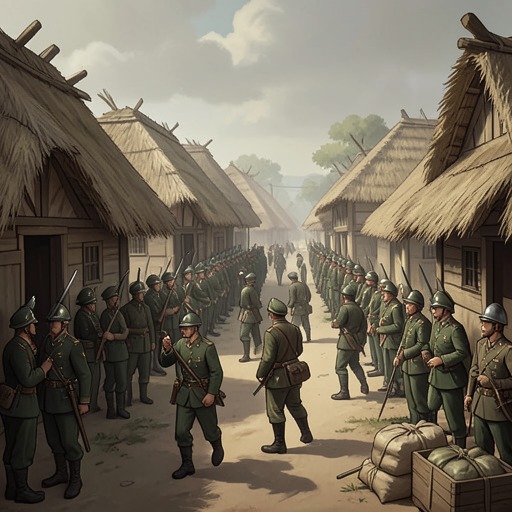
The levies provoke resistance in the countryside. At Gubysov, peasants put up armed opposition to food collection; the authorities respond through military action. The policy thus draws local communities into a contest in which a demand for grain is backed by armed force.
Strelnikov’s record shows how enforcement operates at a wider regional scale. He suppresses the Gubysov peasants and deals with soldiers who plunder a food convoy, alongside other rebellions and mutinies. In these cases, he takes opponents by surprise, then investigates, tries, sentences, and carries out punishments with speed and severity. The sequence joins administrative process to coercive power: the authorities’ response is presented as decisive, but its pace leaves little distance between judgment and punishment.
The policy also appears amid broader wartime efforts to restore military discipline. As a new offensive is planned, revolutionary courts-martial are established and the death penalty, recently abolished, is restored. These measures place food collection within an expanding apparatus of emergency rule, where military readiness and control of dissent reinforce one another.
Resistance and political conflict
Resistance to food levies is not confined to organized peasant opposition. In a later account of events in Veretenniki, a young man describes how Kharlam sought to exploit a village murder and the resulting unrest. Kharlam urged the authorities to establish a Poor Peasants’ Committee and promised to set villagers against one another; the speaker then recounts being accused of evading labor service, fleeing, and involvement in the murder. He escaped custody, but the village was burned, and his mother died without his knowledge. The account does not make the levy alone responsible for every event. It shows how grain collection, denunciation, local factionalism, and state intervention can combine in a crisis whose consequences exceed the original dispute.
The novel also places the policy within a larger argument over revolution and justice. One defender of dictatorship invokes starving workers and the abuses of the old order to justify the people’s anger and a radical transformation. The dispute exposes a tension between the stated purpose of social justice and the coercive means used to pursue it: the policy is defended as part of a historical reckoning, even as its enforcement produces new conflicts and punishments.
Authority and everyday consequences
Food levies sit alongside other forms of revolutionary administration. In Moscow, a district meeting announces that a large house will be taken over as a hostel for visiting delegates, while its occupants are given a year to find other accommodation unless they qualify for rehousing as working people. The meeting’s disputes over who counts as a worker and whether nationality is at issue reveal the contested categories through which officials organize daily life. Though distinct from grain collection, this episode shares the same broader setting of state claims over property and the reordering of ordinary lives.
The policy’s economic context is also unstable. In 1922, when the ban on private enterprise had been lifted within narrow limits, small-scale resale produced speculation and abuses without creating new wealth or relieving the town’s squalor. This later setting underscores how the struggle over food and resources persists through changing economic arrangements: coercive collection gives way to restricted trade, but scarcity and the uneven distribution of goods remain central pressures.
Significance
Food levies connect the novel’s political abstractions to material need. They bring the state into direct confrontation with peasants who resist surrendering grain, and they provide a context for military campaigns against dissent. Their significance lies in this collision between an asserted collective purpose and the lived costs of enforcement: a policy intended to secure resources helps turn villages into sites of suspicion, violence, and loss.