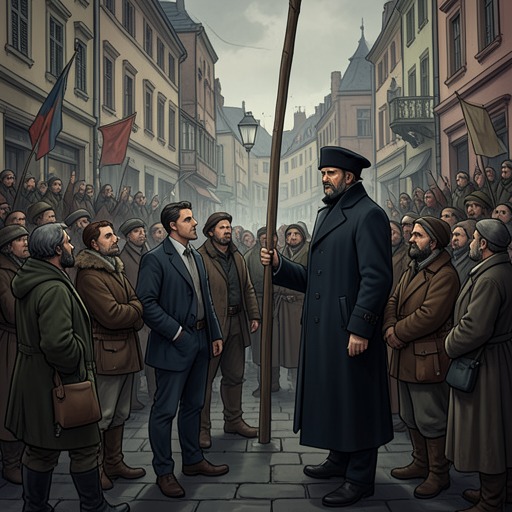
Galicia
Doctor ZhivagoGalicia is a frontier landscape in Doctor Zhivago where the machinery of the First World War becomes immediate: armies retreat and break through, wounded men crowd into makeshift hospitals, and the threat of encirclement forces people to flee. The region’s changing fortunes frame Yurii Andreievich Zhivago’s service as a doctor and make military events inseparable from the exposed routines of those living and working behind the lines.
A contested wartime region
In the second autumn of the war, after the early Russian successes had given way to reverses, Brusilov's Eighth Army withdrew from the Carpathians instead of advancing into Hungary. Russia was evacuating Galicia, occupied during the first months of the fighting. The retreat forms the broad military background to the local scenes: the front is not a stable boundary but a pressure moving through villages, hospitals, and roads.
The front’s movement brings sharply different outcomes. Russian forces break through enemy positions south of the village where Misha Gordon arrives, but supporting units lag behind; the advance troops are cut off and captured. Among the prisoners is Pavel Antipov, who surrenders when his platoon does. A report from his friend Galiullin wrongly says that Antipov was killed by a shell, showing how the confusion of battle turns incomplete observation into apparent certainty.
Battle and its uncertain witnesses
Galiullin’s view of the attack gives the battlefield a physical scale. Soldiers run across no man’s land through dry broom and spiky gorse, fall together when they take cover, and then surge forward again. Men struck by fire drop among them like felled trees. The lieutenant leads with his revolver raised, shouting encouragement that neither he nor the men can hear. When two German sixteen-inch shells burst in front of the attackers, smoke hides what follows; from the observation post, Galiullin believes the lieutenant and his men have been wiped out. The episode contrasts the apparent clarity of a distant report with the uncertainty of what the battlefield actually permits a witness to know.
Hospitals behind the front
The hospitals reveal the human cost of the military situation. A truck with two trailers brings wounded men to a Moscow hospital, already desperately overcrowded after the battle of Lutsk; patients fill passages and landings, and the pressure is beginning to reach the women’s wards. At the Galician front, the medical unit is scattered through a village whose houses, with their broad lattice windows, have miraculously escaped damage. The village’s intact appearance offers no protection from the war’s proximity.
A field first-aid station in a damaged wood receives the wounded in ammunition carts without springs. Men jolted along the road have been picked up from the battlefield during a brief lull in the artillery fire; many are unconscious, and the most urgent cases are to be operated on after hurried bandaging. Nearby, exhausted survivors of a decimated unit lie motionless after four days of fighting, too spent to smile or swear. The scene sets medical urgency beside military exhaustion: the wounded are still being carried in while the men who survived the same fighting have scarcely the strength to notice them.
Retreat and forced movement
The war also governs movement far from the firing line. Gordon reaches the divisional area on a Red Cross train organized through voluntary contributions by the Tatiana Committee for Aid to the Wounded. Though headquarters describes his destination as nearby, the village is about fifty miles away, not fifteen, and he has to obtain permission and a carriage to reach it. The misleading estimate captures the distance between administrative assurance and the actual conditions of travel behind the front.
As the threat spreads, the village’s relative safety ends. After residents have packed, shouts, gunfire, and running footsteps wake them during the night; a sinister glow appears over the village. Yurii Andreievich learns that German forces have broken through and finds the hospital under fire. It begins moving at once, without waiting for the evacuation order. He arranges for Gordon to leave with the first party, then runs with him along the village street, ducking against the walls as bullets pass and shrapnel bursts over the fields.
A region measured by war
Galicia’s narrative significance lies in the way strategic changes become bodily and practical facts. A retreat means prisoners and false reports; a breakthrough means wounded men on jolting carts, hospitals on the move, and departure before dawn. The region is also seen at different times: in Yurii’s recollection of his first spring at the front, the Carpathian headquarters lies in a deep, mist-filled valley; by the second autumn of the war, retreat and bombardment dominate the landscape. The contrast makes the passage of time legible through the altered conditions of military life.
The military population is not the only one being moved. On a twenty-three-car train, sailors occupy the front, civilian passengers the middle, and about five hundred labor conscripts are carried in eight cars at the rear. They include people of different ages, occupations, and social positions, from lawyers and stockbrokers to cab drivers, bath attendants, ragpickers, lunatics, shopkeepers, and monks. The crowded mixture widens the wartime picture beyond the line of battle: Galicia belongs to a world in which armies, patients, volunteers, civilians, and conscripts are all caught in the same upheaval.