Hare
Doctor ZhivagoThe Hare recurs in Doctor Zhivago at the meeting point of hunger, barter, and winter wildlife. Roasted and exchanged for a towel at a railway market, then eaten at the Zhivago household’s dinner table, it is a practical source of food; in the snowy fields around Varykino, hares are startled from a cabbage patch and caught in traps intended for lynxes. The animal’s changing place in these scenes—from coveted meat to living creature to unintended victim—makes it a small but concrete measure of how human need intersects with the independent life of the landscape.
Food, barter, and the railway market
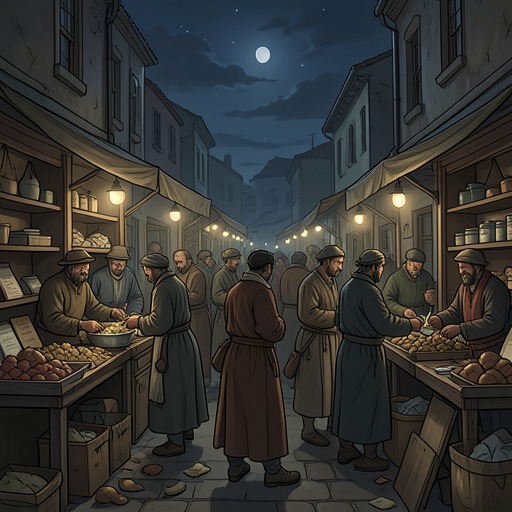
At a station crowded with peasant women selling their wares, Antonina Alexandrovna Zhivago walks along the line with a towel over her shoulder. A woman wearing a black shawl patterned in scarlet notices it, approaches cautiously, and offers half a hare in exchange. Antonina has not understood the woman’s initial offer until she displays the food and explains that it is hare, not dog meat, and that her husband is a hunter. The clarification gives the bargain an ordinary, immediate logic: a household textile can be exchanged for a meal.
They make the trade, each convinced she has got the better of it. Antonina feels ashamed, as though she has cheated the peasant woman; the seller, by contrast, is delighted with the exchange and leaves with a friend, heading home along the snowy path. The hare has no ceremonial or symbolic framing in the transaction. Its value lies in the food it provides, while the scene’s attention to the women’s differing reactions shows how an everyday bargain can register differently on either side of a scarcity-shaped exchange.
The hare at the dinner table
The animal returns as cooked food when the Zhivagos invite the co-operativist Kostoried to dinner. He eats a hare’s leg with an audible wheeze, moving several times around the room because he fears drafts and chills. After finishing the bone and wiping his fingers, he turns the meal into a point in a political disagreement: roasted hare may be excellent, he tells Yurii Andreievich, but eating one does not prove that the peasants are prosperous.
Yurii takes the hare as part of a larger hopeful picture. He points to intact trees and fences and to the markets and their women, arguing that such signs show that life continues somewhere and that some people are happy. Kostoried rejects that conclusion: a meal and a busy railway market cannot establish what conditions are like beyond the railway, where peasant rebellions take place against whichever side holds power. In this exchange, the hare is not evidence of general abundance so much as a particular, limited piece of evidence that the two men interpret differently. Its presence at the table makes visible the gap between the fact of a meal and the larger claims made about rural life.
Tracks and traps at Varykino
In a description of the Zhivagos’ winter stores and routines, hares emerge from the distant cabbage patch when someone steps outside before dawn. They hop away across the snow, leaving tracks that cross the whiteness, while dogs bark in the distance and the morning gradually breaks. The hares belong to a landscape observed in its daily sequence: cellar provisions, darkness, footsteps, animal movement, and dawn.
Their tracks are set beside the long, orderly prints of lynxes, which cross the plain like strings of beads. The contrast draws attention to the animals’ differing ways of moving through the same snowy country. Lynxes walk with one paw placed in front of the other and are said to travel many miles in a night; traps are set for them. But the traps catch hares instead, half-buried in the snow and frozen stiff. The intended quarry escapes the human effort to control it, while the smaller animal becomes an unintended victim.
A recurring measure of ordinary life
Across these appearances, the Hare connects the practical and the wild without reducing one to the other. At the railway station it is a valuable foodstuff, exchanged for a towel; at dinner it is a leg on a guest’s plate and the focus of an argument over what a market can prove; in the winter landscape it is an animal that flees, leaves tracks, and suffers the consequences of traps meant for another species.
That recurrence gives the hare a modest but distinctive narrative role. It places everyday survival alongside the rhythms of the land, while the failed lynx traps qualify any simple impression of nature as a storehouse available for human use. The animal is both part of the household economy and a living presence beyond it: first displayed and divided for food, later glimpsed in motion across the snow, and finally found frozen where the trap has caught the wrong creature.