History as a Christian struggle against death
Doctor ZhivagoHistory as a Christian struggle against death is Nikolai Nikolaievich’s vision of history as a human undertaking to answer mortality, grounded in the Gospel rather than in any required certainty about God. It joins faith to individual freedom, love of one’s neighbor, and creative work: a person dies not outside history but within a continuing effort to make life prevail. The idea becomes both a subject of Nikolai’s books and an intellectual inheritance that shapes Yurii Andreievich Zhivago and Misha Gordon in contrasting ways.
Definition and Christian Foundation
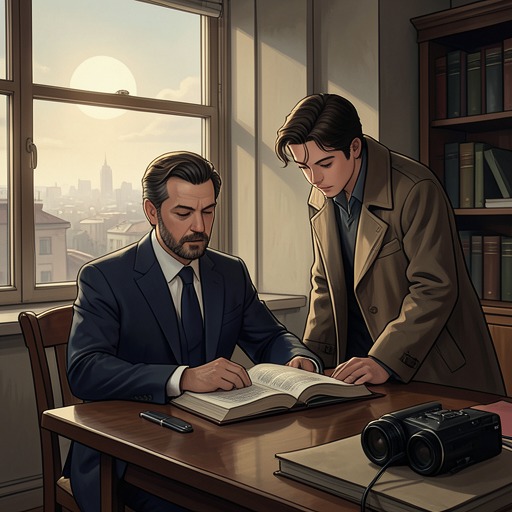
Nikolai presents this conception in conversation with Ivan Ivanovich, who teases him about his former religious status and the consequences of being unfrocked. Nikolai acknowledges that the experience was unpleasant and that he was barred from the civil service for a long period and forbidden to go to Moscow or St. Petersburg. He treats these penalties as secondary to his argument: a person may be an atheist, or uncertain whether God exists, and still believe that humanity lives in history rather than in a state of nature. In his account, history in this sense begins with Christ, and the Gospel provides its foundation.
History, he argues, consists of centuries of systematic exploration of the riddle of death, undertaken in the hope of overcoming it. The search is not confined to religious doctrine: Nikolai connects it to discoveries such as mathematical infinity and electromagnetic waves, and to the making of symphonies. Intellectual discovery and artistic creation become different forms of humanity’s answer to mortality.
The Human Work of History
Nikolai insists that this work requires faith and spiritual equipment, whose basic elements he finds in the Gospels. First among them is love of one’s neighbor, which he describes as a vital force that cannot remain enclosed within an individual heart: once present, it must overflow and be spent. The ethical principle leads to two ideals he regards as indispensable to modern humanity, free personality and life understood as sacrifice.
His contrast is historical as well as moral. He characterizes the ancient world through enslavement, cruelty, and the monumental deadness of bronze and marble, arguing that people did not yet live toward the future in the same sense. With Christ, he says, time and humanity could breathe freely. His formulation of death follows from that turn: a person does not die apart from the human story but participates in it while the work of overcoming death continues. Death remains real, but it is placed within a collective, unfinished labor rather than treated as the final measure of a life.
Christ and the Common Person
Elsewhere, Nikolai describes Christ’s arrival as the end of an ancient world represented by Rome, which he depicts as crowded with conquered peoples and borrowed gods. Against that imperial mass, Christ appears as emphatically human and provincial, a Galilean; the focus shifts from gods and nations to ordinary people: the carpenter, the plowman, and the shepherd. The shift gives Nikolai’s theory of history a social as well as spiritual emphasis. History’s value lies not in the prestige of empires or rulers but in the recognition of individual human life.
That understanding also clarifies why freedom and sacrifice belong together in his account. The individual matters precisely as a person capable of loving others and giving of himself, not as an interchangeable member of a mass. Nikolai’s attack on the ancient enslaver and his celebration of ordinary laboring figures thus reinforce his account of a history whose moral direction is toward human life.
Art, Memory, and Intellectual Inheritance
In later life, Nikolai lives in Lausanne and develops his view in books published there in Russian and in translation. He describes history as another universe, made by humanity with the help of time and memory in answer to death’s challenge. His reinterpretation of Christianity, in turn, leads to a new conception of art. Art is not merely decorative or unnecessary: it belongs to the larger effort to preserve meaning and create life in the face of mortality.
The theory affects the younger men in different ways. Yurii recognizes how much his uncle’s thought helped form his character; its influence, he feels, has allowed him to advance and become freer. Misha is even more powerfully influenced and responds by enrolling in the Faculty of Philosophy, attending theology lectures, and considering a transfer to the theological academy. Yet where the ideas open Yurii, they seem to fetter Misha. Yurii understands that Misha’s enthusiasm is partly connected with his background, and, out of tact, does not try to dissuade him, though he wishes his friend were more down-to-earth. The inheritance therefore does not operate as a single doctrine imposed in the same way on every listener: it can enlarge one person’s freedom while burdening another with its abstractions.
History Tested by Catastrophe
The novel’s depictions of war and scarcity place Nikolai’s abstract account beside the material struggle to keep life going. Wounded men are brought into an overcrowded Moscow hospital after the fighting at Lutsk; at the front, an attack watched by Galiullin is broken by artillery, and Lieutenant Antipov is captured, while a rumor falsely reports him killed. These episodes show how war subjects individuals to forces beyond their control and makes the survival of particular lives uncertain. They do not resolve Nikolai’s theory, but give its concern with death and historical participation a concrete setting.
The same tension appears in civilian life. In revolutionary Moscow, daily food may be thin millet, soup made from herring heads, or a little kasha; Antonina Alexandrovna searches for fuel and exchanges a small mirror wardrobe for a few armloads of poor birch logs. Later, credit slips let Yurii and his father-in-law collect flour, cereals, macaroni, sugar, suet, soap, matches, and Caucasian cheese from a distribution center. On the journey east, labor conscripts occupy eight cars at the back of a twenty-three-car train, with about five hundred people of widely different occupations and circumstances. Such particulars make history more than a sequence of doctrines or political events: it is also the strained, uneven passage through which households and individuals try to secure food, warmth, and continued life.
Against that backdrop, Nikolai’s account of history as a struggle with death does not promise that suffering will be prevented or that every life will be saved. It identifies a continuing human work—love, sacrifice, freedom, discovery, and art—as the means by which individuals belong to a story larger than their mortality. The novel’s attention to everyday survival gives that claim its human scale: history’s answer to death is measured not only in grand ideas, but in acts and conditions that keep people alive together.