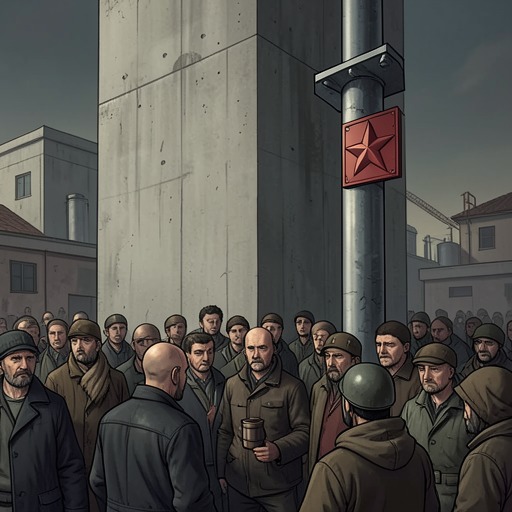
Hospital of the Holy Cross
Doctor ZhivagoThe Hospital of the Holy Cross is the Moscow hospital at which Yurii Andreievich Zhivago practices medicine amid war, revolution, and institutional upheaval. Its identity changes along with the society around it: although the charitable society named in its title is dissolved, the hospital continues operating, eventually under the name Second Reformed. For Zhivago, it is at once a workplace, a site of professional recognition and moral strain, and an increasingly politicized institution whose demands extend far beyond treating patients.
Identity and wartime setting
The hospital retains the name Hospital of the Holy Cross even after the society associated with it has been dissolved. The name’s persistence reflects a practical institutional continuity rather than an unchanged organization: the hospital remains open, and Zhivago returns to work there, but its purposes and administration are reshaped by the new order.
During the second autumn of the war, Moscow’s hospitals are severely overcrowded, especially after the battle of Lutsk. Wounded men arrive by truck and are placed in corridors and on landings; the pressure spreads even to the women’s wards. The hospital is therefore not an isolated workplace but part of a strained medical system absorbing the consequences of the retreat and the evacuation of Galicia.
Zhivago’s medical work and judgment
The hospital is where Zhivago’s professional judgment is tested. He diagnoses a woman who has died in its surgical ward with echinococcus of the liver, although his colleagues doubt the diagnosis. When the autopsy confirms it, the medical director acknowledges that the staff had been wrong and congratulates him. The episode establishes a concrete measure of Zhivago’s competence, while the delayed confirmation also shows how recognition depends on the institution’s procedures and colleagues’ assessments.
His work brings him into contact with patients whose needs cannot be reduced to routine examination. When he visits a woman with a severe illness and recommends hospital admission, he emphasizes the need for constant medical supervision in the first weeks and arranges an admission order. The episode presents clinical judgment as a practical responsibility: he assesses the patient’s condition, explains the limits of care at home, and helps secure access to continued treatment.
The hospital’s wartime work also confronts its staff with suffering beyond what medical intervention can immediately resolve. A nurse sees two lightly wounded soldiers move toward a stretcher bearing a badly injured man, apparently intending to help him. She tells them to wait for the surgeon, who has the necessary instruments. The scene places the impulse to relieve suffering beside the need for trained care, making the hospital a setting where compassion and professional restraint meet under extreme pressure.
Reorganization and political demands
After the revolution, Zhivago resumes duties at his old hospital, though it is still called the Hospital of the Holy Cross despite the dissolution of the society that gave it that name. The staff have divided into political camps. Moderates regard Zhivago as dangerous, while more radical colleagues consider him insufficiently committed to their cause. He belongs comfortably to neither group, a position that makes the hospital’s internal divisions part of his daily working environment.
His responsibilities also expand beyond clinical practice. The medical chief assigns him general statistics, requiring him to process questionnaires and reports on mortality, sickness, staff earnings, political consciousness, participation in elections, and shortages of fuel, food, and medicines. At his old table by the staff-room window, charts and forms accumulate beside notes for his medical writing. The hospital now treats its employees and operations as objects of administrative measurement, and Zhivago must record both material scarcity and political participation.
The administrative transformation becomes visible in the institution’s new name: the Hospital of the Holy Cross is now known as the Second Reformed. Some staff members have been dismissed; others resign, including doctors accustomed to fashionable practices and high fees. They describe their departure as a civic protest and look down on those who remain, but the narrative identifies self-interest among their reasons. Zhivago stays. His continued presence distinguishes his practical commitment to the institution from the departing doctors’ claims of protest, without placing him securely within either political camp.
Institutional significance
The hospital’s renaming and staffing changes condense a broader conflict between continuity of care and political remaking. Its original title survives for a time after the society behind it disappears; later, the replacement name announces that the institution itself has been reorganized. Across these changes, patients still require diagnosis and treatment, while shortages and overcrowding press on the work. The institution is neither simply untouched by history nor entirely remade at once: its old rooms and routines persist within altered structures.
That tension is especially clear in Zhivago’s overlapping roles. He is a physician responsible for individual patients, a diagnostician whose judgment is eventually vindicated, and an employee required to report statistics that include political consciousness and election participation. The hospital brings these responsibilities into the same workplace, showing how medical service becomes entangled with state administration without erasing the immediate claims of illness and care.