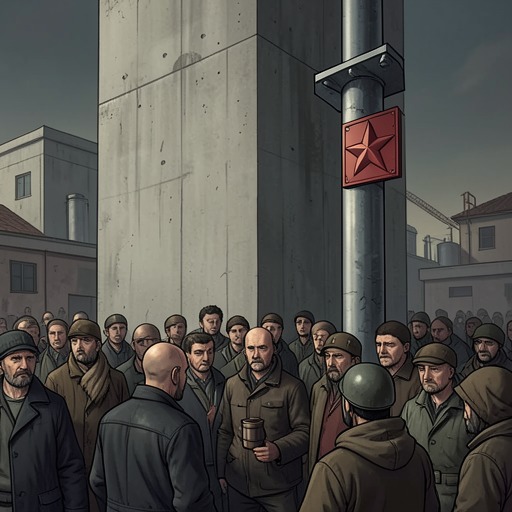
Individual truth versus collective dogma
Doctor ZhivagoIndividual truth versus collective dogma is a recurring conflict between the solitary pursuit of truth and the organized beliefs, slogans, and institutions that claim to speak for everyone. The novel gives this conflict both a philosophical voice in Nikolai Nikolaievich’s refusal of ideological conformity and a political, material form in orders that threaten soldiers, meetings that dispossess residents, and revolutionary interventions that convert a village into a site of accusation and flight. Its concern is not simply that groups are wrong, but that a doctrine can replace attention to particular lives with ready-made explanations and collective commands.
The Individual and the Search for Truth
Nikolai Nikolaievich’s intellectual independence is presented as a movement rather than a settled creed. His ideas have taken shape, but he has not yet found their adequate expression; the books that will make him famous remain unwritten. He is expected to join writers, professors, and philosophers of the revolution, sharing their ideological concerns and even their terminology, yet the narrator distinguishes him from them: they cling to dogmas and are satisfied with words and superficialities, while he continues to seek an idea capable of pointing clearly toward change. The image he longs for is neither a finished system nor a party formula, but something as unmistakable as lightning or thunder, intelligible even to a child or an illiterate person.
His resistance to doctrinal thinking is sharpened in conversation with Ivan Ivanovich. Nikolai argues that group memberships and societies may offer refuge to mediocrity, regardless of whether their members invoke Soloviëv, Kant, or Marx. In contrast, individuals seek truth and avoid company whose principal concern is not truth itself. The distinction makes intellectual independence an ethical practice: loyalty belongs not to a school or faction but to what Nikolai calls immortality, another and stronger word for life, and to Christ. His position is not reducible to a simple test of religious belief. He says that one may be an atheist, or uncertain whether God exists, and still believe that human beings live in history rather than a state of nature.
Nikolai’s account of history deepens that claim. In his understanding, history begins with Christ and rests on the Gospel; it is a prolonged human attempt to solve the riddle of death and overcome it. Mathematical infinity, electromagnetic waves, and symphonies belong to this search. The argument connects truth-seeking to the effort to make life more than a succession of isolated facts, and places knowledge, art, and religious history within one expansive human undertaking.
Truth, Example, and Ordinary Life
Nikolai’s most concentrated defense of truth is also a defense of its manner of action. Against the notion that human beings can be restrained from brutality by threats alone, he imagines that, if fear of prison or punishment after death were sufficient, the emblem of humanity would be the circus lion tamer wielding a whip, rather than the prophet who sacrifices himself. What has raised humanity above the beast, he insists, is not the cudgel but an inward music: the force of unarmed truth and the attraction of its example. The contrast opposes coercion to persuasion without treating truth as mere private opinion. Truth has power, but its power works through a life that can be witnessed rather than through a threat that compels obedience.
This understanding also changes how Nikolai reads the Gospels. He does not make their central significance a list of ethical maxims and commandments. He emphasizes that Christ speaks in parables drawn from life and explains truth through everyday reality. The Gospel’s form matters: meaning becomes accessible through the familiar rather than imposed as abstract instruction. Nikolai’s claim that communion between mortals is immortal follows from this emphasis. Human connection participates in a life that exceeds the individual, and the whole of life can be symbolic because it is meaningful.
The contrast with collective dogma therefore concerns more than which belief is correct. A doctrine can repeat the vocabulary of justice, religion, or revolution while severing its words from lived meaning. Nikolai’s pursuit asks whether an idea can illuminate actual human existence and remain open to further movement. His interlocutors’ failure to understand him does not establish that his thought is empty; it shows the difficulty of conveying a truth that resists both institutional labels and the consolations of a ready-made system.
Collective Language and Revolutionary Authority
Elsewhere, the conflict takes a sharper institutional form. When a new offensive is planned at Meliuzeievo, the effort to improve the army’s morale is accompanied by revolutionary courts-martial and the restoration of the death penalty, recently abolished. The change reveals the distance between revolutionary aims and the instruments used to enforce them: an army in crisis is addressed not only through persuasion but through the prospect of lethal punishment.
That distance becomes visible when Commissar Gints addresses the surrounded rebels of the 212th Infantry. Mounted Cossacks encircle the men, and Gints stands on piled timber to speak about soldierly duty, the fatherland, and other lofty subjects. His language finds no sympathy among listeners exhausted by war and weary of familiar phrases. The men have endured four months of appeals from Left and Right; Gints’s foreign-sounding name and Baltic accent further alienate him from them. His speech is not received in a neutral space: armed horsemen form the ring, the soldiers are surrounded, and their exhaustion shapes what any appeal can mean.
When Gints grows impatient, he moves from high principles to a direct threat. He reminds the deserters that revolutionary courts-martial have been established and orders them, on pain of death, to disarm and surrender their leaders. Refusal, he says, would prove them traitors and an irresponsible rabble. The episode exposes the coercion concealed within ostensibly elevated political language. When the appeal to duty fails, authority turns to denunciation and the threat of execution. Collective labels do not answer the soldiers’ experience of war; they are deployed to demand submission and make resistance appear self-evidently criminal.
Strelnikov’s record presents another version of revolutionary order. He has acted against armed peasants resisting food levies, infantrymen who looted a food convoy, mutinous soldiers, and other opponents. In each case, he surprises his enemies and rapidly investigates, tries, sentences, and enforces the sentence with severity and resolution. His operations control desertion and reorganize recruiting bodies, allowing conscription to proceed and Red Army reception centers to work overtime. As pressure from the north increases, he receives further military and operational responsibilities, and his interventions produce immediate results. The sequence shows how an organized authority can translate contested conflicts into swift procedures and measurable effectiveness. It also places individual judgment under the power of a system whose reach expands as its commands prove effective.
Collective Decisions in Homes and Villages
The language of collective benefit becomes tangible in the proposed conversion of the Tiverzin residence into a hostel. At a meeting, the chair condemns the committee’s slackness, calls for candidates for a new committee, and announces that the large house will be taken over as accommodation for delegates attending conferences. It is to bear the name of Tiverzin, who lived there before being deported. Working people, the chair says, will be rehoused; others must find accommodation themselves and receive a year’s notice. The decision converts an individual home into an administrative resource, and the announcement’s promise of a year’s notice makes the displacement sound orderly without undoing it.
The residents’ response exposes the instability of the categories used to justify the decision. They shout that every one of them is a working person. Another voice cries that the policy expresses Great-Russian chauvinism and insists that nationalities are equal. The chair rejects the relevance of nationality to the case and points to Khrapugina as someone who is also being evicted. The exchange makes visible how collective classifications can become weapons in competing claims to fairness: the officials invoke a public purpose, while residents contest who counts as a worker and whether the decision is discriminatory. No shared slogan resolves the material fact that people are being told to leave their home.
The story Kharlam tells about Veretenniki shows how political categories can also be manufactured through rumor and retaliation. After an old woman is murdered, village kulaks use the killing to inflame distrust of the town authorities, warning villagers that officials intend to seize grain and potatoes. They urge resistance and use village meetings to intensify the dispute. Kharlam then carries his account to the town, calling for a Poor Peasants’ Committee and claiming that he can set the villagers against one another. His intervention turns local conflict into an official political accusation: the village is represented as a problem requiring organized action.
The consequences described in the same account are not a clean victory for any doctrine. Red Army men arrive, a court is established, and the speaker is accused of evading labor service, fleeing, killing the old woman, and stirring up the village. He escapes from confinement by pulling up a floorboard and hides in an old quarry. The village burns while he is away; his mother drowns herself in an ice hole, and he does not learn of her death until later. He says the soldiers were housed separately and given liquor, that they became drunk, and that a fire spread from their house to others. The villagers flee, while the men from town die in the fire. Rumors that every tenth man will be shot keep the displaced villagers from returning. The repeated insistence that events happened by themselves conveys a world in which responsibility is obscured even as violence, accusation, and loss accumulate.
The Novel’s Critique of Dogma
Across these episodes, collective dogma appears not only as an explicit belief but as a way of simplifying human beings. In Gints’s address, exhausted soldiers are reduced to deserters and potential traitors; in the housing meeting, residents are sorted into categories of workers and others; in Kharlam’s account, a village’s complex suffering is turned into a case for political mobilization. Each institution claims the authority to name a situation, and those names help determine who may be threatened, displaced, or punished.
Nikolai Nikolaievich’s alternative is not withdrawal from history. He seeks an idea that could point toward change, but insists that truth must remain connected to life, recognizable beyond specialist language and party terminology. His emphasis on example, parable, and communion offers a standard by which to measure collective action: does its language preserve the meaning of particular lives, or does it make those lives disappear inside a formula? The novel gives no easy institutional remedy. Instead, it sets the searching individual against political speech that hardens into command, and makes the conflict legible in both an argument about truth and the consequences borne by soldiers, householders, and villagers.