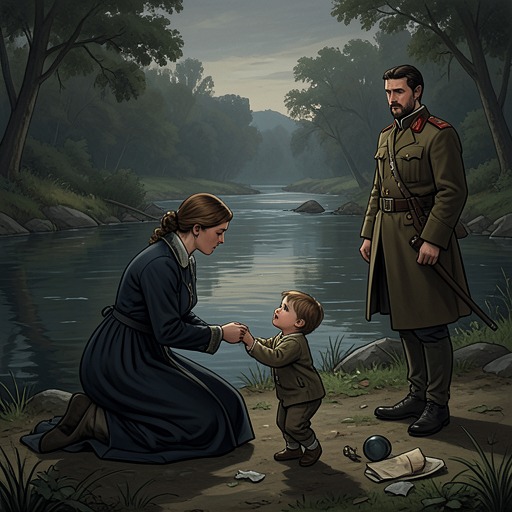
Lara Antipova and Katenka’s mother-daughter relationship
Doctor ZhivagoLara Antipova and Katenka’s mother-daughter relationship is shaped by a hard question: how to keep a child safe when political danger closes in and no dependable refuge seems to remain. Lara’s love is not merely tenderness; it becomes a practical, urgent responsibility—to anticipate arrest, find a place to hide, and consider who could care for Katenka if she could not.
Motherhood under threat
The danger becomes immediate when Lara says the air is full of threats and fears that she and Yurii may be arrested. Her first concern is what would happen to Katenka. She cannot accept the possibility of leaving her daughter exposed to misfortune, so she insists she must think of a plan. The fear is political, but its measure is intimate: the safety of one child rests on choices made by adults who may have little power over what happens next.
Lara and Yurii agree that escape to Moscow is not a practical answer: arranging the journey would attract attention. Lara instead proposes withdrawing to Varykino, where the isolated, neglected house might let them avoid notice through the coming winter. The place is not presented as secure or comfortable; it is empty and desolate, and wolves are said to live nearby. Lara nevertheless judges the danger posed by people such as Tiverzin and Antipov more frightening than the wolves. Her plan is a mother’s calculation under pressure: accept the hardship of concealment in the hope of gaining time and protecting Katenka.
Planning for separation
Lara considers not only where to take Katenka but what would happen if she herself were detained. She has in mind Sima and Glafira, who live with their eldest sister, Avdotia, a librarian. Lara regards the sisters as an honest working family and wonders whether they would look after Katenka if the worst occurred. She has not yet decided to ask them, and she hopes there will be another way out. Even so, the possibility of entrusting her daughter to others shows how concretely Lara prepares for a separation she fears but cannot rule out.
Her caution is sharpened by the threat to Pasha. Lara fears that those who wield revolutionary authority might destroy her and Katenka, and even Pasha, in the name of revolutionary justice. She sees motherhood as a constraint on the risks Yurii can choose for himself: he may gamble with his own life, but she is responsible for a child’s life as well as her own. That distinction makes Katenka’s safety a limit on any decision driven solely by adult love or personal courage.
Love and maternal duty
Lara’s feelings for Yurii do not displace her concern for her daughter; they make the conflict more visible. She describes the love between herself and Yurii as a gift that needs blessing, but fears that its unrestrained, destructive element is hostile to domestic happiness. In the same conversation, she contrasts Yurii’s freedom to rise above the clouds with her own need, as a woman and mother, to remain close to the ground and shelter her young. The image gives emotional form to the responsibility that governs her choices: whatever the height or force of adult feeling, Katenka remains someone who must be protected.
When the danger becomes too immediate to ignore, Yurii agrees to Lara’s original idea of going to Varykino and dropping out of sight. Lara is grateful, yet she refuses to make the refuge depend on his living in her family’s house, whose empty rooms would force painful comparisons with the past. Instead, she suggests the house where the Mikulitsyns had lived. Her concern for the emotional cost of their refuge accompanies her more urgent concern for Katenka, making the journey a shared attempt to escape danger without pretending that flight can restore an undamaged home.
Refuge at Varykino
The journey to Varykino briefly gives the mother and daughter a form of companionship untouched by the gravity of the plan. Lara and Katia ride bundled in fur coats in a sleigh driven by Yurii; as he deliberately turns into snowy banks, they tumble into the hay, laugh, climb back aboard, and scold and pummel him. The scene does not erase the danger that brought them onto the road. Instead, it shows Lara and Katenka together in a moment of bodily ease and shared play while the adults attempt to carry them toward concealment.
At the destination, the Zhivagos’ house stands first, and the travelers hurry inside before darkness. The place is already dark and damaged, its remaining furniture recalling what was once there. Lara’s earlier description of Varykino as empty and desolate has become the material setting of their retreat. The refuge offers distance from those who may arrest them, not a secure return to settled family life. Across these decisions and scenes, Lara’s relationship with Katenka is defined by the effort to preserve a child’s safety amid forces neither mother nor daughter controls.