Larisa Feodorovna Antipova
Doctor ZhivagoLarisa Feodorovna Antipova is a teacher and nurse whose determined care for her daughter and search for her husband carry her through war, displacement, and political danger. Her life is shaped by practical work and intimate loyalties, but the search for Pavel Antipov brings her into contact with Yurii Andreievich Zhivago, whose love for her becomes inseparable from separation, guilt, and loss. She survives the upheavals that scatter her family, only to disappear after Zhivago’s death, with no confirmed account of her fate.
Identity and Life in Yuriatin
In Yuriatin, Larisa Feodorovna shares her husband’s interests, teaches at the girls’ gymnasium, and cares for their three-year-old daughter, Katenka. Their red-haired maid, Marfutka, helps with the household, but the work remains demanding. Larisa is busy without respite, yet happy: this settled combination of family, teaching, and shared interests is the life she had hoped to make. Yuriatin is also her native town, a place to which she belongs rather than merely a stop in the family’s travels.
The town’s seasonal rhythms give that domestic life a local form. As winter approaches, boats are hauled from the Rynva and stored in yards until spring. A boat rests in the yard of the Antipovs’ rented house, and Katenka plays beneath its white hull. The detail locates Larisa’s early family life within the ordinary calendar of her hometown—a domestic world that war will interrupt.
Searching for Pavel
Pavel’s letters first describe his regret and his longing for his wife and daughter. After military training in Siberia, he is commissioned lieutenant ahead of schedule and sent to the front. His later letters are less despondent; he hopes that a military distinction or a slight wound might earn him leave to see his family. Then, during the advance of Brusilov’s forces, his letters stop. Larisa initially attributes the silence to military operations, but as the advance slows and no word arrives, she makes inquiries in Yuriatin, Moscow, and at Pavel’s old field address. No one can tell her what has happened.
Already helping in the military ward attached to the town hospital, Larisa trains as a nurse and qualifies. She takes six months’ leave from teaching, leaves the house in Marfutka’s care, and brings Katenka to Moscow, where she leaves the child with Lipa. Convinced that letters cannot provide the answer, she takes a nursing post on a hospital train bound for Mezo-Laborch, the last address Pavel gave her. The search is not a passive wait for news: she changes her work and leaves home in order to reach the front herself.
Her search leads her to a hospital where Zhivago is recovering in the officers’ ward. On the day she makes her first round, he is reading a batch of letters from Tonia; in the opposite bed, Osip Galiullin is looking through censored newspapers. Larisa enters without recognizing either man. Galiullin recognizes her, but she knows neither of them, and only after approaching him does she learn that he served with her husband and has kept Pavel’s belongings for her. Zhivago and Galiullin each recognize her without realizing the other knows her. The encounter brings the separate lines of her search and Zhivago’s wartime experience into the same room.
Marriage, Love, and Political Danger
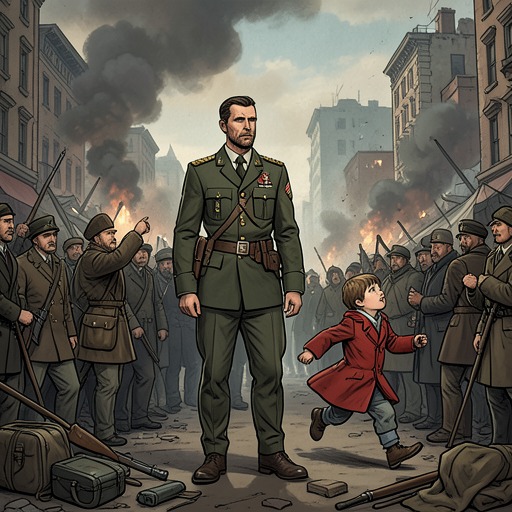
Years later, Larisa tells Zhivago what he had suspected: the revolutionary commander Strelnikov is her husband, Pavel Antipov, who took an assumed name. She had gone looking for Pavel at the front and refused to believe that he was dead. Katenka knows who her father is and is proud of him. Larisa explains that Pavel took the name Strelnikov because active revolutionaries lived and acted under aliases.
She also describes the cost of that secrecy. Strelnikov took Yuriatin and shelled the town while knowing that his wife and daughter were there; he did not try to find them, since doing so would have risked exposing his identity. Larisa accepts that his conduct followed his duty, and even allows that her safety and the Soviet’s provision of housing might mean he was protecting them indirectly. Yet she cannot make sense of his having been nearby without seeing them. Her account holds together pride in Pavel and bewilderment at the separation his revolutionary role requires.
Larisa’s relationship with Zhivago develops amid this divided loyalty. Their conversations bring affection and attraction into conflict with her marriage and his own family ties. When Zhivago speaks too openly about his feelings, Larisa stops him; she says that she has always feared such a moment and asks him to go away briefly and return as the man she knows. Her request is an attempt to preserve their relation within limits she can bear, not to deny the feelings between them. They have no further conversations of that kind, and she leaves a week later.
After she and Zhivago meet again, Larisa speaks of the damage she associates with her earlier life. She says that she was made to encounter life too soon and through the distorted perspective of an older man who exploited his position. She describes herself as broken, while Zhivago answers with reassurance that she is good. Her account of her past helps explain why she distrusts self-confident, controlling men: although Anfim Samdeviatov has helped her greatly, she says that his practical competence and masterfulness do not make him a person she could love. Her moral association of him with someone from her past reveals how experience continues to shape her understanding of intimacy.
Flight to Varykino and Separation
As arrests and searches spread through Yuriatin, Larisa fears that she and Zhivago will be detained and asks what would happen to Katenka. She sees no safe route out of town, so proposes withdrawing from notice at Varykino. Its isolation, an empty house, and the prospect of winter make it a frightening refuge, but she judges the political threat more dangerous than the wolves said to be nearby. The plan is also a mother’s effort to protect her child: going into the background might buy them time.
When Zhivago returns to Yuriatin after his captivity, he finds Larisa’s key and note in the customary hollow between the bricks. She has heard that he is alive and gone to Varykino with Katenka, expecting that he might go there directly, but leaves the key in case he comes to the flat. She has sold some furniture and left food, mostly boiled potatoes, with instructions to keep the saucepan weighted against rats. The practical provisions make the note both an expression of joy and a record of how precarious their home has become.
On the reverse of the same paper, Zhivago discovers further news: his family is in Moscow, and Tonia has given birth to a daughter. Larisa has crossed out several lines and says they can talk when they meet; she is leaving to find a horse and does not know how she will manage without one, especially with Katenka. Her letter thus connects their separate family histories even as the two households remain apart.
At Varykino, the danger surrounding Larisa and Katenka grows. Larisa says that people who have recently arrived in the area are capable of destroying both her and Pavel in the name of revolutionary justice. After a nighttime search at a neighboring house uncovers weapons and leads to arrests, she concludes that their safety is over. She proposes retreating to Varykino because it is lonely, neglected, and less conspicuous, and hopes Samdeviatov can serve as a link to town or help them hide. Zhivago and Larisa’s refuge is therefore a response to a political threat, not a secure return to ordinary domestic life.
That refuge ends when Larisa and Katenka leave with Komarovsky. Samdeviatov tells Zhivago of their departure and takes back the horse he had lent him, promising to return within the week and remove Zhivago from Varykino for good. Zhivago mourns Larisa and the loss of their shared summer; in the days after she leaves, he sometimes hears her calling him from another room. Her departure separates the couple and leaves Zhivago alone with his writing and grief.
Return to Moscow and Disappearance
After Zhivago’s death, Larisa appears in Moscow and finds his funeral already under way. She explains to Evgraf Andreievich that she came upon the old streets, recognized Kamerger Street, and entered the house where Pavel had once lived as a student. She had not known that the house had become Zhivago’s home. Seeing the open door, the gathered people, and the coffin, she was overwhelmed by the coincidence and by the discovery that the dead man was Zhivago.
In conversation with Evgraf, Larisa also learns that Pavel did not die as she had believed he might have: Evgraf says that Pavel shot himself in that house soon after Larisa left, and that Zhivago found and buried him. Larisa says she has heard that account but does not believe Pavel would have taken his own life. The disclosure gives her a belated account of Pavel’s death, while exposing how much of her husband’s final history had remained beyond her reach.
Evgraf asks Larisa to stay and help sort Zhivago’s manuscripts, because she knew his writing so well. She agrees, saying that working on the papers would comfort her and that she knows his handwriting intimately. She also asks for help tracing a child who had been entrusted to strangers, and seeks information about official records and institutions for children. Her urgency shows that, even in the aftermath of Zhivago’s death, she remains occupied by a search for someone lost.
Larisa stays several days on Kamerger Street and helps begin the sorting of Zhivago’s papers, though the work is completed without her. One day she goes out and does not return. The narrative says that she must have been arrested in the street and supposes that she died in one of the northern concentration camps, forgotten under a number on a lost list. Her disappearance is the final, unresolved consequence of the political dangers that had repeatedly forced her to protect her daughter, leave home, and seek safety elsewhere.
Narrative Role
Larisa’s plot is repeatedly organized around acts of care and search: she makes a home in Yuriatin, raises Katenka, trains as a nurse, and goes to the front for news of Pavel. These practical commitments give her an independent trajectory through wartime events, even as war and political power continually divide her from the people she loves. Her work as a teacher and nurse is not incidental background; it is the means by which she supports her family and enters the spaces where the novel’s characters cross paths.
Her relationships preserve conflicts that political labels cannot settle. Pavel is both her husband and the revolutionary commander whose secrecy keeps him from his family; Zhivago is both a beloved companion and a man whose attachment threatens the boundaries she is trying to maintain. At Varykino, the need to protect Katenka makes flight urgent, while her later return to Moscow brings her into contact with the manuscripts through which Zhivago’s life can be remembered. Her final disappearance denies her a settled ending: she is neither shown safely reunited with her daughter nor definitively accounted for, but vanishes into the same machinery of arrest and confinement from which she had spent years trying to escape.</body_en