Maria Zhivago’s Funeral
Doctor ZhivagoMaria Zhivago’s Funeral marks the death of Maria Nikolaievna and the beginning of Yura’s orphaned childhood. Its public rites move from the singing procession and hurried burial to the boy’s private, bodily grief; that night, a blizzard obliterates the familiar landscape, and Yura fears the snow will bury his mother beyond his reach. The funeral is therefore not only a ceremony of farewell but the scene in which bereavement first shapes his perception of the world.
The procession and burial
The mourners proceed singing “Rest Eternal.” When they stop, the song seems to continue through their feet, the horses, and the gusts of wind, carrying the funeral beyond the voices of the singers. Passers-by make way, count the wreaths, and cross themselves. Some join out of curiosity and ask who is being buried. Told that it is Zhivago, they initially take the dead person to be the boy’s father; when corrected that it is his wife, one answers that it comes to the same thing and calls it a fine funeral. The exchange gives the procession a public, almost casual audience, while exposing how readily a family’s loss becomes a spectacle to strangers.
At the grave, religious words and gestures hold the burial together against the urgency of death. The priest scatters earth over Maria’s body with the sign of the cross, and the mourners sing “The souls of the righteous.” Then the coffin is closed, nailed shut, and lowered into the ground. Four spades rapidly fill the grave; earth falls onto the lid, and a small mound rises where Maria has been laid. The brisk, physical work of burial contrasts with the irretrievability of the last moments that precede it: the rites give death a form, but cannot slow or undo it.
Yura’s grief at the grave
A ten-year-old boy climbs onto the new mound. The funeral’s stupor briefly makes it seem as though he might speak over his mother’s grave, but his body tells another story. He raises his head and looks absently across the bare autumn landscape toward the monastery domes; then his face contorts and his neck stretches. The narration compares him to a wolf cub about to howl, rendering grief as an involuntary, animal intensity rather than a composed act of mourning. He covers his face with his hands and sobs as cold rain lashes them.
Maria’s brother, Nikolai Nikolaievich Vedeniapin, approaches and leads the boy away from the cemetery. A former priest who had asked to be unfrocked, he is both the dead woman’s brother and Yura’s uncle. His intervention takes the child out of the immediate scene of burial, but it does not resolve the loss. The funeral’s public ritual has ended; Yura’s grief continues into the night, no longer contained by the mourners’ procession or the cemetery.
The blizzard and the fear of separation
That evening, Yura and his uncle spend the night at a monastery, where Nikolai Nikolaievich is given a room because of his former connection to the place. They are due to travel south the next day to a provincial town on the Volga, where Nikolai works for the publisher of a progressive local newspaper. Their tickets have been bought and their belongings packed. Yet the station is near enough for them to hear engines shunting in the distance, while the room’s low windows look onto the road, a neglected kitchen garden, and the part of the churchyard where Maria was buried earlier that day. These practical details place the boy between the journey ahead and the grave left behind.
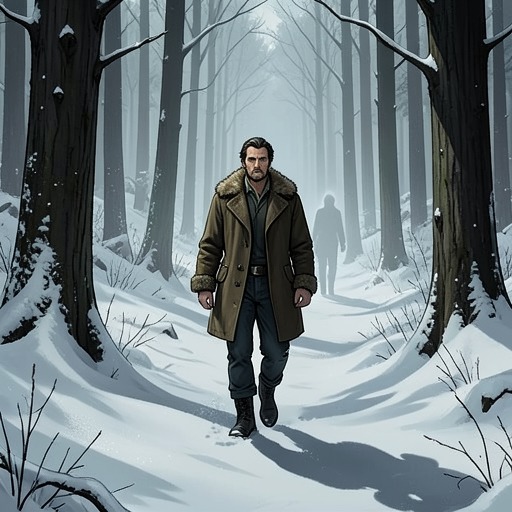
During the night, a knock at the window wakes Yura. A flickering whiteness lights the dark cell. Wearing only his shirt, he runs to the window and presses his face against the cold glass. The landscape has disappeared: there is no visible road, graveyard, or kitchen garden, only snow-filled air. The storm is described as if it had noticed the boy and were using its power to terrify him; whitening lengths turn over in the sky and shroud the earth until the blizzard seems alone in the world, without a rival. The weather does not merely obscure the setting. It makes the world that held his mother’s grave seem to vanish.
Yura’s first impulse is to dress, go outside, and do something. He fears that the cabbage patch will be buried so deeply that no one can dig it out, and that his mother will sink helplessly farther from him into the earth. His imagined rescue joins the ordinary garden to the grave: if the snow covers the ground, the place that connects him to Maria may become inaccessible as well. The impulse ends in tears. His uncle wakes, speaks to him of Christ, and tries to comfort him before standing thoughtfully at the window as day breaks. By morning, Yura and Nikolai begin to dress for the journey, but the night has shown that leaving the graveyard does not mean leaving grief behind.
Narrative significance
The funeral’s structure sets communal convention beside an experience no convention can master. The procession, prayers, cross, coffin, and shovels carry the dead through the recognized stages of burial; the boy’s sobbing, followed by his fear of the snow, makes the same death immediate and unfinished. The strangers’ mistaken identification of the deceased adds a small but telling contrast: for them the funeral is a spectacle whose participants can be confused, while for Yura the difference between his father and mother is absolute.
The storm extends the scene’s emotional movement without turning Yura’s fear into a literal event. First he watches the world disappear behind snow; then he imagines the garden being buried and his mother receding underground. The grave and the weather converge in his child’s mind as two forces of concealment and separation. Maria’s burial thus introduces a lasting pattern for the opening of the story: the external world is not neutral scenery but something Yura experiences through the pressure of loss, fear, and attachment.