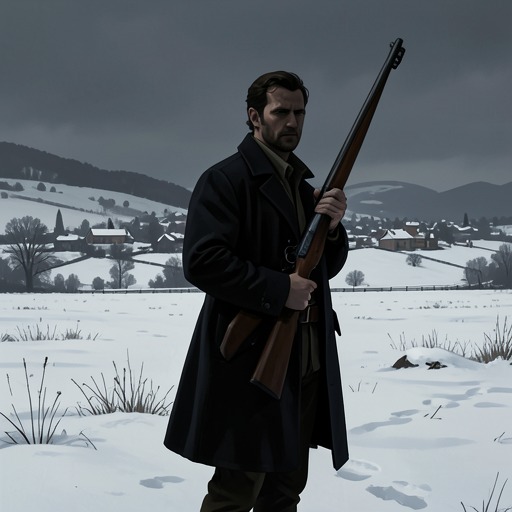
Maxim Aristarkhovich Klintsov-Pogorevshikh
Doctor ZhivagoMaxim Aristarkhovich Klintsov-Pogorevshikh, known as Pogorevshikh, is the young deaf-mute associated with the brief Zybushino republic. First encountered through rumor as a supposedly speechless assistant whose voice arrived only in moments of inspiration, he emerges in person as an articulate, self-assured theorist: his unusual way of speaking and his political involvement turn a local legend into a concrete, if still enigmatic, character.
Identity and Reputation
Stories circulating about Blazheiko’s chief assistant made his deafness and muteness part of the republic’s folklore. People said that he could speak only when inspiration came, then lost the gift again. The tale magnified a real difference into something almost miraculous, leaving the figure known to the region difficult to distinguish from the legend attached to him.
A report from the surrounding area gives the rumor a more ordinary, though still unresolved, form: the deaf-mute was said to be young and educated, and residents insisted that he really existed. That gap between local hearsay and the person himself shapes his introduction. Before Zhivago meets him, Pogorevshikh is already both a bodily reality and a story told about that reality.
Speech and Self-Presentation
When Zhivago encounters him, Pogorevshikh hands over two cards. One is his visiting card, which gives his double name, Maxim Aristarkhovich Klintsov-Pogorevshikh, and his preference to be called Pogorevshikh, after an uncle with that name. The other displays a table of hand signs, an alphabet for deaf-mutes. Its presence makes his means of communication visible rather than mysterious.
The sign alphabet does not explain away his speech. Zhivago realizes that Pogorevshikh is an exceptionally gifted pupil of a school that taught deaf-mutes to understand and produce speech by watching their teachers’ throat muscles. Pogorevshikh’s communication depends on sustained observation and learned skill, not a sudden supernatural gift. The contrast recasts the earlier tales: what villagers describe as inspiration is, at least in this instance, a remarkable capacity acquired through attention and practice.
Role in the Zybushino Republic
Zhivago infers Pogorevshikh’s connection to the republic from what he has said about his home region and a shooting expedition, and asks whether he helped establish it. Pogorevshikh answers with delighted laughter, rocking from side to side and slapping his knees, then launches into a long account. He confirms that Blazheiko offered the opportunity and Zybushino the setting in which to put his own theories into practice.
The political experiment had been extraordinary in both its claims and its brevity. The republic rejected the Provisional Government and separated from the rest of Russia; Blazheiko proclaimed a new millennial kingdom in which work and property would be collectivized, while calling the local administration an Apostolic Seat. The republic lasted only two weeks before a unit loyal to the Provisional Government entered the town and the deserters withdrew to Biriuchi. Pogorevshikh’s part belongs to this short-lived attempt, not to a lasting political order.
Ideas and Narrative Function
Zhivago struggles to follow Pogorevshikh’s exposition. What he can make out is a philosophy combining anarchist principles with hunters’ tall tales. Pogorevshikh then prophesies disastrous upheavals in a manner as calm and authoritative as an oracle. Zhivago privately considers such upheaval plausible, but the boy’s composed certainty irritates him. Their encounter therefore sets the content of the predictions against the manner of their delivery: the forecasts may fit an approaching crisis, yet Pogorevshikh’s confidence does not make his system coherent or persuasive.
Pogorevshikh’s appearance also shifts the novel’s handling of knowledge. The reader first receives him through village reports, where disability becomes the basis for an almost magical anecdote; only later does Zhivago encounter the person, his sign-language card, and the practiced method behind his speech. This movement from rumor to observation does not erase his strangeness, but it locates it in concrete abilities, political involvement, and an eccentric account of the world rather than in the legend alone.