Meliuzeievo
Doctor ZhivagoMeliuzeievo is a small town in fertile black-soil country, transformed by the passage of armies and by the improvised institutions of war and revolution. Dust, mud, crowded hospitals, railway crowds, public meetings, and requisitioned homes give it a changing civic landscape; for Yurii Andreievich Zhivago and Larisa Feodorovna Antipova, it is also a place where shared work brings them into one another’s orbit. The town’s significance lies in this overlap: vast political changes arrive not as abstractions but as pressure on streets, buildings, occupations, and ordinary lives.
A Town Between Front and Home
Meliuzeievo is first seen beneath a haze of black dust raised by troops and convoys moving in both directions. Some are going toward the front, others away from it, and the traffic makes it difficult to tell whether the war is still being fought or has ended. The town’s fertile setting offers no refuge from the conflict: its roofs disappear behind dust, while the soldiers’ movement repeatedly subjects the town to the war’s unsettled rhythm.
Rain changes the dust into coffee-colored mud that spreads across the largely unpaved streets. At the end of almost every street lies the steppe, gloomy beneath a dark sky. The landscape opens out from the small town toward what the narrative presents as the immensity of war and revolution. Meliuzeievo is provincial in scale, but the forces passing through it are not; its exposed horizon makes that disproportion visible.
The war’s effects also appear in the wounded. A truck with two trailers arrives at a hospital entrance carrying injured men, while elsewhere in the town’s medical service wounded people crowd passages and landings. Near the front, ammunition carts without springs jolt men collected from the battlefield toward a first-aid station; many are unconscious, and the cases requiring urgent attention are hastily treated. Such scenes connect Meliuzeievo’s civilian streets and buildings to the immediate machinery of combat: the town receives the consequences of fighting even when the front itself lies elsewhere.
Provisional Offices and Public Argument
As the front moves and the old order gives way, new offices spring up in Meliuzeievo with mushroom-like speed. Zhivago, Lieutenant Galiullin, Nurse Antipova, and others from the larger cities are repeatedly elected to posts. They serve as temporary town officials and as minor commissars in the army and health department, treating the succession of assignments at first as a kind of outdoor game. Yet the novelty wears thin. They increasingly want to return to their ordinary work and homes, a desire that measures the distance between revolutionary improvisation and the continuity of private life.
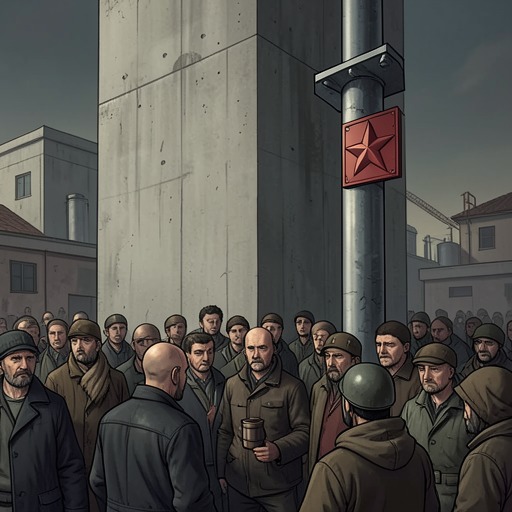
The town’s public spaces are put to new uses. After the fall of the Zybushino Republic, the Meliuzeievo Executive Committee campaigns against local anarchistic tendencies. Peaceful meetings are held each night in the Platz, a square where soldiers once drilled and where citizens now gather for political discussion. The gatherings are small and include people who, in the old days, would have met outside the fire station to gossip. The changed purpose of the square does not erase its older social habits; political debate grows out of a familiar local practice of assembling and talking.
The Meliuzeievo cultural soviet invites local and visiting speakers to guide these discussions. Visitors dismiss as nonsense the stories about the talking deaf-mute, while local craftsmen, soldiers’ wives, and former servants defend them. Ustinia becomes one of the most outspoken defenders. Initially restrained, she grows bold enough to heckle speakers whose views are unwelcome and develops into a practiced public speaker. Her intervention shows how an official campaign against local anarchistic tendencies turns into a contest over who has authority to define the town’s truth.
The arguments reach beyond the square. Voices from the meetings carry through the hospital’s open windows, and on quiet nights listeners can make out fragments of speeches. Mademoiselle Fleury, persuaded that Ustinia’s political performances are worth hearing, sometimes rushes into rooms to urge others to listen, mimicking the speeches in her broken accent. Public life thus enters the hospital not only through administration and medical work but through sound: the town’s political argument becomes part of the everyday environment of those caring for the wounded.
Hospital, Work, and Zhivago’s Writing
One hospital where Zhivago convalesces and later serves as a doctor occupies the former residence of Countess Zhabrinskaia, who offered the house to the Red Cross at the beginning of the war. The two-story residence stands at a prominent corner by the main street and the square known as the Platz. Its position looks out over the square and street, a neighboring farm, and the Countess’s old garden. A former private home has become a medical institution at the heart of the town, with its view encompassing both the new public gatherings and remnants of the old property.
The medical work is shaped by conditions across the wider wartime network. Moscow hospitals are overwhelmed, and the influx of wounded after the battle of Lutsk has forced patients into passages and onto landings; overcrowding is beginning to affect the women’s wards. At another first-aid station, the road from the trenches brings a stream of wounded during a brief lull in artillery fire. These details establish the strain under which doctors and nurses work and the way the war’s shifting fronts determine the use of hospitals and private buildings.
Zhivago and Antipova are often brought together by their work. In a letter to his wife, Zhivago mentions that he works a great deal with a Moscow-born nurse named Antipova, who is from the Urals. The matter-of-fact report places their association inside the demands of medical service, before the significance of their bond becomes explicit. In Meliuzeievo, their shared duties provide a recurring point of contact amid temporary appointments, military disruption, and the desire to return home.
The town also belongs to Zhivago’s inner and creative life. Much later, remembering the time in Meliuzeievo, he again notices in Antipova a quality he had observed there: she seems not to cultivate her beauty or seek to please, and her apparent hostility toward her own loveliness intensifies his attraction. The recollection makes the town part of the emotional history he carries beyond it. His memory of Meliuzeievo is not limited to public turmoil; it preserves the beginnings of a personal perception that will gather force in a later encounter.
Housing and the Reorganization of Domestic Space
Revolutionary change is registered inside houses as well as in public offices. When Zhivago returns to Moscow, he learns that part of the ground floor of his family’s home has been assigned to the Agricultural Academy. Its library, herbariums, and seed specimens have been moved in, while the family has surrendered rooms they can no longer afford to heat. Even the word for rooms has changed to the political and administrative term living space. Though this transfer occurs after the family has left Meliuzeievo, it clarifies a pattern visible across the narrative’s settings: domestic space is increasingly reorganized by institutional need and new rules of allocation.
That pressure becomes explicit in a speech about turning a large house into a district soviet hostel for visiting delegates and naming it the Tiverzin Hostel. The announced plan gives current residents a year’s notice to find other accommodations, while working people are to be rehoused. Protesters insist that they too are workers, and one objects that the decision reflects Great-Russian chauvinism. The dispute reveals how the language of collective provision collides with the individual experience of losing a home, and how the categories used to distribute space provoke arguments about class and nationality.
In Yuriatin, the same material upheaval appears in the rooms Antipova shares with her daughter, Katenka. Their own flat in the school building has been taken over by the Town Housing Department, and they have been given part of another house whose owners have gone away, leaving their furniture behind. Antipova has pushed the unwanted furniture into two dark rooms and whitewashed the windows to keep out the sun. For Zhivago, entering those rooms is like passing through a labyrinth; for her, they are the practical result of lost housing and someone else’s abandoned possessions. The parallel links Meliuzeievo’s larger transformations to the intimate cost of making a place to live.
A Passage Rather Than a Destination
The town’s railway connection belongs to the same world of instability. As the Zhivago family arrives in the Urals, its train remains on a siding behind other trains that screen it from the station. The family feels that its formerly unbroken connection with Moscow has snapped: beyond the station begins a provincial territory with its own center of gravity. This arrival is not itself in Meliuzeievo, but the contrast helps define the town’s place in the novel’s geography. Meliuzeievo is one of the provincial settings through which characters pass as the familiar capital-centered world breaks apart.
The station also carries personal histories from the town’s earlier revolutionary upheavals. When Zhivago asks a man whether he had been at Biriuchi station near Meliuzeievo, he is trying to connect an uncertain memory of a nighttime incident with the Zybushino rebellion. Years later, Mademoiselle Fleury, once from Meliuzeievo, is in Moscow seeking an exit visa after twelve years of petitioning to return to Switzerland. She walks on, unaware that she has overtaken Zhivago and survived him. Her departure gives the town’s history a quiet afterlife: a place once marked by war, political argument, and temporary assignments remains present in the lives of people dispersed far beyond it.
Meliuzeievo is therefore neither a stable refuge nor simply a backdrop to the characters’ affairs. Its hospital, square, streets, homes, and railway connections show how war and revolution remade everyday space, while its recurring association with Zhivago and Antipova gives those public transformations a personal counterpoint. The town’s provisional nature is its defining condition: institutions appear, homes change hands, the front advances and recedes, and people long for ordinary occupations even as their lives are being carried elsewhere.