Misha Gordon
Doctor ZhivagoMisha Gordon is a lifelong friend of Yurii Andreievich Zhivago and, at several turning points, a witness to the costs and continuities of his friend’s life. As a child, Gordon sees Zhivago’s father die by suicide; years later, he finds Zhivago at the war front and confronts the destruction around him. After Zhivago’s disappearance and death, Gordon’s care for those left behind and his reading of Zhivago’s writings make him a bearer of personal memory across successive periods of upheaval.
Identity and Early Friendship
Gordon is the son of a lawyer and, at eleven, is travelling with his father from Gorenburg to Moscow after a three-day train journey. His mother and sisters have gone ahead to prepare the family’s apartment. The boy is described as thoughtful, with large dark eyes, and is in his second year at the gymnasium. He and his father share a second-class compartment, while the Russian landscape passes outside the train.
Gordon’s connection with Zhivago begins in childhood: the boys live with the Gromeko family, where Zhivago and Antonina Alexandrovna Gromeko grow up. Later, the three friends—Zhivago, Gromeko, and Gordon—sit together at a concert. Gordon spends much of his time at the Gromekos’ home, so his friendship with Zhivago belongs to the everyday intimacy of a shared household, not merely to the exceptional events that will later bring them together.
The Train and the Childhood Witness
On the journey to Moscow, Gordon’s father speaks at length with a distressed first-class passenger, Andrei Zhivago. The older man has been drinking and talks about his son, his late wife, and the family he has left behind. In his final visit to the compartment, he tries to tell Gordon’s father something, cannot manage it, rushes out onto the platform, and throws himself from the moving train.
The death is Gordon’s first direct encounter with Zhivago’s family history. He is deeply shaken, and initially cries from grief and fright. After the body is recovered, he sits examining a small wooden box of minerals from the Urals, Andrei’s last gift to him. The object ties the abrupt public event to a private remnant of the dead man: the train carries on, but Gordon retains both the memory of the suicide and the gift left behind.
Years later, Gordon recounts the connection to Zhivago. At school, he had accompanied Zhivago to a hotel room when Zhivago’s mother had taken poison. Gordon recognized Victor Ippolitovich Komarovsky there as the lawyer who had travelled with Andrei. He explains that, as a boy on the train, he had witnessed Andrei’s suicide and heard his father’s account of the millionaire’s troubled affairs. This remembered chain of encounters reveals that Gordon’s own childhood experience had become part of Zhivago’s understanding of his father’s death and of Komarovsky’s role in that history.
Friendship at the Front
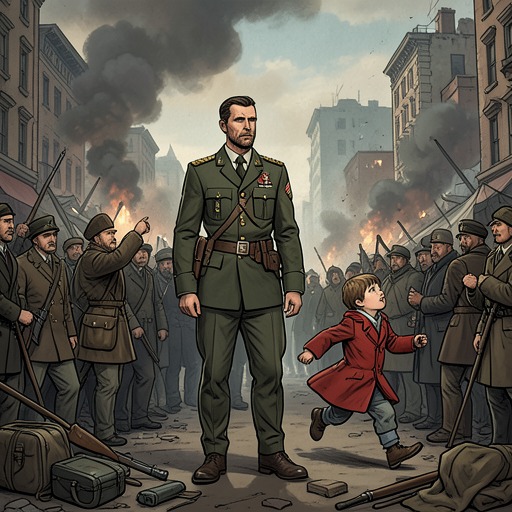
During the First World War, Gordon goes to find Zhivago, who is attached to a divisional hospital. Gordon is travelling with a Red Cross train supported by voluntary contributions from the Tatiana Committee for Aid to the Wounded. Learning that Zhivago is in a nearby village, he obtains permission to travel behind the lines and takes a carriage from headquarters. The stated distance proves misleading: the village is about fifty miles away, not the fifteen he had been told.
The journey passes ruined settlements and brings Gordon within hearing of distant artillery. After a patrol sends the carriage off the main road, he and the driver lose their way for hours; they first arrive at a village with the right name but no hospital, because another village shares it. Once he reaches the correct place, Gordon intends to spend a day with Zhivago before returning to the station. Instead, circumstances keep him there for more than a week. His visit becomes an extended reunion amid the war, rather than a brief stop between railway journeys.
In those days, the friends talk about the war and its effects on thought. Zhivago finds it difficult to accept the logic of mutual destruction and to become accustomed to the wounded and the consequences of modern fighting. Gordon, too, sees the suffering around the front. He recognizes the moral difficulty of remaining a spectator while others face danger, but also doubts that simply expressing grief is a more honest response. His account presents him not as a combatant or a medical worker, but as someone trying to behave plainly within the circumstances he encounters.
Gordon and Zhivago also witness a death in a shared scene with the nurse Lara and Lieutenant Galiullin: the dying man is Private Gimazetdin, Galiullin’s father. The narrator emphasizes that these people are together without all knowing one another or recognizing one another, and that some connections will remain uncertain until a later meeting. Gordon’s presence therefore places him among the witnesses to a network of lives that the novel brings into contact before their full relations become clear.
Care, Disappearance, and Zhivago’s Legacy
In 1929, Gordon visits a cramped, altered former tailor’s shop that now serves as his room. Its low window begins at floor level, and gaps in the old gold lettering allow people outside to see those inside up to the knees. Zhivago, Innokentii Dudorov, Marina, and the children are there; after Marina leaves with the girls, the three men continue their conversation. The setting’s visibility contrasts with the private nature of what the friends discuss, including the pressure of their time and Zhivago’s own poor health.
When Zhivago says he must leave and asks Gordon not to be angry, Gordon urges him to stay, pointing out that the window is open and apologizing for the stuffiness. Zhivago nevertheless departs. Soon afterward, Marina breaks down, and Gordon and Dudorov take turns staying with her and looking for him. For two days they visit places where he might have gone, including Flour Town and Sivtsev Vrazhok, and search among his former acquaintances. They do not report him missing to the police, deciding that official attention could bring trouble to a man whose life does not meet the standards of the period. On the third day, letters arrive for Gordon, Dudorov, and Marina: Zhivago apologizes for the anxiety he has caused, asks them not to worry, and tells them to stop searching because the search will be fruitless.
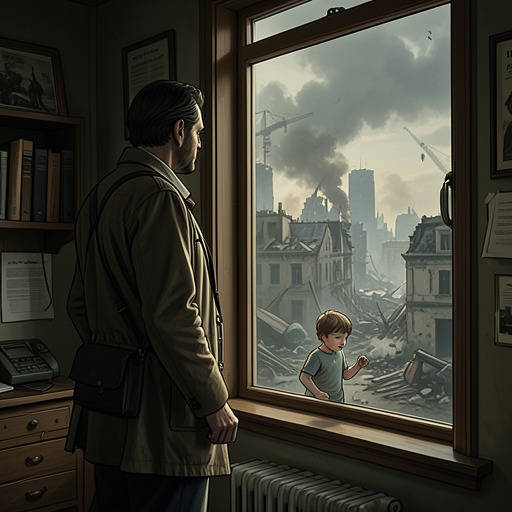
Five or ten years later, Gordon and Dudorov sit together at an open window overlooking Moscow and read an album of Zhivago’s writings, assembled by Evgraf Andreievich Zhivago. They have read the book before and nearly know it by heart, but this evening’s reading gives them a new view of their city: Moscow seems not merely the setting of Zhivago’s story but its principal protagonist. Although the anticipated relief and freedom did not follow victory, the friends sense signs of freedom in the postwar air. Their response to the writings makes Gordon’s final role clear: he helps preserve the memory of his friend, and the book offers the survivors a language for imagining a future not wholly confined by the political world they have lived through.
Narrative Role
Gordon’s life intersects with Zhivago’s at three distinct thresholds: the childhood journey on which he witnesses Andrei’s suicide, the wartime reunion where the friends discuss violence and its moral demands, and the later effort to find Zhivago when he disappears. These episodes make him both a participant in their shared past and an observer who can connect events across years. His recollection of the train journey supplies a crucial link between Andrei, Komarovsky, and Zhivago’s family history; his presence at the front places him among witnesses to the novel’s converging characters; and his later reading with Dudorov carries Zhivago’s writings into the lives of those who survive him. The friendship thus persists beyond ordinary companionship: it becomes a practice of remembering, searching, and reading together.