Moscow
Doctor ZhivagoMoscow is both a home repeatedly approached and a city repeatedly transformed. Its schools, workshops, family houses, hospitals, and streets hold the ordinary structures of life; war and revolution press through those structures, overcrowding wards, scattering families, and altering the city’s material world. The contrast between cultivated domestic interiors and the wounded, displaced, and impoverished people moving through the capital gives Moscow its central significance: it is not a stable refuge outside history, but a place where history enters the rooms and bodies of everyday life.
Domestic worlds and social geography
When Amalia Karlovna Guishar arrives from the Urals with her children, Rodion and Larisa, Moscow becomes the setting for a new start. She enrolls Rodion in a military academy and Larisa in a girls’ gymnasium, where Larisa meets Nadia Kologrivova. To support herself, Amalia buys Levitskaia’s dressmaking establishment near the Triumphal Arch, taking over its clientele, seamstresses, and apprentices as well as the business’s goodwill. The city’s institutions and commercial life thus offer practical routes into an unfamiliar place, even as Larisa’s schooling and her mother’s business connect their new life to people who already belong to Moscow.
The workshop’s position near the corner of Tverskaia Street places it close to the Brest railway, its engine depots, warehouses, and workers’ lodging. Olia Demina, one of the dressmaking apprentices, lives in those lodgings with her uncle, who works at the freight yard. The proximity of a small women-run business to the railway’s infrastructure brings different kinds of labor into the same urban landscape: tailoring and apprenticeship on one side, freight and railway employment on the other. Olia is quick at her work, had been singled out by the previous owner, and is beginning to find favor with Amalia. She also likes Larisa, making the workshop a setting for attachment as well as livelihood.
Another Moscow household gives the city a very different texture. The childless Sventitskys live in a house on the Dolgoruky property in Flour Town, an old cluster of buildings with three courtyards and a garden, bounded by narrow side streets. Their house is too large for them, and its rooms preserve the accumulated life of an older family: Nikolai Nikolaievich Vedeniapin stays in a corner room on the second floor, in a darkish study crowded with books, papers, rugs, and prints. A semicircular balcony, sealed behind double glass doors for winter, looks toward an alley marked by sleigh tracks and irregular fences. Flour Town’s old fabric, with its cramped streets and inward courtyards, contrasts with the more orderly domestic interiors elsewhere in the city.
The Gromeko house on Sivtsev Vrazhok is one such interior. Alexander Alexandrovich Gromeko and his brother Nikolai Alexandrovich are professors of chemistry; Alexander lives there with Anna Ivanovna and their daughter Tonia, while Yurii grows up in the household. The upper floor contains the bedrooms, schoolroom, Alexander’s study and library, Anna’s boudoir, and the rooms of Tonia and Yura. Below, the reception rooms’ pistachio curtains, piano, aquarium, olive-green upholstery, and plants create the impression of a green, gently swaying seabed. The Gromekos’ hospitality and love of music turn the house into a place for chamber-music evenings, where piano trios, violin sonatas, and string quartets are performed. Moscow is therefore more than a collection of streets and institutions: it is a network of homes in which education, music, kinship, and friendship can take root.
A city seen through war
The domestic city is repeatedly interrupted by war. As the wounded arrive in Moscow after the battle of Lutsk, a truck with two trailers pulls up at a hospital entrance and men are carried inside. The hospitals are so overcrowded that patients fill passages and landings; the pressure is beginning to reach the women’s wards as well. Yurii, a doctor at the Hospital of the Holy Cross, turns from the window exhausted and recalls a recent death in its surgical ward. He had diagnosed echinococcus of the liver, but his colleagues doubted him, and the post-mortem examination is due that day. The hospital’s shortage of space and the uncertainty of diagnosis make the city’s crisis intimate: war’s consequences reach both the body in the ward and the doctor’s burden of judgment.
The novel also places the Moscow hospital system within a wider front-line emergency. At a first-aid station in a damaged wood, survivors of four days of heavy fighting lie exhausted beside the road, while unsprung ammunition carts jolt newly wounded men toward treatment. Many of the wounded were picked up only half an hour earlier during a lull in the artillery fire, and about half are unconscious. This scene is not located in Moscow itself, but it clarifies the pressure behind the city’s overcrowded hospitals: the stream of casualties begins at the front and continues toward medical facilities, where care must be improvised amid relentless demand.
When German forces break through near the village where Yurii and Misha Gordon are stationed, the hospital is evacuated without waiting for formal orders. Gunfire and running footsteps wake the village; Yurii confirms that the breakthrough is real, sends Gordon with the first party, and hurries to make sure he gets a place in the carriage. The flight unfolds under fire, with bullets passing as they run close to the walls and shrapnel bursting over the fields. This evacuation belongs to the novel’s larger geography of displacement, but it also gives Moscow’s hospitals a precarious role: their work and their patients must move whenever the front advances.
Revolution, trains, and separation
Revolution changes who moves through Moscow and under what conditions. On a twenty-three-car train carrying the Zhivago family, sailors occupy the front cars, civilians the middle, and labor conscripts eight cars at the rear. About five hundred conscripts have been assembled from radically different backgrounds: lawyers and stockbrokers from Petrograd travel alongside cab drivers, floor polishers, bath attendants, Tartar ragpickers, escaped lunatics, shopkeepers, and monks. The convoy’s arrangement gives physical form to a new political order in which people of different occupations and stations are grouped together under compulsion. Moscow is the family’s point of departure into this altered world, and the train makes clear that leaving the city does not mean escaping the upheaval that has remade it.
The separation becomes explicit in Tonia’s long, battered letter, which reaches Yurii in Larisa Feodorovna’s house in Yuriatin. Tonia tells him that she and their family are being deported abroad with prominent professors and political figures, including her father and Nikolai, Yurii’s uncle. They may go to Paris; she does not know whether Yurii will later be allowed to join them, and she fears that they will never meet again. Their daughter Masha has been named in memory of Yurii’s mother, while Sasha has grown into a strong boy who cries whenever his father is mentioned. The news turns Moscow from an earlier shared home into a place bound up with a family’s forced departure and the uncertain hope of reunion.
Tonia’s account also links the city and its émigrés to Larisa. Before leaving the Urals, Tonia says, she came to know Larisa and is grateful for the help Larisa gave during her confinement. She describes herself as someone inclined to make life simple and seek sensible solutions, in contrast to Larisa, whom she sees as complicating matters and creating confusion. The letter’s tenderness does not erase the strain of separation: Tonia declares her love for Yurii, recognizes that he does not love her in the same way, and nonetheless blesses him for the long ordeal ahead. Its arrival in Yuriatin makes the lost Moscow household present again, but only as memory, kinship, and news of exile.
Return in the NEP years
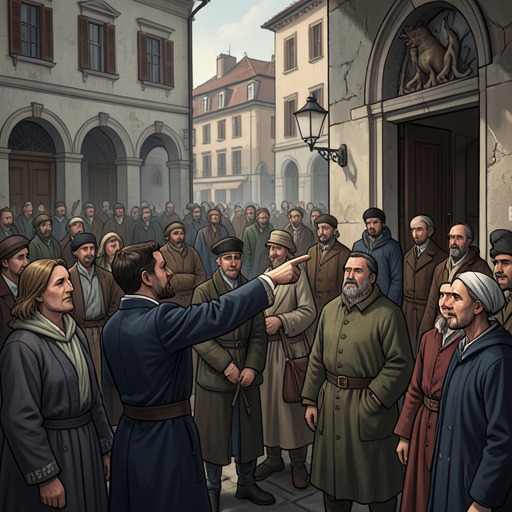
Yurii returns to Moscow at the beginning of the New Economic Policy after years away. His physical condition records the journey: he has traded valuable clothes for bread and arrives in a gray sheepskin hat, puttees, and a worn army overcoat stripped of its buttons. The clothes make him nearly indistinguishable from the Red Army men crowding the capital’s stations and squares. A good-looking young peasant boy, Vasia, accompanies him; the two are taciturn, avoid people, and keep together at gatherings rather than risk becoming the focus of attention. Their presence in surviving drawing rooms recalls Yurii’s childhood, but the man welcomed there is visibly changed, and the old habits of polite society now coexist with the clothes and reticence of a harsher world.
The novel dates their arrival precisely to the spring of 1922, when warm sunshine falls from the golden domes of the Church of the Saviour onto a square where grass grows between the paving stones. The image suggests a city not simply destroyed or renewed, but left unevenly between those conditions: signs of old religious and architectural grandeur remain, while the cracks in the pavement admit the growth of grass. Moscow’s appearance holds past and present together without reconciling them.
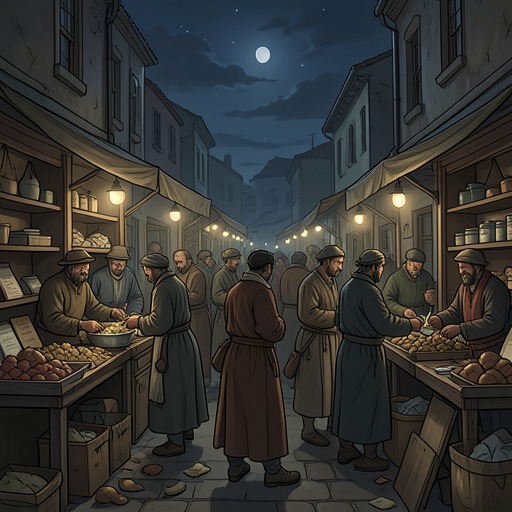
The new economic policy produces another uneasy mixture. Private enterprise is again permitted within narrow limits, and modest trade resumes, but the transactions described are petty and repetitive rather than productive. Goods are resold again and again, speculation accompanies the small deals, and fortunes are made without relieving the city’s squalor. A few owners of private libraries gather their books and obtain an empty former shop to run a cooperative bookshop, offering a fragile cultural use for premises abandoned since the revolution. These contrasting forms of urban survival—futile resale and the pooling of books—show how Moscow’s people adapt to limited opportunities without mistaking economic activity for renewed prosperity.
The city as a measure of upheaval
Moscow’s recurring settings make historical change tangible at different scales. At home, a room holds the music and books of the Gromekos or the papers of Vedeniapin; at work, the dressmaking shop sustains women’s labor beside the railway’s depots and lodgings; in hospitals, overcrowded passages testify to the movement of the wounded; and at the stations, conscripts and returning soldiers embody upheaval in the city’s streets. None of these settings stands apart from the others. Domestic comfort depends on a city’s social and cultural life, while war and political measures alter who can remain in a household, who must travel, and what can be bought or preserved.
The capital’s changes are especially visible in the contrast between the Gromeko home and Yurii’s return. The carefully arranged rooms, family library, and chamber music of his childhood establish a world of cultivation and relative security. Years later, he reappears in Moscow in worn clothes, accompanied by a peasant boy, while the city’s economy is reduced to narrow trade and its families are divided by deportation. Yet the bookshop formed from several private libraries suggests a continuity of shared intellectual life, even in the diminished city. Moscow’s significance lies in this tension: it holds the remembered possibility of home while showing how war, revolution, exile, and poverty have altered the conditions under which home can exist.