Pamphil Palykh
Doctor ZhivagoPamphil Palykh is a former private in the Tsarist army and a partisan whose reputation for revolutionary harshness turns into a history of fear, remorse, and devastating violence against his own family. The doctor identifies him as a case of psychic illness bound to the upheavals of the time: Palykh fears that if he is killed, his wife and children will fall into the hands of the Whites. When they draw near the partisan camp, the prospect he has dreaded becomes unbearable, and he kills them. His story tests the boundary between political conviction and private life, showing how a man once prized as an embodiment of class militancy becomes trapped by the violence he has helped make ordinary.
Identity and Revolutionary Reputation
Palykh had served in the Tsarist army and joined the partisans after the revolution. The doctor describes him as a former private with a highly developed class instinct and a deep commitment to the revolution. But the same commitment was associated with extreme measures: Palykh had favored harshness and executions, and the doctor remembers finding him repellent. The contrast between devotion and cruelty is part of the character’s defining tension, not a late change in allegiance.
The narrative places that reputation within a political history. Early in the revolution, educated left-wing activists feared that upheaval might remain an episode confined to the upper classes, leaving the deeper layers of society untouched. They therefore sought to spread revolutionary propaganda and intensify popular anger. Men like Palykh, already consumed by hatred of intellectuals, officers, and the gentry, were welcomed as valuable evidence of revolutionary instinct. Their barbarity could be mistaken for firmness and their inhumanity for class consciousness. Partisan chiefs and Party leaders esteemed Palykh for precisely the traits that Yurii Andreievich sees as signs of a narrow and damaged character.
The doctor’s first account calls him a complex case, not simply a political type. Palykh’s anxiety centers on what would happen to his family if he died and they were left exposed to the Whites. The doctor believes the family is among those traveling toward the camp, but lacks enough Russian to examine Palykh properly and proposes that Angelar or Kamennodvorsky help question him. Political reputation and psychological distress thus enter the narrative together: the man celebrated for directing violence outward is also consumed by an imagined threat to those closest to him.
The Doctor’s Conversation with Palykh
As the families approach, Yurii Andreievich visits Palykh and finds him preparing for their arrival. Palykh has cut birch saplings to make roof joints for his tent, which he says is too low and lets in rain. He calls his wife and children his dear guests. The doctor warns him that civilians are unlikely to be allowed to live inside the camp and may have to stay by the wagons outside. This practical limit sharpens the question at the heart of Palykh’s anxiety: being near his family will not mean being able to shelter them from danger.
The two sit on the cut saplings, and Palykh begins recounting his life. He recalls a young marriage, his wife’s care of the household, his own fieldwork, and the children they had together. Conscription took him from that domestic life into war; the revolution then changed his understanding of who the enemy was. In his account, soldiers turned away from fighting the Germans and were urged instead to return home and confront the bourgeoisie. He later joined the partisans. The sequence connects family, military service, and revolutionary violence without suggesting that Palykh’s later actions were inevitable: the life he remembers as an ordinary one is now divided by successive wars and political upheavals.
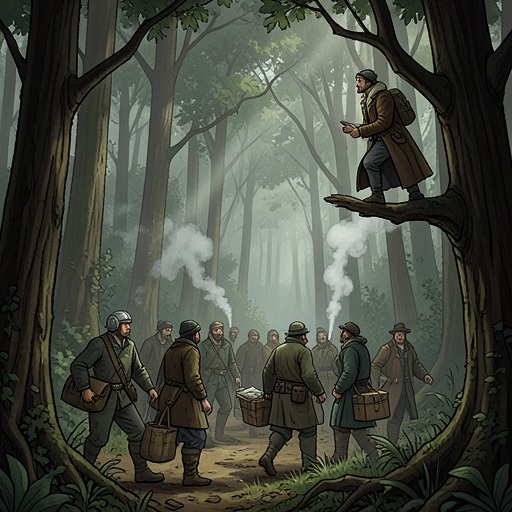
Palykh explains that he fears the partisans are about to be surrounded by enemy forces. His military experience informs the alarm, but his apprehension is not only strategic. Earlier, he confesses to having killed many officers and bourgeois victims without remembering their names or numbers. One death remains distinct: a young cadet who came to address mutinous soldiers during the February Revolution under Kerensky. The cadet climbed onto a water butt on a railway platform to urge the men to continue fighting. When he fell into it, Palykh laughed and then shot him. He says he cannot understand how he did it, describing the killing as if something had pushed him.
That memory unsettles the image of Palykh as a man who can absorb violence without consequence. He claims that most of the deaths he caused left no lasting trace in his memory, yet this one has stayed with him. The episode began in ridicule rather than political calculation, and his later inability to explain his action sits uneasily beside his reputation for deliberate harshness. His confession does not erase responsibility; it shows that even he cannot make his past violence fully coherent to himself.
Family, Fear, and the Camp
The doctor’s concern gives Palykh’s fear a specific context. The families of the partisans are expected to reach the camp within two days. The partisans are preparing to welcome them and then move on. For Palykh, the approaching reunion intensifies the possibility that his wife and children could be left exposed if he is killed. His efforts to prepare the tent suggest a straightforward wish to receive them, but the camp’s rules and the danger surrounding it place limits on what he can provide.
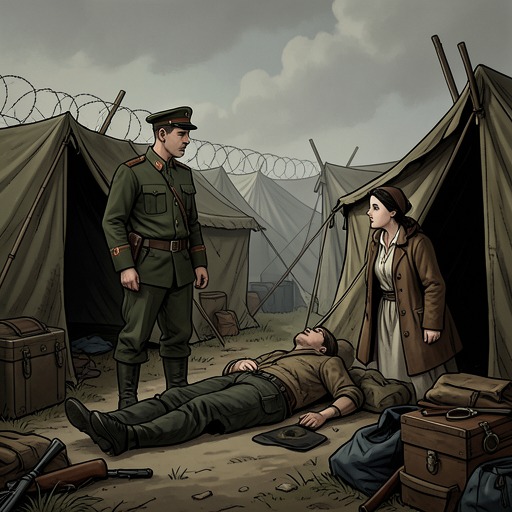
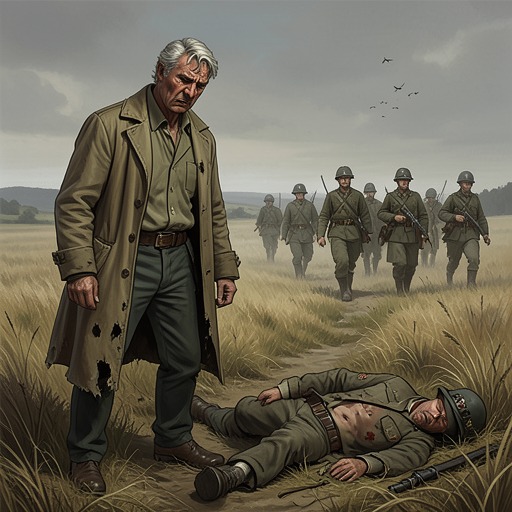
After a terrible incident elsewhere in the camp, Palykh has seen the dying man and read a threatening inscription. His fear for his own family rises to a new climax. He imagines them being handed over to torture and cannot bear the future he pictures for them. The narration presents this as the immediate cause of his act, while making clear that his imagined catastrophe is not the same as an actual attack on his family. In desperate anguish, he kills his wife and their three children with the same sharp ax he had used to carve toys for them. The object’s two uses make the reversal unmistakable: a tool associated with making small gifts becomes the instrument of the destruction he claims to fear.
Breakdown and Narrative Significance
Palykh does not kill himself immediately afterward. The doctor, Liberius, and members of the army soviet debate what should be done, while Palykh remains at liberty in the camp. He walks with his head bowed and an expression of suffering that does not lift. His continued existence after the murders leaves the story without a simple resolution: the people he feared losing are dead by his hand, and the account offers no recovery or consolation.
Palykh’s trajectory exposes the peril of treating cruelty as proof of political clarity. A man once valued by revolutionary leaders for his hatred of class enemies has learned to understand danger through violence, yet cannot control the terror he feels for his own family. The story does not equate his private motive with innocence; instead, it places his responsibility beside the historical and political climate that praised his brutality. His feared future for his family becomes a catastrophe he himself brings about, turning protection into its opposite and leaving the distance between revolutionary slogans and lived human consequences starkly visible.