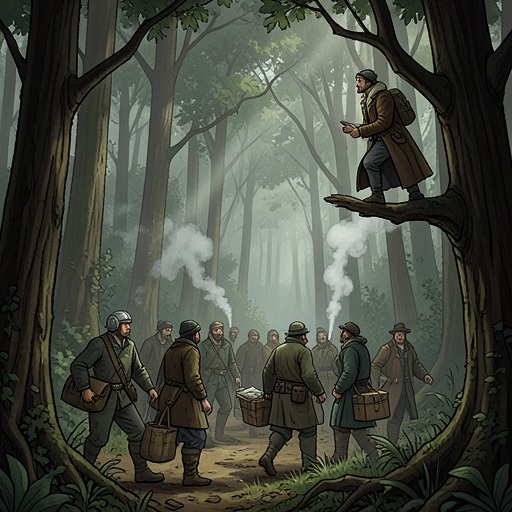
Pamphil Palykh’s murder of his family
Doctor ZhivagoPamphil Palykh’s murder of his family is a wartime catastrophe in which fear for his loved ones turns into the reason he kills them. After hearing a dying man describe the violence inflicted on captives, Pamphil imagines his wife and three children suffering the same fate if he himself were to die. In desperate anguish, he kills them with the sharp ax he had used to carve their toys; afterward, he remains alive, wanders the camp in an unmistakable state of mental collapse, and vanishes before dawn.
The Warning That Triggers the Crisis
The episode follows a dying man’s account of being held with more than forty others in a freight car and subjected to torture. He speaks of women and children before dying without finishing his sentence. Those gathered around him understand that he is dead, remove their caps, and cross themselves. The narrative then reports that news of a still more terrible incident spreads through the camp that night: Pamphil had been among the listeners, had heard the man’s words, and had read the threatening inscription on a board.
The account does not establish that the threatened violence has reached Pamphil’s family. Instead, it shows how the report becomes a source of overwhelming anticipation. Pamphil’s persistent fear about what would happen to his family if he died rises to a new climax. In his imagination, he sees them handed over to torture and hears their cries for help. The account links this imagined future directly to his desperate decision, without presenting it as a response to an attack on them that has already occurred.
The Killing and Its Means
Pamphil kills his wife and all three of his children, acting, as the narrative explains, both to forestall the suffering he fears for them and to end his own anguish. The same sharp ax he uses had once served a tender domestic purpose: he carved toys for the two little girls and the boy, who had been his favorite. That reversal is central to the episode. An object associated with making playthings for his children becomes the instrument of their deaths, joining familial attachment and lethal violence in a single terrible act.
The narration identifies the act as a case of insanity and stresses its shocking aftermath: Pamphil does not kill himself immediately. It leaves his thoughts and intentions unanswered rather than supplying a further plan or motive. The account’s explanation remains tied to the crisis it has described—his fear for his family, intensified by the dying man’s words—and does not claim that the family’s fate was otherwise determined.
Aftermath in the Camp
While Liberius, the doctor, and members of the army soviet debate what should be done, Pamphil moves freely around the camp. He keeps his head lowered, his gaze unfocused, and an expression of suffering on his face. The other people avoid him; some call for him to be lynched, but those suggestions are not followed. The camp’s response thus combines recognition of his extreme disturbance with fear and hostility, without resolving what should happen to him.
At dawn, Pamphil disappears. The narration presents his departure as an escape from himself, not as a new destination or a return to safety. His vanishing leaves the immediate aftermath unresolved: the deliberation over his fate has not concluded, and the family he feared losing has been killed by his own hand.
Narrative Significance
The episode places private family tragedy inside a world where reports of violence make even an imagined future seem unbearable. The dying man’s testimony reaches Pamphil as a warning, but its effect is not protective: it magnifies his fear until he treats killing his family as a way to spare them from what he imagines. The account distinguishes the reported threat from the terrible act that follows, showing how anticipation itself becomes destructive.
The ax sharpens that tragic reversal. It carries the memory of Pamphil’s ordinary care for his children, yet the same tool is used in the act that destroys the household. His survival, wandering, and dawn disappearance then extend the catastrophe beyond the moment of the killing. The event leaves not an explanation that makes the act comprehensible or justifiable, but a portrait of fear collapsing into violence and of a camp unable to settle what to do with the man who remains.