Partisan policy of excluding and relocating civilians’ families from camp
Doctor ZhivagoThe Partisan policy of excluding and relocating civilians’ families from camp treats the presence of wives and children as a threat to military discipline and seeks to move them away from the partisan encampment. Its stated logic of order has immediate human consequences: separation revives Pamphil’s anguish, while the wider refugee crisis exposes how little control the camp command has over people fleeing the war.
The rule and its human cost
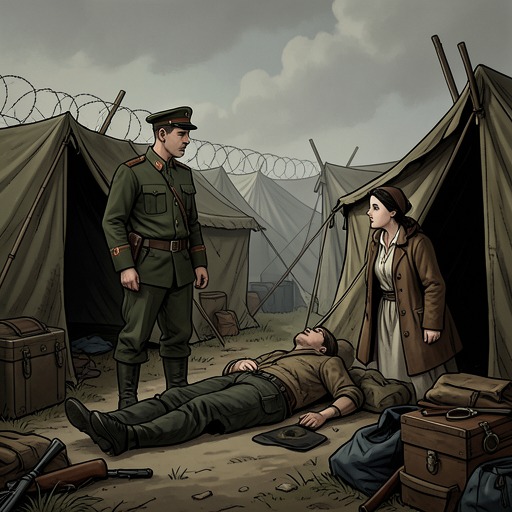
When Yurii Andreievich visits Pamphil, he finds him cutting birch saplings to raise the roof of his tent against the rain. Pamphil explains that he is preparing it for his wife and children. The doctor warns that civilians—women and children—will not be allowed to live inside the camp; they will have to stay with the wagons outside, where Pamphil can visit them in his spare time. The rule is presented as a boundary between the armed camp and civilian life, but it makes family intimacy conditional on permission and leaves dependents physically beyond the camp’s shelter.
The cost of that boundary becomes explicit after Pamphil’s family arrives. His wife and children have spent the summer fleeing along dusty roads under the open sky. The children bear the sun and hardship on their faces, while fear and strain have hardened their mother’s expression. Pamphil, who is devoted to them and carves small animals from wood for the children, begins to recover in their presence. News that families are considered bad for discipline and may be sent under escort to winter quarters some distance from camp reverses that improvement: his spirits fall, and his hallucinations return.
Relocation amid the refugee crisis
The proposed removal of the families is discussed more than it is prepared, and the doctor doubts that it will actually be carried out. Yet even as an uncertain plan, it exerts force. The possibility of separation is enough to worsen Pamphil’s condition; the policy therefore operates not only through an accomplished transfer but through the threat of one.
After the partisans break through the Whites’ encirclement, refugees pour toward the camp. The influx includes surrounding peasants driven from their homes by punitive measures, who seek the partisans as protectors. But a camp intent on getting rid of its own dependents has no room for these newcomers. Its men are sent to turn them aside and direct them to Dvory, a village by the Chilimka River, where the refugees are supposed to spend the winter and receive allotted supplies. Relocation is thus the command’s answer to both its existing families and the larger population seeking refuge: civilians are to be accommodated elsewhere, not within the armed camp.
Limits of command and narrative significance
The plan meets the disorder of displacement. The breach in the White positions closes, leaving the partisan unit that crossed it unable to return to the taiga. Meanwhile, the women refugees evade the men sent to turn them back. Because the taiga makes it easy to lose one’s way, the search parties often miss them; the women press into the forest, cut trees, build roads and bridges, and display resourcefulness on a scale that frustrates the command.
Their actions work havoc with Liberius’s plan. The policy’s practical contradiction is stark: the camp tries to exclude and redirect civilians in the name of discipline, yet war continually drives more people toward it, and those people move according to their own needs rather than the command’s design. The episodes make relocation less a settled administrative solution than a contested effort to control the boundary between combatants and civilians—one whose pressure falls most heavily on families already made vulnerable by flight.