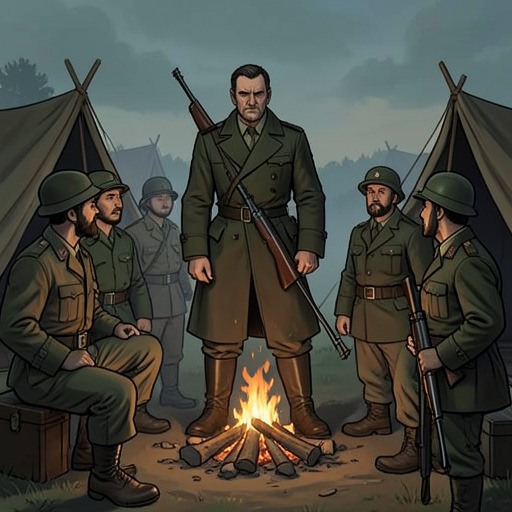
Pavel Antipov’s capture
Doctor ZhivagoPavel Antipov’s capture turns a battlefield disappearance into a prolonged uncertainty for his comrades and his wife, Larisa Feodorovna Antipova. During an assault in which his platoon is cut off and forced to surrender, Antipov is taken prisoner; because the bombardment obscures what happened, those watching from an observation post believe he has been killed. The false report and its later correction make the capture a story not only of military defeat, but of how war separates people from reliable knowledge of one another.
The assault and capture
The attack begins with Antipov leading his men across an open field toward the enemy trenches. They move at a run, sometimes dropping to the ground together before pressing forward again. From an observation post, his friend Lieutenant Osip Galiullin watches the advance and initially calls for the artillery battery, then decides against it. Once the attackers are near the enemy, the barrage stops; German shells burst in front of them, and clouds of dust and smoke conceal what follows. Believing Antipov and his men have been killed, Galiullin withdraws with the other observers when another shell lands near their position.
The actual outcome is not death. Russian forces have broken through the enemy line south of the village where Galiullin is stationed, and supporting units follow into the gap. But the advance parties become isolated as those behind them fall back from the pace of the attack. Antipov’s platoon is surrounded, and when it surrenders he is obliged to give himself up as well. The capture is thus the consequence of a breakthrough that cannot be sustained: forward movement leaves the leading soldiers exposed and cut off.
The mistaken report and its aftermath
The smoke and the apparent destruction of the assault give rise to a false account: Antipov is said to have been killed by a shell and buried in the explosion. The report is attributed to Galiullin, who had watched Antipov lead the attack through field glasses. It is not a deliberate deception at first; Galiullin has seen the bombardment, lost sight of the unit, and concluded that no one could have survived.
After Antipov’s comrades accept the presumed death, Galiullin is asked to take charge of his belongings and keep them for his widow. Among the effects are many photographs of her. This practical duty preserves a link between the missing officer and his wife, even while his fate remains misunderstood. The photographs make the uncertainty personal: the objects entrusted to Galiullin are not merely a soldier’s possessions but evidence of a marriage awaiting news.
The truth reaches Larisa
Later, in a hospital ward, Galiullin recognizes Larisa Feodorovna Antipova when she comes on her first round as a nurse. She does not initially recognize him, and neither Galiullin nor Yurii Andreievich Zhivago realizes at first that the two patients and the nurse are connected through Antipov. Galiullin tells her that he knew her husband and has kept his things for her. She expects confirmation of the story she has heard—that Antipov was killed by a shell and buried in the blast—and asks him to explain how it happened.
Galiullin cannot bring himself to tell her the truth at once. He first chooses what he regards as a comforting lie, saying that Antipov was taken prisoner after advancing too far with his unit, being surrounded and cut off, and forced to surrender. The account is, in fact, true, though Galiullin presents it as reassurance rather than as a correction grounded in certainty. Larisa does not believe him. Shaken by the meeting and unwilling to break down in front of strangers, she leaves the ward; when she returns, she avoids looking at Galiullin and turns to Zhivago instead.
Significance
The episode sets the uncertainty of wartime communication against the apparent clarity of a battlefield report. Galiullin’s observation is vivid but incomplete: he sees Antipov lead the attack and sees shells hide its outcome, yet the resulting assumption of death proves wrong. The later hospital encounter reveals how a mistaken battlefield conclusion can travel into a marriage and shape a widow’s understanding of her future.
Capture also reverses the meaning of the belongings Galiullin has guarded. They were entrusted to him as remnants of a presumed dead man’s life; when he meets Larisa, they become the tangible thread connecting her to a husband who is alive but absent. The scene does not resolve that separation. It replaces the certainty of reported death with the harsher uncertainty of captivity, leaving Antipov’s fate beyond the immediate knowledge of both his friend and his wife.