Rowan tree imagery
Doctor ZhivagoRowan tree imagery gathers the novel’s scenes of shelter, longing, and departure around one tree at the edge of the partisans’ camp. The rowan first appears as a vivid natural presence in the autumn taiga; later, Kubarikha’s song turns it into a messenger for a captive soldier, and in winter Yurii Andreievich Zhivago addresses it while preparing to leave. Across these appearances, the tree connects the life of the forest to human separation without dissolving the difference between them.
The tree at the camp boundary
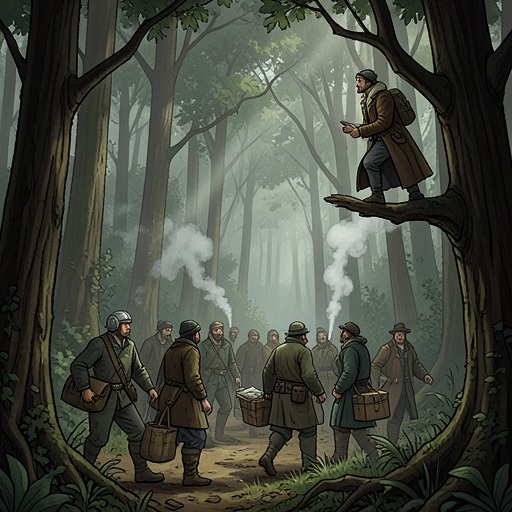
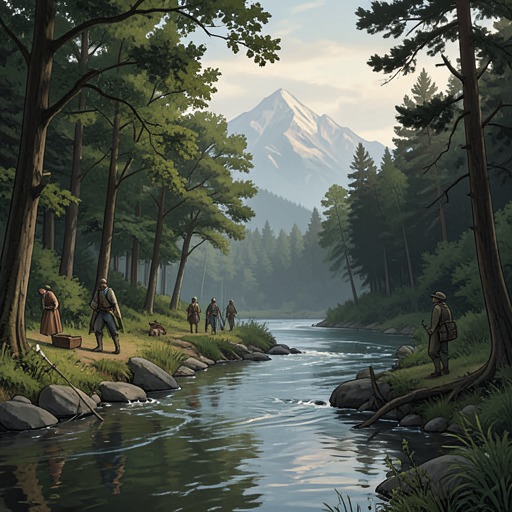
At the partisans’ new campground, the taiga is dense enough to disorient Yurii, who has explored it while the tents were being pitched. One of the places that stays in his memory lies just beyond camp: an isolated rowan stands on a mound above low, wet marshland. The surrounding forest is bare, making the tree’s leaves and berries conspicuous against the late-autumn sky. Its position at the boundary gives it a double character: it belongs to the immense forest, yet can be seen from the footpath and clearing beside the human encampment.
Small birds settle among its branches to eat the largest berries. The narration describes their relation to the tree as an intimacy that has lasted a long time: the tree seems at last to yield its fruit as a nurse feeds a child. This image makes the rowan more than a striking marker in the landscape. It figures natural sustenance as an act of care, while keeping that care rooted in the ordinary relation between birds and berries. The tree does not speak; its imagined generosity is the human meaning given to what it provides.
The episode also sets the tree against another remembered place in the taiga: an escarpment where the forest seems to continue below itself, as if an entire stretch of trees had fallen to a lower level. That uncanny repetition makes the forest feel vast and unstable. By contrast, the rowan offers a singular, recognizable point at the camp’s edge, one that can recur in memory and later guide a more personal encounter.
Kubarikha’s song and the absent home
At dusk, near the rowan and the mound marking the campground boundary, Yurii hears Kubarikha singing. After a lively song has drawn listeners and laughter, she sings more softly, apparently believing herself alone. The song she half sings and half recites tells of a hare afraid of a wolf and appeals to a rowan bush not to surrender its beauty to a wicked enemy. It asks the tree to scatter its red berries across the snow and carry them to a distant town, to the last house in a street, where the singer’s grieving bride waits.
The song identifies its speaker as a soldier held captive in foreign parts, homesick and longing to break free and return to his beloved. The rowan’s berries thus become an imagined means of crossing the distance between captivity and home. The repeated movement from the wide world to the town, then to the last house and its window, gives the longing a narrowing destination: not merely a country or a place, but a particular person waiting inside a particular room.
The narration describes the old Russian song as seeming still on the surface while rushing underneath, gradually unfolding its theme through repetitions and comparisons before revealing its sorrow. It calls the song an attempt to stop time with words. In this context, the rowan’s appeal belongs to the song’s effort to keep separation from becoming final: the berries cannot literally carry the soldier home, but the verse gives longing a route and a voice.
Winter return and departure
When the season has turned and snow covers the path, Yurii comes back to the tree. He has just spoken its name. Half buried in snow and frozen leaves and berries, it extends two white branches toward him. The sight recalls Lara’s strong white arms; he seizes the branches and pulls them toward himself, and the tree shakes snow over him. The scene makes the earlier image of the tree feeding birds return in altered form: now it is Yurii who reaches toward it, prompted by a memory of an absent woman.
Beside the tree, Yurii speaks without realizing what he is saying, addressing it as his beloved and as his own flesh and blood. The words collapse distinctions between beloved, tree, and intimate kinship, but the scene’s action remains concrete: he grasps the branches, receives the falling snow, and then continues into the taiga. Under a clear full moon, he goes to a marked tree, retrieves his belongings, and leaves the camp. The rowan is therefore not simply a symbol of refuge. It stands at the threshold of his departure, holding together a remembered landscape and a love he cannot reach in that moment.
Recurrence and significance
The rowan’s appearances develop through changes in season and relation. In autumn, its berries sustain birds; in Kubarikha’s song, red berries are imagined as a message sent toward a captive’s home; in winter, snow-covered branches draw Yurii into a memory of Lara. Each return shifts the tree from visible landmark to figure of care, then to a mediator of longing. The transitions do not make nature an uncomplicated answer to human suffering: the soldier remains captive in the song, and Yurii leaves the camp rather than finding Lara there.
Instead, the image gives separate experiences a shared form. The birds receive nourishment from the tree; the song’s speaker asks it to carry a message; Yurii addresses it while recalling someone absent. Its berries and branches make connection imaginable across distance, while the changing seasons keep loss and time in view. Positioned beside the camp and the path into the taiga, the rowan becomes a meeting point between human life and the forest, and a remembered point of orientation at the moment Yurii departs.