Russian Army
Doctor ZhivagoThe Russian Army enters this account not as a stable institution but as a force in retreat, increasingly unable to protect its positions, care for its wounded, or sustain the loyalties on which military life depends. Its reverses reshape the work of hospitals, scatter soldiers and civilians, and prepare the ground for a revolution born of wartime experience rather than intellectual theory alone.
Retreat and the changing front
By the second autumn of the war, the early military successes had given way to reverses. The Russian Army was evacuating Galicia, which it had occupied in the first months of fighting. Brusilov's Eighth Army, massed in the Carpathians in readiness to move down into Hungary, was instead drawn into the general retreat. The altered direction of the campaign is presented as more than a change of position: it marks the failure of the confidence with which the war had begun.
The front remained fluid and perilous. Near the village where Gordon arrived, Russian forces broke through enemy positions, and supporting units followed, widening the gap. But those supports fell behind; the advance units were cut off and captured. Lieutenant Antipov was among the prisoners, compelled to surrender when his platoon gave itself up. The movement forward thus turned abruptly into encirclement and loss, while the distance between a military report and a soldier’s fate was exposed by the false rumor that Antipov had been killed by a shell.
Combat and the cost of battle
Galiullin watched Antipov’s attack from an observation post. The assault crossed an autumn field toward the enemy trenches, with soldiers advancing, stopping, and running again under fire. The account gives the attack a collective rhythm: the men move together, but those struck down fall separately, and do not rise with the rest. As the troops neared the enemy, the artillery barrage stopped; two large German shells then burst in front of them, and smoke hid what followed. Galiullin believed the lieutenant and his men were finished. The scene makes clear how little an observer could know in the instant when battle turned into apparent annihilation—and how readily that uncertainty could become a report of death.
The strain continued behind the line. At a first-aid station set up in a forester’s house and nearby tents, ammunition carts brought wounded men from the battlefield during a brief pause in artillery fire. The carts were not designed to carry the wounded, and their jolting journey compounded the urgency of their condition. Many had been collected only half an hour earlier; about half were unconscious. Orderlies unloaded them on stretchers while the staff hurried to bandage them and operate on the most urgent cases. Military movement, makeshift transport, and medical triage had become parts of the same system of attrition.
The Moscow hospitals were also overwhelmed. After the battle of Lutsk, wounded men filled passages and landings, and the pressure was beginning to affect the women’s wards. A truck with two trailers arrived at the hospital entrance carrying more wounded. The Army’s casualties therefore extended well beyond the battlefield: they entered civilian spaces and disrupted the ordinary work of medical institutions, even far from the front.
Hospitals on the move
Military defeat repeatedly forced the medical service to abandon one place for another. When the Army was again hard-pressed and beaten, all medical units received orders to move east. Zhivago, serving as a doctor, told his family that they might leave the following day or the day after, though he did not know their destination. He described the recurrent dislocation of army life: people became accustomed to a place just as orders sent them elsewhere. Even a room whose defects had first seemed unbearable could become familiar enough to feel like home once departure was imminent.
The retreat could become immediate and dangerous. During the night, gunfire and commotion woke the occupants of the village; Zhivago learned that German forces had broken through. The village was under fire, and the hospital began moving at once, without waiting for an evacuation order. He arranged for Gordon to leave with the first party, then accompanied him through streets where they kept close to the walls as bullets passed and shrapnel burst over the fields. The medical unit’s flight was not a planned transfer but a response to a collapsing front.
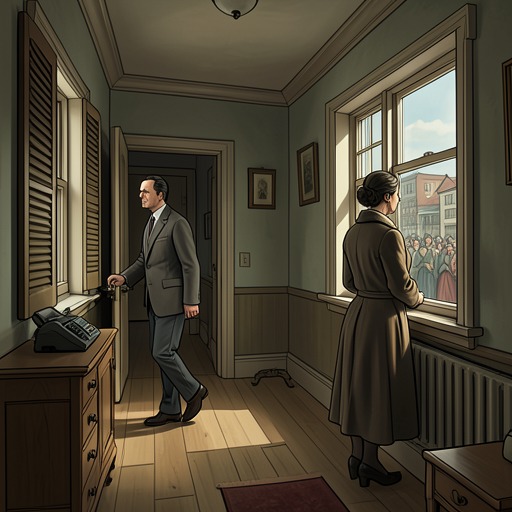
This repeated movement joined military defeat to domestic and professional upheaval. Doctors and nurses could not hold a settled post; patients had to be transferred amid danger; and even those seeking relatives found themselves carried along by the machinery of the war. A Red Cross train, funded by voluntary contributions collected by the Tatiana Committee for Aid to the Wounded, brought Gordon into the region behind the lines. Its passengers included prominent people from Moscow carrying gifts for the troops, while travel itself depended on permits and unreliable estimates of distance. The train’s charitable purpose and improvised journey show the civilian effort gathered around an Army whose needs had outgrown ordinary arrangements.
From military duty to revolution
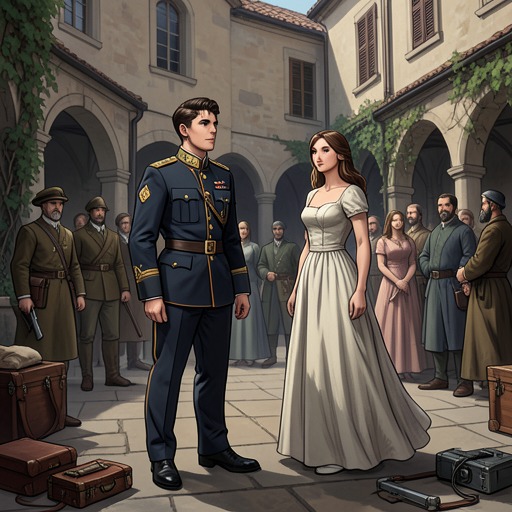
The collapse of the Army’s authority also altered the moral language through which its members understood duty. Lara, serving as a nurse while searching for Pasha, noticed that obligations once treated as sacred—to country, Army, and society—had lost their force now that the war was lost. The change left no trusted authority to replace them. She thought that a person might need to commit herself instead to something absolute, such as life, truth, or beauty; for her, the care of Katenka supplied a purpose. The Army’s defeat thus appears not only as a military reversal but as a rupture in the system of collective obligations that had shaped individual lives.
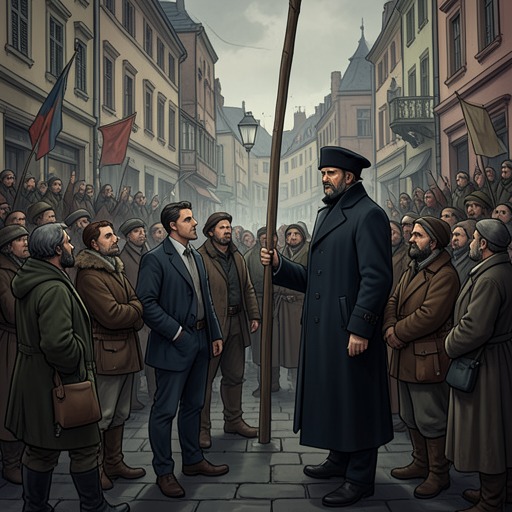
The revolution that follows in Zhivago’s reflections is distinguished from the idealized intellectual revolution of 1905. It is described as a new upheaval, born of the war, bloody and elemental, and led by professional revolutionaries—the Bolsheviks—while rooted in the soldiers’ revolution. The sequence places the Army’s reverses, suffering, and loss of shared purpose within the conditions that made political upheaval possible. Military collapse does not simply precede the revolution as background; it changes how people understand authority, solidarity, and the possibility of continuing to fight.
A scattered military society
The Army’s disintegration is also visible in the mixed population carried by wartime trains. In one twenty-three-car train, the Zhivagos travelled in the fourteenth car; sailors occupied the front, civilian passengers the middle, and labor conscripts eight cars at the rear. There were about five hundred conscripts, drawn from sharply different ages, professions, and social conditions. Lawyers and stockbrokers travelled alongside cab drivers, floor polishers, bath attendants, Tartar ragpickers, escaped lunatics, shopkeepers, and monks, all grouped together as members of the exploiting classes.
The contrast among these passengers exposed unequal access to safety. Lawyers and stockbrokers sat around hot stoves, told stories, and laughed; they were unworried because they had influential relatives and connections, and believed they could buy their way out if necessary. Their confidence contrasts with the wider wartime displacement around them. The train makes visible a society reorganized by military and political compulsion: people who would not ordinarily share a space were gathered into the same moving system, but not with equal resources or equal freedom.
Across these episodes, the Russian Army is defined by motion that no longer signifies advance: retreat from occupied territory, units cut off after a breakthrough, wounded men carried from the front, hospitals ordered east, and civilians and conscripts packed into trains. The institution’s weakening is registered through the practical details of transport and care as much as through battlefield outcomes. Its failure to maintain a stable front or a settled order helps explain why the war becomes, for the characters, a force that remakes work, family life, moral obligation, and political belief.