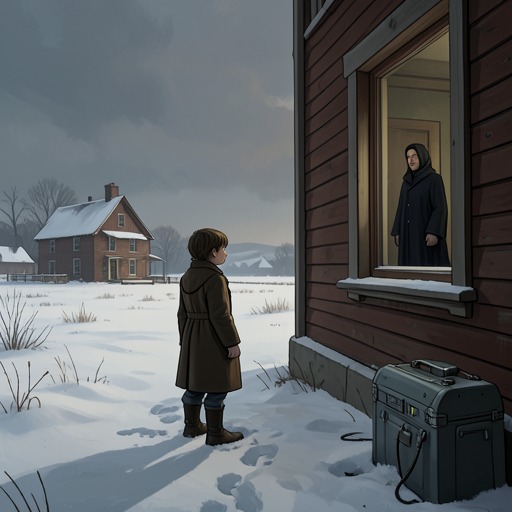
Tania's escape from Nagornaia
Doctor ZhivagoTania’s escape from Nagornaia is a story of childhood bereavement transformed into urgent self-rescue: after a robber kills her father and her little brother, she halts a passing train to bring help, then boards it and leaves her former life behind. Recounted years later to Misha Gordon and Innokentii Dudorov, the episode explains both the violence behind Tania’s childhood and the freedom she associates with having survived it.
Background and the return to the signal station
Tania’s story begins in the period of the New Economic Policy, when money had lost much of its value. Her Uncle Vasia sells a cow and brings home two sacks of banknotes. After drinking, he boasts in Nagornaia about the money. The boast gives a stranger a target: when Vasia takes an old woman to a county hospital eleven miles away, the stranger follows the household’s trail back to the signal station.
The old woman had arrived in pain, asking to be taken to hospital and offering to pay. Vasia harnesses Udaloy, the horse, and drives her there. Later, Tania and Aunt Marfa hear the horse and cart return sooner than expected. Marfa opens the door before Vasia can knock, but the visitor is a stranger. He says that he has killed Vasia in the wood and demands the money from the cow sale, threatening the women if they do not tell him where it is.
Marfa’s cellar trap and its reversal
The robber’s announcement leaves Tania and Marfa terrified. Marfa, who has just learned that her husband is dead, conceals her distress and first begs for mercy, denying that she knows anything about the money. She then claims it is in the cellar and offers to open the trapdoor. The robber suspects a trick and insists that Marfa go down herself. She says her legs are bad and proposes that Tania accompany him instead.
Tania thinks she is about to die. But the robber does not take her: he sees that Marfa is not her mother and grabs little Petia, carrying him into the cellar as he goes down the ladder. Marfa slams the trapdoor, locks it, and helps Tania drag a heavy trunk over it. Her action reverses the immediate balance of power, confining the robber below, but it also traps Petia with him. The robber pounds on the floor and threatens the child; Marfa remains seated on the trunk, apparently unable to understand what is happening. Tania screams at her to open the cellar and save Petia, but cannot move her.
Tania later remembers Petia’s cries and says the robber choked him to death below. The attempted rescue has become a second catastrophe: the cellar door keeps the murderer from reaching the women, but Marfa’s disordered state prevents her from responding to the danger to the child. Tania is left with an armed danger in the house, a dead brother below, and an aunt who can no longer be relied on to act.
The train as rescue
Near dawn, Tania hears Udaloy neighing outside. She imagines the horse urging her to leave and find help, then recognizes the whistle of the pusher engine kept ready at Nagornaia to help freight trains up the hill. The train is passing at its usual time, and Tania takes its sound as an opportunity. There is little time to consider what to do: she grabs a lantern, runs to the track, and stands between the rails, waving the light.
Because of the headwind, the train is moving slowly. Tania brings it to a stop, and the driver, who knows her, leans from the cab. She calls out that the signal house has been raided and that there has been murder and robbery. Red Army men jump down from the army train to find out why it has stopped on the steep, wooded hill. Tania tells them what happened; her appeal converts a passing train from a means of departure into immediate help.
The soldiers drag the murderer out of the cellar. He pleads for mercy, but they take the law into their own hands: they tie his hands and feet to the rails and drive the train over him. His death ends the immediate threat, though it cannot undo the deaths in the household. Tania does not return for her clothes. Still frightened, she asks to be taken along and is put on the train.
Flight and unresolved aftermath
Tania says that after leaving Nagornaia she wandered across much of her own country and other places with homeless children. She remembers the later freedom against the suffering of her childhood, but does not present that freedom as uncomplicated: she also acknowledges that the years brought sin and misery, leaving those experiences for another time.
The story closes not with a settled account of the household but with competing reports about Marfa. A railway official gets off the train that night to take charge of government property and decide what should be done with her. Some people say that she never recovered and died in a madhouse; others say that she improved and was released. Tania’s escape is therefore decisive for her own survival, but the fate of the aunt who helped create the cellar trap remains uncertain.
Retelling and significance
Tania tells the episode retrospectively, addressing her listeners directly and repeatedly returning to the terror and loss of that night. The narrative is structured around a succession of reversals: the apparently routine return of the cart brings a murderer rather than Vasia; Marfa’s trap confines the attacker but endangers Petia; and the familiar railway whistle becomes the signal for Tania to summon help and leave. Her account gives her escape a concrete, practical agency: she acts not through force against the robber, but by recognizing the passing train as a chance to bring rescuers to the house.
The aftermath also places the episode within a longer history of displacement. Tania’s train journey is an abrupt departure from home, and her later wandering with homeless children follows from that break. When Gordon and Dudorov hear the story, they remain silent for a long time before a truck arrives and crates are loaded. Gordon then asks whether they realize who Tania is, framing the tale as a disclosure that changes how her listeners understand her identity. The episode thus connects a private family catastrophe to the adult Tania whose story they have just heard, without resolving every secret surrounding her past.