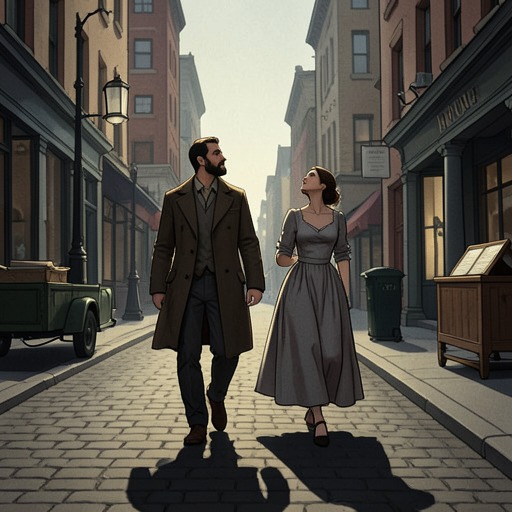
The Arbat
Doctor ZhivagoThe Arbat is a Moscow district transformed by upheaval: its streets remain routes through everyday life, yet demolition and scarcity make the familiar city difficult to recognize. Yurii Andreievich Zhivago crosses it on his way through the stricken capital, and there he finds and rescues a wounded man whose later protection becomes consequential in his own life.
Streets in a Changing City
As the cab carries Yurii Andreievich Zhivago home, it turns from a square into one of the narrow streets opening off it. An empty cart drawn by a draft horse clatters ahead, raising pillars of dust in the low sun. Once the cab passes it and picks up speed, the doctor sees old newspapers and posters torn from walls and fences and scattered over the sidewalks and streets. Wind, hooves, wheels, and pedestrians seem to push the loose paper in different directions. The debris makes the district a visible record of disruption, while the journey ends at the house where Antonina Alexandrovna is waiting; their anxious reunion gives the passage through the unsettled streets an intimate destination.
The Arbat is also part of Zhivago’s ordinary daily geography. He most often sees the sky and the people while crossing it at the corner of Old Coachyard Row, near the pharmacy of the Russian Medical Society. That vantage point places him amid the city rather than apart from it: even as he feels unable to affect the immense forces remaking the future, he continues to encounter Moscow through its streets and inhabitants.
Familiar Ground Made Strange
The district’s physical changes unsettle long familiarity. A resident describes an old woman who makes a business of buying whole houses to use as fuel; as fences come down, places once hidden behind them are exposed. Streets that had been known stone by stone become hard to navigate, even in daylight, and the neighborhood can feel like a strange town. The change is not simply the loss of landmarks: demolition reveals small, overgrown garden spaces, with round tables and half-rotten benches, previously concealed from view.
This altered urban landscape takes on the character of the woods. In one newly visible wilderness at the intersection of three streets, an old woman searches for mushrooms. The anecdote joins the district’s material destruction to its unexpected return to natural growth: houses are dismantled for fuel, while decaying leaves and mushrooms make the city seem forest-like. The Arbat thus registers revolution through the intimate scale of altered routes, exposed gardens, and new uses for buildings.
Rescue and Its Consequences
One cold, dark night shortly before the October fighting, Zhivago encounters an unconscious man on a sidewalk in the district. The stranger lies with his head against a curbstone and his feet in the gutter; he groans weakly and mutters about a wallet. He has been attacked and robbed, and blood covers his battered head, though the doctor’s examination finds his skull intact.
Zhivago goes to the pharmacy in the Arbat, calls for the cab used by the hospital in emergencies, and takes the man to the emergency ward. The wounded patient proves to be a prominent political leader. Zhivago treats him until he recovers, and the rescue reaches beyond the immediate emergency: for years afterward, the man acts as the doctor’s protector and gets him out of trouble during a period marked by suspicion. The chance encounter makes the Arbat more than a setting of urban change; it is where an act of medical care creates a lasting bond with political consequences.