The refugee women’s crossing of the taiga
Doctor ZhivagoThe refugee women’s crossing of the taiga is a forced migration that turns into an act of collective improvisation—and, in the eyes of the partisans, a strategic danger. Sent away from the camp toward a village that has already been burned, the women refuse the route laid down for them and carve another through the forest. Their passage exposes the gulf between military plans and the survival needs of civilians: what the women build to escape starvation may also provide the enemy with a way into the taiga.
A diversion devised by the camp
After the partisans broke through the White encirclement, refugees poured into the taiga. The newcomers were not all relatives of partisan fighters; peasants from the surrounding countryside had fled White punitive measures and regarded the partisans as their natural protectors. Yet the camp, already anxious to rid itself of its own dependents, had no room for strangers. Its men were therefore ordered to turn the fugitives away and direct them to Dvory, a village on the Chilimka River, where they were supposed to settle for the winter and receive allocated supplies.
The plan depended on a destination that could serve as a refuge. In practice, the camp command could not control the movement of people or events. The women were difficult to find in the vast taiga, and the men sent to redirect them often missed them altogether. At the same time, the partisan unit that had broken through was cut off from returning to the forest when the Whites closed the breach. The refugees’ passage thus unfolded amid a changing military situation, while the command’s attempt to manage the civilians was already failing.
A road cut through the forest
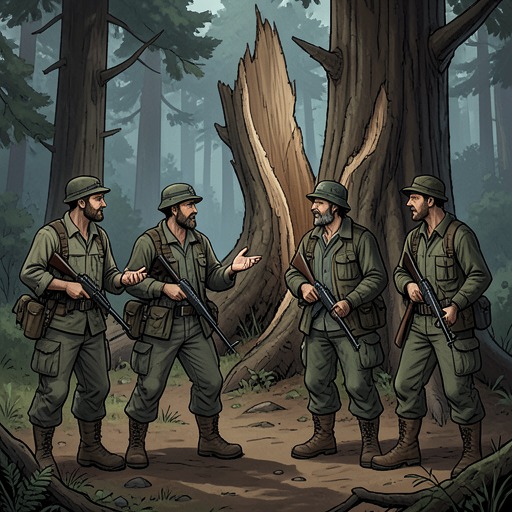
The women did not simply wait for help or accept the detour. Chopping trees, they made roads and bridges through difficult country, displaying a resourcefulness that the narrative pointedly measures against the expectations of the men around them. Their work was at once a means of movement and a challenge to the camp’s authority: they were entering the forest despite orders intended to keep them elsewhere, and in doing so they disrupted the plan devised by Liberius.
The passage also carried a grave human cost. Svirid, sent to meet the women, saw mothers trudge under sacks, bundles, and babies after losing their milk and being driven to desperation by the journey. Some abandoned their children, scattered the corn they had been carrying, and turned back, judging a quick death preferable to starvation on the road or being torn apart by an animal in the forest. Others, described as the strongest, showed courage and self-control that equaled or surpassed that of men. These contrasting responses make the crossing more than an image of triumphant endurance: it is a flight in which ingenuity and courage coexist with exhaustion, hunger, and choices made under unbearable pressure.
Dvory is gone
When the camp’s leaders asked how the newly arrived strangers had disobeyed the order to go to Dvory, the answer revealed why the diversion had collapsed. The village, including its mill, had burned; nothing remained but cinders. Seeing no living thing there, some of the refugees panicked, cried out, and turned back toward the Whites, while others redirected themselves toward the partisan camp. The intended winter settlement had ceased to exist, and the women’s apparent disobedience was inseparable from the absence of the refuge promised to them.
The women crossed swamps and other difficult ground with saws and axes. Some of the men assigned to guard them helped them, and the refugees reportedly cut twenty miles of road, complete with bridges. A partisan response treats this accomplishment not as uncomplicated praise but as a new military problem. The road makes the women’s passage possible, yet it may also create a route through which the Whites can bring artillery into the taiga. The very work that answers an urgent civilian need therefore risks weakening the forest’s defensive barrier.
Civilian survival and military control
The crossing shows how the aims of an armed organization can collide with the immediate necessities of the people it claims to protect. The refugees arrive seeking shelter from the Whites, but the camp’s first response is to move them elsewhere so that it can rid itself of its own dependents. When the designated destination proves burned out, orders cannot supply what survival requires. The women’s road is not a plan issued by the command; it is a practical answer made by people confronting an impassable forest and a failed refuge.
Their collective labor also unsettles gendered assumptions within the military hierarchy. The narrative sets the women’s achievement—twenty miles of road and bridges—against the claim that such work would take the men a long time, while preserving the danger that their effort unintentionally serves the enemy. It neither reduces the women to helpless victims nor turns their resourcefulness into a simple victory. Their crossing is courageous and consequential precisely because it has no safe outcome guaranteed: it brings people toward shelter, disrupts the partisans’ plans, and may open the path for a renewed attack.