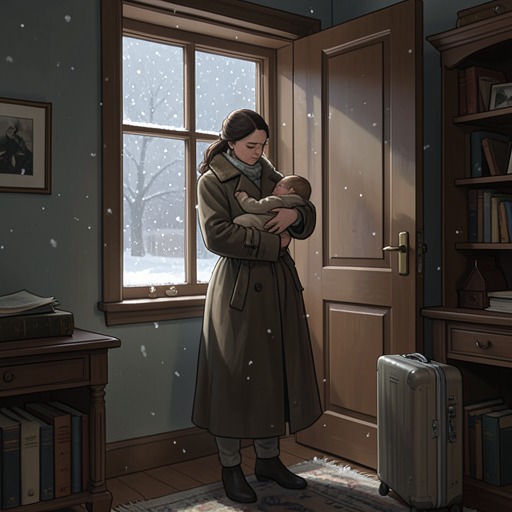
Tonia and her family’s deportation from Russia
Doctor ZhivagoTonia and her family’s deportation from Russia becomes an intimate catastrophe through the delayed letter that brings the news to Yurii in Yuriatin. The family’s forced departure separates him from his wife and children while revealing that Tonia has borne their daughter, Masha. Her account of exile, hope, and love reaches him five months after it was sent; as he reads, the surrounding room disappears from his awareness, and separation becomes an immediate, overwhelming presence.
The family’s expulsion
Tonia’s letter explains that several prominent people—including professors associated with the Cadet Party and Right-wing Socialists, Miliukov, Kizevetter, Kuskov, Yurii’s uncle Nikolai, her father, and other members of the family—are being deported abroad. The family has not settled its destination, though Paris is the likely one. Tonia regards their exile as a misfortune, but also recognizes that it is mild compared with what might have happened during the upheaval. Her family is preparing to leave while Yurii is absent, and she does not know whether the exit permit being issued to them will later be extended to him.
The deportation is more than a change of address: it breaks the possibility of ordinary family life without giving Tonia certainty about what comes next. She imagines that, if Yurii is found alive and conditions in Russia improve, he might obtain a separate visa and they might live together again. Yet she admits that, as she writes, she cannot believe such happiness is possible. Her hope persists alongside her recognition that the family’s future is beyond her control.
News carried by a delayed letter
The letter’s journey makes separation tangible. Written on many sheets, it arrives crumpled and soiled in a tattered envelope that has been opened at the post office. It is from Moscow and has been on its way for five months; unable to find its addressee, those handling it eventually turn to someone who knows Yurii from an earlier visit for a haircut. Lara gives it to him without his noticing the gesture. He begins reading in her house in Yuriatin, initially conscious of where he is, then gradually loses awareness of the room and its people.
The letter carries news beyond the deportation. Tonia tells Yurii that they have a daughter, christened Masha in memory of his mother, Maria Nikolaievna. Their son Sasha has grown into a big, strong boy; when the family speaks of his father, he cries and cannot be comforted. These details make the family’s separation present through the lives of children Yurii is not there to see. Tonia also tells him that she met Larisa Feodorovna in the Urals, thanks her for standing by her during a difficult time and helping her through childbirth, and describes her as a good person unlike herself in temperament.
Tonia’s account of their marriage
The letter becomes a reckoning with the marriage as well as a report of events. Tonia believes that she loves Yurii and that he does not love her. She searches their life together for an explanation, wondering whether he sees her through a distorting mirror and whether she has somehow brought this misfortune upon herself. She describes her own love as embracing both what is unusual in him and his ordinary traits, and says that his gifts and intelligence are dear to her.
Tonia also reflects on the difference between loving someone and believing oneself to love them. She imagines that, even if her feeling had been cold, fear of the devastating truth of failing to love would have prevented her from recognizing it. Her letter thus holds together devotion and doubt: she blesses Yurii and says she does not blame or reproach him, while still naming the painful inequality she perceives in their love. The deportation gives this private uncertainty a final urgency, because their separation may leave no opportunity to resolve it together.
The farewell and its aftermath
Tonia blesses Yurii for the trials and uncertainties ahead and tells him that she would be glad if all went well for him. As the family packs and those overseeing the departure hurry her, she writes that they may never see each other again. The farewell ends not with reconciliation or a settled future, but with her urgent appeal to her husband to understand what their parting means. Her uncertainty about whether he is alive, and about whether he can ever join them, remains unanswered in the letter.
When Yurii reaches its end, he looks up with tearless eyes, unable to see or attend to what surrounds him. Snow falls outside; as he stares through the window, its white spaces become associated with the gaps between the letter’s black characters. The narrative thereby makes the delayed message’s effect part of the event itself: the family has been dispersed by expulsion, while Yurii receives their separation as a private and nearly wordless grief. Elsewhere, his writing turns toward Lara and toward reflections on individual and social life, but the letter leaves the family’s fate suspended between Tonia’s hope of reunion and her fear that they will never meet again.