Ural
Doctor ZhivagoThe Urals are more than a destination on the novel’s map: they are a family inheritance, a landscape remembered before it is seen, and a refuge whose promise of rural renewal is steadily tested by war and revolution. For Anna Ivanovna Gromeko, the region holds the family estate at Varykino; for Lara, its countryside briefly restores a sense of purpose; for the Zhivago family, it becomes the intended alternative to life in the great towns. Yet the Urals are never outside history. Military collapse, displacement, and political campaigns reach the region and unsettle the very domestic life its forests seem to promise.
Geography and Family Inheritance
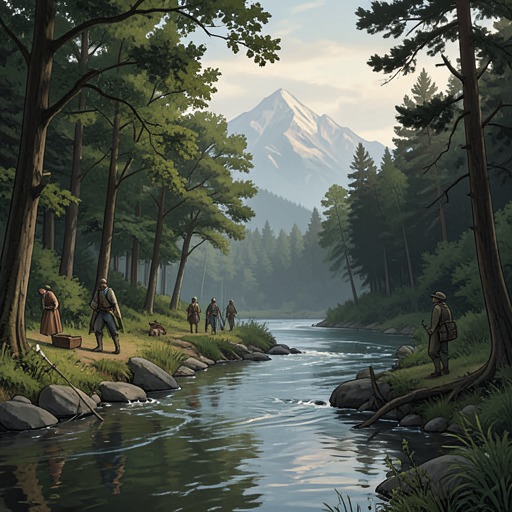
The Urals enter the family story through Anna Ivanovna’s father, an ironmaster who owned a vast estate near Yuriatin. The property included abandoned, unprofitable mines, placing industrial remains beside the region’s rural expanse. Anna’s memories give the estate a more intimate character: she describes Varykino, on the Rynva River, to Yura and Tonia, who have never visited it. Her account lets them imagine ten thousand acres of dense forest and the river’s bends cutting through the land near the Krueger property. Before they arrive, the Urals are already present in their lives as a place transmitted through family recollection.
This inherited geography links separate generations and different ideas of home. Anna’s father’s estate is not simply property to be recovered; it is the setting through which she shares her past with the younger pair. Later, when the family considers leaving the cities, the Krueger land offers a practical prospect as well as a remembered one: they might grow vegetables, with forest all around them. The move looks backward toward an inherited rural world while also answering the immediate difficulty of making life possible elsewhere.
Lara’s Countryside and Sense of Purpose
For Lara, the Urals are associated not only with Varykino but with her summers at Duplyanka, where she went with the Kologrivovs. In 1911, on her last visit there with them, the journey had become a familiar ritual. After the train set the family down at the station, Lara was allowed to walk alone to the estate while the luggage and the rest of the family went by cart and barouche. Her solitary walk separates her experience of the countryside from the household’s arrival routine and gives the landscape a personal meaning.
The moment in the fields brings Lara back to what she understands as her purpose: to grasp the meaning of the natural world and call things by their right names, or, if she cannot, to give birth to successors who might do so. The passage makes rural space a source of perception and vocation, not merely a pleasant setting. But this feeling of restoration is not permanent. That summer Lara arrives worn down by the many responsibilities she has assumed; she is easily upset and increasingly suspicious, with a tendency to nurse grievances. The contrast makes the countryside’s renewal real but temporary: it offers a recovered sense of direction without erasing the pressures she carries into it.
War and Political Upheaval in the Region
The novel’s Urals are also crossed by the consequences of national conflict. At the front, the military situation deteriorates into retreats, capture, overcrowded hospitals, and evacuation. In one episode, wounded men are brought into a hospital as the Moscow medical system struggles to accommodate them; in another, news that German forces have broken through prompts an immediate hospital move from a village under fire. These scenes establish the larger wartime disruption against which movement toward the Urals takes shape. The region may be distant from the principal cities, but it is not insulated from military events or the displacement they produce.
Revolutionary government extends that disruption into local administration. While a new offensive is being planned, revolutionary courts-martial are instituted and the death penalty, recently abolished, is restored. Elsewhere, the military authorities attempt to impose order on exhausted soldiers through speeches, threats, and armed force. The gap between official language and the listeners’ experience is part of the region’s political reality: people wearied by the war no longer respond as authorities expect. The Urals therefore signify neither a stable periphery nor a simple escape from politics. They are a place where national power reaches into local life and where the collapse of military discipline alters the conditions under which civilians travel and settle.
The Journey to Varykino
In April, Yurii Andreievich Zhivago sets out with his whole family for the former Varykino estate near Yuriatin, far away in the Urals. The decision grows from a plan to leave the big towns for a year or two and try to live from the land. Varykino offers a house and a surrounding forest, while cultivating vegetables promises a measure of self-sufficiency. The journey gives concrete form to a desire for ordinary survival: rather than accept a passive end to their difficulties, the family will attempt to make a life elsewhere.
The route itself marks a change of landscape. On the train, the plains give way to hills and mountain country; the north wind drops, warmer air arrives from the south, and the track climbs through wooded slopes before descending again. The railway does not simply carry the passengers to a new home. It moves them from one kind of country into another, with the forest seeming to take on the role of a guide as the train works its way through it. Yet the journey is also embedded in a society being reorganized by force. The twenty-three-car train includes sailors and civilian passengers, while eight cars at the rear hold about five hundred labor conscripts of varied ages and occupations. Their presence makes the family’s migration part of a wider, involuntary movement of people under revolutionary rule, not an isolated retreat into pastoral life.
Refuge, Return, and the Limits of Rural Renewal
The Urals gather together two contrary possibilities. Varykino’s forest and fields stand for work, shelter, and a life that may be rebuilt; the landscape Lara encounters at Duplyanka briefly restores her sense of vocation. At the same time, the region is bound to abandoned mines, wartime upheaval, political coercion, and the dangers that follow displacement. The Zhivagos’ journey toward the inherited estate is an effort to recover a domestic scale of existence, but it cannot remove them from the historical forces that have driven them there.
This tension persists beyond the family’s departure. In a later letter, Tonia recalls the Urals as a terrible and fateful place for her family, while also remembering Lara’s support during a difficult period and her care during childbirth. That account turns the region into the setting of separation as well as attempted refuge: the family’s experiences there become part of the painful history that Tonia writes down before leaving. The Urals thus remain more than a natural backdrop. They hold the promise of return to land and family memory, while exposing how little control individuals retain when war and political change determine where they can live, work, and belong.