Yuriatin
Doctor ZhivagoYuriatin is a town on the navigable Rynva River, served by one of the Ural railways, and a place where private hopes repeatedly meet the upheavals of war and revolution. It is Lara’s native town and, for a time, the home she imagines she has finally made; later it becomes the destination of her search for Pavel Antipov, the setting of her renewed life with Yurii Zhivago, and a town transformed by shortages and political repression. Its streets, houses, hospital, and riverbank hold both the textures of domestic routine and the consequences of a country coming apart.
Setting and Local Character
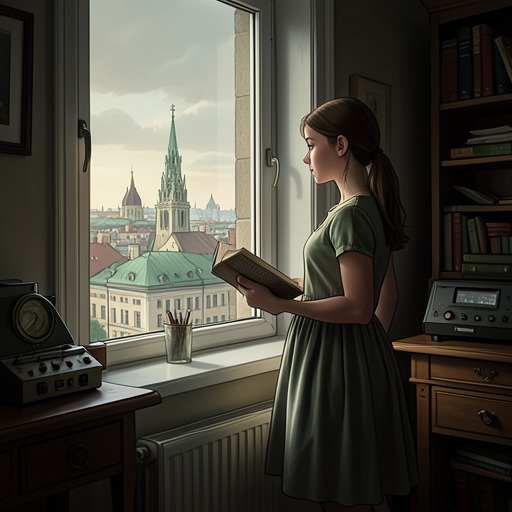
The Antipovs fare better in Yuriatin than they had expected. The Guishars are remembered favorably, easing Lara’s efforts to establish a household in a new place. She raises their three-year-old daughter, Katenka, manages the house, and teaches at the girls’ gymnasium. Marfutka, their red-haired maid, helps, though the work exceeds what she can complete. Lara is busy and happy: this is the kind of life she had hoped for.
The town’s provincial character is part of its appeal. Lara likes its northern accent, its unassuming ways, and the naïve trustfulness of its intelligentsia, who wear felt boots and gray flannel sleeveless coats. She feels drawn to the land and to ordinary people. The contrast within the Antipovs’ household is telling: Pavel, though the son of a Moscow railway worker, proves to be the more urban in outlook. He judges Yuriatin’s people harshly, finding their ignorance and crudeness irritating. As he reads widely during his years of provincial seclusion, he grows intellectually beyond his fellow teachers, and even Lara no longer seems as well-informed to him. Their different responses to the town register a widening difference in sensibility: Lara finds connection where Pavel feels confined.
Yuriatin’s seasons arrive through local custom rather than spectacle. As winter approaches, boat owners haul their boats from the Rynva on carts and store them in back yards, where the vessels lie outdoors until spring. Their pale, upturned hulls are as familiar a seasonal sign to the town as migrating storks or the first snowfall elsewhere. One such boat stands in the Antipovs’ yard; Katenka plays beneath its white hull as if it were a summerhouse. The image joins the town’s rhythms to the child’s everyday world, a modest shelter that makes a household yard feel like a place of play.
The Antipovs’ Home and Lara’s Search
Yuriatin is the setting of Lara and Pavel’s early married life, but that domestic happiness does not survive his departure. After Pavel leaves, Lara experiences the town as suddenly emptied: it seems silent, even the crows appear fewer, while Marfutka tries to draw her back to the present and Katenka tugs at her sleeve. Lara regards his leaving as the greatest defeat of her life, because the bright hopes she had invested in their life together have collapsed.
Pavel’s letters first come from Siberia. He admits that he had been mistaken, says he misses his wife and daughter, and is commissioned lieutenant before term. He is then sent to the front, never passing near Yuriatin and spending too little time in Moscow to see anyone there. His later letters are less despondent. He hopes to distinguish himself through a military exploit or a slight wound and earn leave to return to his family. When Brusilov’s forces break through and attack, his letters stop. Lara initially attributes the silence to military operations; when the advance slows and the troops dig in without news from him, she begins making inquiries in Yuriatin and by mail in Moscow and at his old field address. No one can tell her what has happened.
Lara’s search turns Yuriatin from home into a point of departure. She has volunteered in the military ward of the town hospital, then trains seriously and qualifies as a nurse. Taking six months’ leave from teaching, she entrusts the house to Marfutka and takes Katenka to Moscow, leaving her with Lipa while she goes to look for Pavel. Convinced that letters cannot bring reliable news, she obtains work as a nurse on a hospital train bound for Mezo-Laborch, the last address Pavel had given her. The local life she had wanted is interrupted by the war’s uncertainty; her departure is an attempt to cross the distance that information and correspondence have failed to bridge.
Streets and Landmarks
Yuriatin’s geography is made legible through named streets, familiar institutions, and a landmark that gives directions their local shorthand. When Zhivago finds Lara’s library order slips, he reads her address as Merchant Street, opposite the House with Sculptures. A local reader explains that the name is as recognizable in Yuriatin as a parish church used to identify a Moscow street or the Five Corners in Petersburg. The phrase is not an official address so much as a piece of shared local knowledge.
The House with Sculptures has a history of changing public use. A merchant built the dark, steel-gray building in the previous century as a private theater. His heirs sold it to the Merchants’ Guild, which gave its name to Merchant Street. The façade was once a place for theatrical posters and programs; now government proclamations and decrees cover its lower portion, and the building is used by the Party’s Town Committee. Its female mythological figures and statues of Muses holding cymbals, lyres, and masks still look down from the upper floor. On a cold, windy afternoon at the beginning of May, Zhivago walks through gusts of dust and sand to visit Lara. Between gusts, the figures seem to him like women who have come out onto the balcony to watch him. The familiar landmark thus bears the visible layering of the town’s past and present: a private theater and guild building converted into a political office.
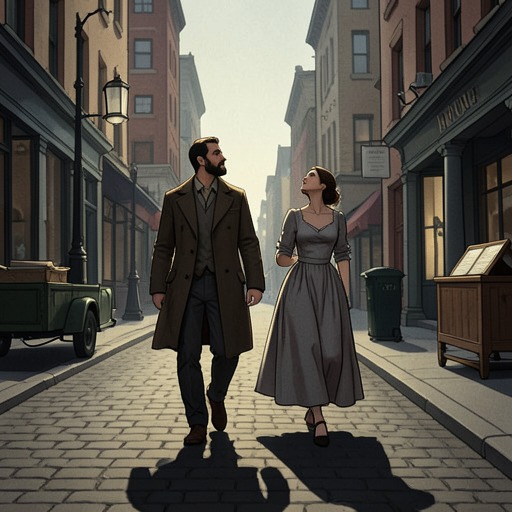
Merchant Street also serves as a route through Zhivago’s working life after his return. Each morning he walks from Lara’s house past the Giant movie house and the former printing shop of the Urals Cossack Army, now called the Red Compositor. At the town hall, a door bears a notice marked Complaints; from the square he turns into Buianovka Street and enters the Army Hospital by its back door to work in the out-patient department. Most of the walk lies beneath spreading trees and passes small frame houses with steep roofs, decorated doors, and carved, painted patterns around their windows. Near the hospital stands the former home of a merchant’s wife, faced with glazed, diamond-cut tiles like those of ancient boyar houses in Moscow. His route makes the town a lived-in landscape of work, civic signage, older wealth, and altered names.
From Refuge to Political Danger
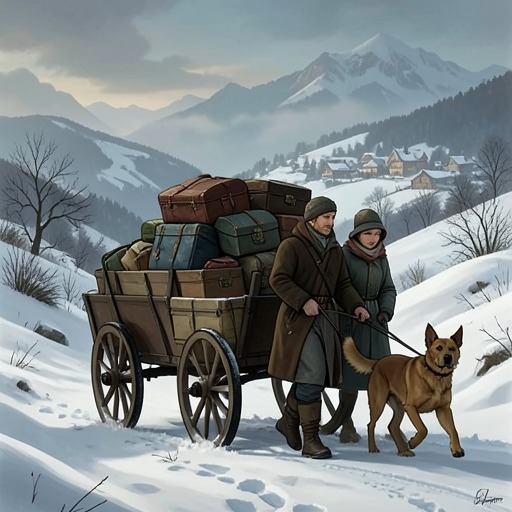
When Zhivago returns to Yuriatin after his ordeal on foot, arrival is itself a physical struggle. Exhausted and weak, with a stick in hand and a bag containing only a charitable remnant of bread and a piece of suet, he takes an hour to trudge from the railway outskirts to the corner of Merchant Street. His fur coat is gone, perhaps taken or traded for food; the thin, tattered coat left to him does not keep out the cold. He has followed much of the route along a disused railway, passing abandoned trains immobilized by defeat, lack of fuel, and snowdrifts. Some shelter armed bands or fugitives; many have become mortuaries and mass graves for people killed by cold and typhus. Against that devastated approach, Yuriatin appears to him like a friend he had feared never to see again.
The town offers Lara and Zhivago a brief possibility of shelter, but it cannot be separated from the new political order. Lara warns him that since Yuriatin became part of Soviet Russia, it has been drawn into ruin. Supplies are sent to Moscow and disappear into the city’s vast need, while little remains locally. Mail and passenger services have stopped; trains are being used to carry bread. Discontent is again growing, as it did before the Haida uprising, and the Cheka violently suppresses even the slightest sign of it. Lara urges the weakened Zhivago not to attempt a journey on foot and suggests that he take temporary professional work, perhaps in the regional health service. The town’s medical institutions offer a way to survive, even as public life grows more coercive.
Zhivago does take work. As money rapidly devalues and it becomes difficult to make ends meet, he plans to go to Moscow but accepts three temporary jobs. His morning walk ends at the Army Hospital, his principal post; three or four times a week he also attends board meetings of the Yuriatin Health Service on Miassky Street. These routines give him a place in the town while revealing how precarious ordinary life has become: professional work is not a secure return to stability but a means of managing scarcity.
Yuriatin finally becomes a place to disappear from. When Zhivago believes political danger has caught up with him and Lara, he rejects the impractical and conspicuous journey to Moscow. Instead, he proposes that they slip away unseen to Varykino, initially for a week, a month, or whatever temporary refuge they can manage. Their decision does not erase Yuriatin’s importance: the town has been home, a site of return and reunion, and the place where their shared life takes shape. But amid dwindling supplies, halted transport, and the threat of arrest, even a familiar provincial refuge can no longer guarantee safety.