Yuriatin Revolutionary Tribunal
Doctor ZhivagoThe Yuriatin Revolutionary Tribunal represents the revolutionary courts that convert political suspicion and military urgency into powers of trial and punishment. Across the novel’s scattered references, revolutionary justice appears less as a stable legal safeguard than as an authority whose reach can extend from a battlefield to a civilian’s home, with life-altering consequences for people caught in its decisions.
Institutional Authority
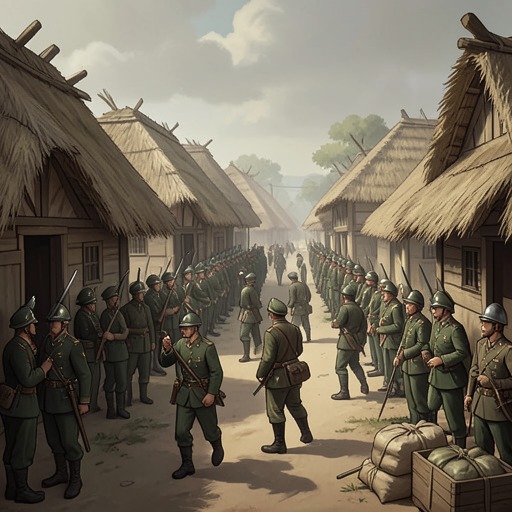
As a new offensive was being planned, the authorities sought to restore morale among the army. Revolutionary courts-martial were established, and the death penalty—recently abolished—was brought back. The tribunal belongs to this larger turn toward intensified discipline: the state’s response to military crisis was not only persuasion but also the threat of legally sanctioned execution.
The tribunal’s authority is also associated with the consolidation of revolutionary rule. In the account of Strelnikov’s record, he is credited with taking opponents by surprise, then investigating, trying, sentencing, and carrying out sentences with speed and severity. The sequence presents trial as one stage in a forceful chain of command, rather than as a process insulated from the military objectives it serves.
Personnel and Political Reach
The tribunal’s local membership brings the institution close to personal and family life. Lara reports that two former political convicts from among the workers, Tiverzin and Antipov, have recently been transferred from Khodatskoie to the local revolutionary court. Both know her well; one is her father-in-law. Their arrival changes her sense of safety. She fears that Antipov’s hostility may expose her and Katenka to danger, and imagines that even Pasha could be destroyed in the name of revolutionary justice.
That fear is not simply an abstract response to political tension. Lara speaks as a mother responsible for Katenka and concludes that she must make a plan before arrest reaches them. The court’s presence thus registers in the domestic sphere before a verdict is described: the prospect of its power alters how Lara understands the security of her family and what she may have to do to protect them.
Proceedings and Consequences
The novel sets formal revolutionary justice beside the instability of local accusation. Kharlam goes to town and tells officials that the village needs a Poor Peasants’ Committee, promising that he can set its people against one another. After Red Army men arrive and a court is established, Vasia is accused of evading labor service, fleeing, killing an old woman, and stirring up the village. He is imprisoned and escapes through a floorboard. The story does not identify that court explicitly as the Yuriatin Revolutionary Tribunal, but its appearance shows how the broader system of revolutionary adjudication could reach rural disputes through official reports and military intervention.
The account emphasizes how readily accusation can shape events. The village is burned while Vasia is absent, and his mother dies without his knowledge; he later emerges from hiding to find that the villagers have dispersed. In this episode, institutional procedure does not settle the truth of the accusations. Instead, charges, detention, flight, and the destruction of the village unfold amid rumors and competing interests, leaving ordinary people to bear consequences they cannot control.
Justice, Discipline, and Fear
The tribunal’s significance lies in the contrast between the promise of revolutionary justice and its coercive reach. Its proceedings are connected to restored capital punishment, rapid enforcement, and the fear that politically empowered officials may act against people they know personally. At the same time, the novel’s accounts of military courts and village proceedings show that the machinery of judgment operates within broader campaigns of discipline and social control.
The institution is therefore not developed through a single continuous courtroom scene. It emerges through policy, reports of officials’ conduct, Lara’s apprehension, and the aftermath of accusations elsewhere. This dispersed presentation makes the court’s power felt less as a visible legal setting than as a pressure extending across public and private life: a decision made in the name of justice may determine who is free, who is suspected, and who must flee.