Yurii Andreievich Zhivago
Doctor ZhivagoYurii Andreievich Zhivago, called Yura as a child and later known as Doctor Zhivago, is a physician and poet whose private life unfolds amid the upheavals of modern Russia. Orphaned young, he chooses medicine because he believes practical life should serve society, yet art remains central to his way of understanding the world. War, revolution, captivity, and separation repeatedly unsettle his domestic and professional life; his response is not political mastery but attention—to people, nature, death, and the possibility that art can create life from what has been lost.
Identity and formation
Yurii is the son of Andrei Zhivago and Maria Nikolaievna Zhivago. His father also has a son, Evgraf Andreievich Zhivago, by Princess Stolbunova-Enrici, making Evgraf Yurii’s half-brother. After Maria’s death, her brother, Nikolai Nikolaievich Vedeniapin, leads the grieving boy out of the graveyard. A former priest who had asked to be unfrocked, Vedeniapin becomes an early family presence at the point when Yurii’s life has been marked by bereavement.
As a young man, Yurii is impressionable, but his habits, opinions, and inclinations are already distinctly his own. His outlook is not presented as a finished system: his thoughts remain unsettled even as his perception shows striking originality. He is attracted to art and history, yet does not regard art as a practical profession. Interested also in physics and natural science, he decides to study medicine, reasoning that a person’s working life should be socially useful. The choice establishes a lasting tension in his life: the physician’s practical service and the writer’s inward attention are different callings, but both become ways of responding to human vulnerability.
Medicine, family, and art
By the time he is addressed as Yurii Andreievich, he is married to Antonina Alexandrovna Gromeko, usually called Tonia. He waits outside the maternity ward after bringing her to give birth, prepared to tell the midwife how to reach him and to ask how he can remain in contact. The scene places his professional identity beside his family life: he is a doctor in the hospital corridor, but also a husband anxiously waiting for news of his wife.
The book repeatedly sets his family attachments against the forces that disrupt them. When he returns and finds Tonia at the door, their first response is immediate recognition and embrace; both begin speaking at once. Later, while hospitalized, he reads the accumulated letters from Tonia as papers and a breeze move around him. The letters make their separation tangible without reducing their relationship to a single reunion: marriage persists through distance and correspondence, even as other attachments and the pressures of the period complicate his life.
Yurii’s understanding of art takes shape in the presence of death. Walking apart from mourners, he feels drawn to dream, think, work out new forms, and create beauty as an answer to the desolation around him. He comes to understand genuine art as work that meditates on death and thereby creates life. This is not simply a theory separate from his experience: it anticipates the place of his writing in a life repeatedly interrupted by loss, and the poems that survive him.
War, revolution, and captivity
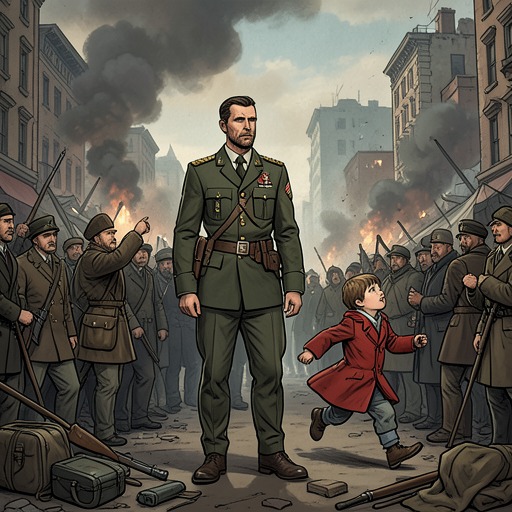
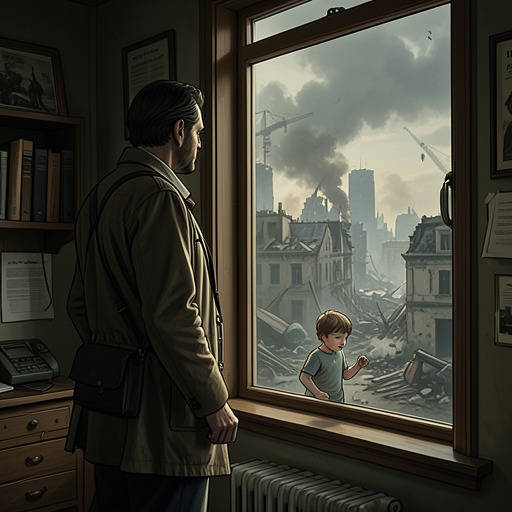
War brings Yurii into unfamiliar towns and confronts him with bloodshed, homelessness, and the practical knowledge demanded by hardship. The revolution that follows is not the intellectual ideal he might once have imagined, but a force born of war: bloody, ruthless, and elemental, led by professional revolutionaries and soldiers. Political change enters his life as lived upheaval rather than an abstract program, displacing people and unsettling the ordinary ties through which they make a home.
During the war Yurii serves as a doctor, but his work does not keep him outside combat. Although the Red Cross convention requires medical personnel to remain outside military operations, an engagement catches him in the field and he has to defend himself. The episode marks the limits of professional neutrality in a conflict that repeatedly draws civilians and medical workers into its violence.
His later captivity with the partisans is unusual precisely because it lacks conventional boundaries. More than a year after being taken prisoner, he is not enclosed by walls, watched by guards, or held in a fixed camp; the mobile force carries him along as it moves through settlements and local communities. His freedom is therefore ill-defined rather than simply absent. On one occasion he again crosses the boundary between medical neutrality and combat, forced to shoot in self-defense when an engagement begins around him.
At last, on a clear moonlit night, Yurii makes his way farther into the taiga, reaches a marked tree, digs up the possessions he had hidden there, and leaves the camp. His escape is a quiet, practical act rather than a public victory. It returns him to movement on his own behalf, but does not restore the life that captivity and war have fractured.
Lara, work, and decline
Back in Yuriatin, Yurii discovers that a voice heard in a winter dream at Varykino had belonged to Lara Antipova. The recognition shocks him; he turns toward her, and shortly afterward, on a cold, windy afternoon at the beginning of May, he changes his plans and goes to see her. Their connection draws him toward a renewed private life even as other obligations and separations remain unresolved. On the evening of his return to town, a sudden weakness gives way to a feeling of kinship with passers-by and with life around him. In the spring light he imagines finding and reconciling those he has lost, and takes the anticipated sight of Lara as a promise that those hopes might be fulfilled.
His recovery does not remove economic pressure. After a summer spent largely unnoticed, he resumes work and, while planning to go to Moscow, takes three temporary jobs rather than one. The rapid devaluation of money makes it difficult for him to support himself. Work is both necessity and a means of return to practical life, but the conditions around him make stability elusive.
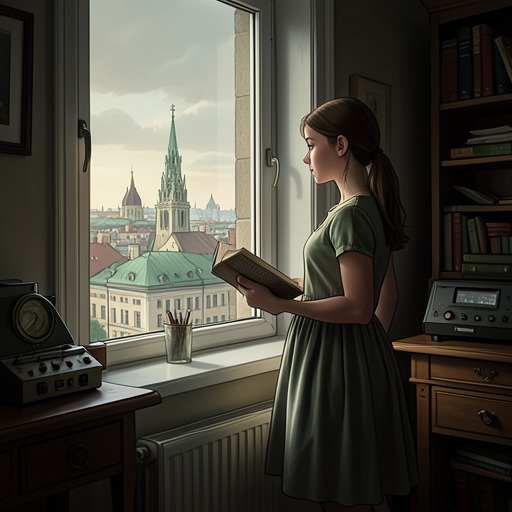
Yurii continues to write, attending even to the individuality of his handwriting as he copies poems from memory. He makes repeated drafts of “Christmas Star,” “Winter Night,” and other poems, revising them as he moves further from their remembered originals. Some of these writings are later mislaid and never recovered. The scene holds creation together with loss: the poems take shape through labor, yet their preservation is uncertain.
After Lara leaves, his daily life deteriorates. He neglects the house and his own care, reverses night and day, and loses track of time. In the final eight or ten years of his life, he gradually loses his abilities as a doctor and writer. Periods of depression give way to brief returns to work, followed by long stretches of indifference to himself and the world. A heart condition he had diagnosed earlier advances, though he had not understood its seriousness.
His circumstances worsen after his friendship with Vasia Brykin breaks down. Vasia’s criticisms become more frequent; Yurii accepts that some are justified, but their relationship nevertheless deteriorates until they part. Yurii gives Vasia the room they shared and moves to Flour Town, where Markel Shchapov has set aside a corner of the former Sventitsky house: a derelict bathroom, a single-windowed room, and a crumbling kitchen and back entrance. He gives up medicine, withdraws from friends, neglects himself, and lives in poverty.
Final years and significance
A friendship with Marina Shchapova grows from the practical routine of carrying water. She often helps with his housework, then stays with him and does not return to the lodge. She becomes his partner, though he has not divorced Tonia and they do not register their marriage; they have children. Their household is recognized locally, but its informal status exposes the unresolved reality of Yurii’s earlier marriage rather than settling it. This later relationship belongs to a life in which attachments continue to form even as social and personal circumstances remain unsettled.
Near the end, Yurii speaks of an intense desire to live and of life as a continuing effort toward improvement. The declaration stands against the long decline that has preceded it: he has endured loss of work, poverty, estrangement, and illness, yet the wish to live remains. His death comes during a journey on a trolley in Presnia. In a panicked effort to open a window fastened with screws, he pulls at the strap three times and feels a sudden, fatal pain; the trolley moves only a short distance before stopping again.
Afterward, the room contains the table at which he had written, now supporting his coffin, while his manuscripts have been put away in a drawer. The altered use of the table gathers together the two recurring facts of his life: the body’s ending and the persistence of the work made by that body. Yurii’s life does not resolve the conflict between medicine and art, domestic attachment and separation, or individual feeling and political upheaval. Its lasting coherence lies instead in his effort to preserve the singularity of experience, and in the belief that art, by attending to death, can still make life.