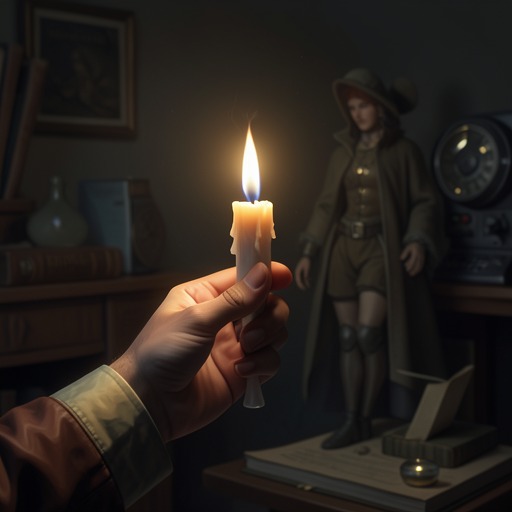
Yurii Zhivago's candle
Doctor ZhivagoYurii Zhivago's candle is both a remembered light in a winter window and the recurring image that binds an earlier Christmas scene to Yurii’s poetry and death. Its significance lies in the way an apparently slight sighting acquires the weight of a turning point: at Yurii’s funeral, Lara imagines that the candle’s light may have set his life on its fatal course, while “WINTER NIGHT” returns to the candle amid a world buried in snow.
The Candle in Lara’s Memory
At the funeral, Lara’s thoughts move backward from the body on the table to an earlier Christmas. She recalls having set out to shoot a figure she regarded as a caricature of vulgarity, and remembering a conversation in the same room, lit only by a candle, with Pasha, who was still a boy. Yurii had not yet entered her life. The candle therefore belongs first to a moment that predates the relationship and the losses now gathered around her.
Lara cannot recover the conversation itself. What remains is a sharply bounded image: a candle burning on the window sill, melting a round patch in the icy crust on the glass. Memory preserves the light and the mark it makes on the frost, while the words spoken in the room have vanished. That imbalance makes the candle more than a prop in a recollection: it is the surviving point of contact with a past Lara can no longer fully reconstruct.
The Sighting and Its Possible Consequence
From the funeral present, Lara asks herself whether Yurii saw that candle as he drove past. She connects his noticing its light from the street with the opening refrain of “WINTER NIGHT,” and wonders whether, from that instant, his life took its fatal course. The passage presents the connection as Lara’s conjecture, not as a confirmed account of what Yurii saw or what determined his fate. Its force comes from the way grief turns a small, ordinary light into a possible hinge between separate lives and times.
The remembered candle thus holds together the room where Lara spoke with Pasha and the street from which Yurii may have glimpsed the window. The scene does not supply a recovered dialogue or establish a precise chain of causes. Instead, Lara’s question makes the image carry what memory cannot settle: whether a brief act of seeing can become, in retrospect, the beginning of a life’s defining course.
The Image in “WINTER NIGHT”
The poem “WINTER NIGHT” opens with snow falling across the whole world, a landscape swept from end to end. Against that blanketing scale, the candle is intimate and fixed: “A candle burned on the table; / A candle burned.” The refrain returns after the blizzard has sculpted arrows and whorls on the glass. Light and frost, a small indoor flame and the vast snow outside, recur together as the poem builds its winter scene.
The poem’s candle is not simply the literal window light as Lara remembers it: the prose places the candle on the sill, while the verse names one burning on a table. The connection is made by Lara’s association and by the recurring words, not by an assertion that the two descriptions record an identical physical arrangement. The poem transforms the remembered sight into a repeatable verbal image, preserving its flame even as the surrounding winter shifts into verse.
Memory, Loss, and Recurrence
At the funeral, Lara is surrounded by the losses she names in thought: one person has died, another has killed himself, and the surviving figure she associates with her past remains distant and alien to her. Against this sense that those she needs are gone, the candle offers no restoration of the past. It gives her instead a fragment she can still touch in memory: the light, the frost, and the round patch melted in the glass.
The image also connects the private history of Lara and Yurii to the poem that bears the candle’s repeated refrain. Its recurrence does not resolve the uncertainty over whether Yurii saw the light or whether it truly redirected his life. Rather, the candle’s continuing presence—in Lara’s recollection, in her funeral thoughts, and in “WINTER NIGHT”—makes that uncertainty part of its meaning. A moment she cannot verify becomes an image capable of carrying memory across absence, and of giving form to the life she is now mourning.