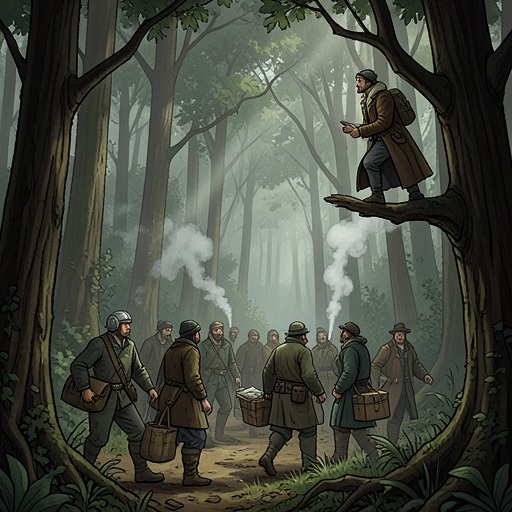
Yurii Zhivago's partisan captivity
Doctor ZhivagoYurii Zhivago’s partisan captivity is defined by a contradiction: there are no walls, chains, or watchful guards, yet he cannot simply leave. More than a year after the Forest Brotherhood takes him prisoner, he moves with its wandering force through settlements and local communities. His unfreedom is difficult to see precisely because it resembles freedom; escape becomes possible only when he finally acts on preparations made long before.
A captivity without walls
The Forest Brotherhood does not hold Zhivago in a fixed enclosure. The partisan force is constantly moving, and he travels with it across inhabited territory, where the fighters mix with the local population rather than remaining apart. No guard continuously watches his movements, and the place of captivity has no walls. The arrangement can look like ordinary travel undertaken by a doctor who simply chooses not to go elsewhere.
That appearance conceals dependence. Zhivago must submit to his unfreedom even though it seems intangible, almost imaginary. The narrative places his captivity alongside other forms of compulsion that are difficult to identify from the outside: the absence of visible restraints does not make his choices genuinely his own. His situation is therefore not a single locked room but a life whose limits are imposed without an obvious boundary.
Failed escapes and enforced company
Zhivago tries to escape three times, and each attempt ends with his recapture. The partisans impose no punishment, but the repeated outcome makes the danger plain; he stops trying. The absence of formal penalties does not undo the power that returns him to captivity. Instead, the failures make the camp’s control seem more complete: it need not visibly punish him to prevent his departure.
Liberius Mikulitsyn favors the doctor, enjoys his company, and has him sleep in his tent. This privileged proximity offers no release. Zhivago finds the enforced companionship irksome, because the chief’s personal liking does not change the fact that the doctor remains there against his will. Favor and coercion coexist: to Liberius, the arrangement may be intimacy or preference, but to Zhivago it is another expression of the camp’s claim on him.
What captivity has taken from him
In an angry speech to Liberius, Zhivago rejects the language and slogans through which the partisans present themselves as Russia’s liberators. He insists that their political self-image cannot make their actions welcome to him. The force has taken him from his wife, his son, his home, and his work—the attachments and responsibilities that give his life meaning—and he refuses to be grateful for a supposed liberation he never asked for.
The speech makes captivity a conflict over who may define freedom. Liberius’s movement can imagine itself as delivering benefits to people; Zhivago counters that imposed benefits remain impositions. His protest is not only against confinement in the camp but against being assigned a political identity and gratitude that contradict his own experience. The rhetoric of emancipation cannot erase the intimate losses caused by his removal from family and ordinary life.
The possibility of return remains uncertain. Zhivago has heard a rumor that an unknown, non-Russian force raided and sacked Varykino, and that both his people and Liberius’s escaped. Kamennodvorsky does not deny the report, but Liberius dismisses it as groundless. The rumor does not establish what happened at Varykino; its importance is that Zhivago is forced to reckon with the possible loss of the very home and family from which captivity has kept him. The uncertain news makes escape more urgent without supplying a secure destination.
The prepared escape
When Zhivago turns away from returning to Liberius, he recalls provisions cached long before: a pair of skis, a bag of biscuits, and other necessities buried in the snow outside the camp at the foot of a tall pine. He had marked the tree with a notch so he could locate the cache if an opportunity arose. The supplies show that, although his earlier attempts failed and he stopped trying, the possibility of departure had not disappeared from his thoughts.
On a clear night with a full moon, Zhivago follows a path between the snowdrifts toward the cache. He knows where the sentries are posted and initially avoids them. At the clearing by the mound and rowan tree, however, a sentry hails him and demands the password. Zhivago identifies himself as the camp doctor; the encounter demonstrates how a familiar role can momentarily stand between him and the authority guarding the camp, but it does not end his dependence by itself.
He continues beyond the clearing into the taiga, finds the marked tree, unearths the hidden supplies, and leaves the camp. The departure differs from his three earlier attempts because it turns long-kept preparation into action. The skis and food are practical means of travel, while the marked tree makes the choice materially possible: escape is not an abstract wish but a route supported by provisions he deliberately set aside.
The limits of apparent freedom
The account makes Zhivago’s captivity legible through the gap between what can be seen and what he is permitted to do. He can move without a guard at his side, and the partisans’ life overlaps with that of local people, yet his three recaptures establish that movement is not the same as freedom. Even Liberius’s favor binds him more closely to the camp rather than loosening its hold.
His final departure does not resolve the uncertainty surrounding Varykino or restore the family life he names as lost. It does, however, change the immediate terms of his condition: Zhivago stops merely enduring a freedom that proves unusable and leaves with the supplies he had prepared. The episode’s decisive movement is from invisible captivity to a concrete act of escape, achieved not through the disappearance of constraint but through planning and a choice to risk departure.