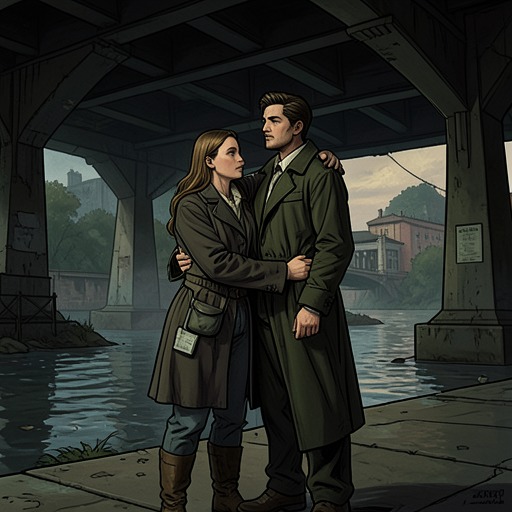
Zhivago and Lara’s renewed affair
Doctor ZhivagoZhivago and Lara’s renewed affair grows out of an encounter in the Yuriatin library and a deliberate visit to Lara’s home, where recognition and disclosure draw them into a secret intimacy. Its defining tension lies in Zhivago’s simultaneous love for Lara and devotion to Tonia: the relationship deepens, but so does his conviction that he is committing a grave betrayal.
Recognition in Yuriatin
In the library, Zhivago first notices Lara not through a dramatic entrance but through the quiet effect she has on another person. A librarian, who has been sneezing and appears nervous, speaks with Lara; after their conversation, the woman puts away her handkerchief, returns to her place smiling, and seems to have recovered her confidence. Other readers notice the exchange and look at Lara with approval. From these small signs, Zhivago understands that she is known and liked in the town. His recognition of her is therefore also a glimpse of her place in the surrounding community: she is not simply a figure from his past, but someone whose presence has already made a difference to people around her.
At the beginning of May, after finishing his errands in town and visiting the library, Zhivago unexpectedly changes his plans and decides to see Lara. The cold wind drives dust and sand into his face as he makes his way to her home on Merchant Street. This choice turns a chance sighting into a renewed approach. The weather and the unfamiliar street do not stop him; his visit is an action he has resolved on during the day, although the evidence gives no explicit account of what he expects from it.
The first words of their meeting come at Lara’s well. She has filled two buckets and carries them on a yoke over her left shoulder. A gust tears off the kerchief tied around her hair and sends it to the far end of the fence. Zhivago runs after it, retrieves it, and brings it back. Lara receives him with her customary natural composure, showing neither amazement nor embarrassment. She says, "Zhivago!" He answers, "Larisa Feodorovna!" and she asks what he is doing there. The lifted kerchief, returned by Zhivago, makes the reunion an intimate but unceremonious one: their recognition is immediate, yet Lara does not turn it into a scene.
From reunion to intimacy
The renewed relationship is not only a private meeting but a change in how they address one another. By the time two months have passed, Zhivago has long been calling Lara by her familiar name and addressing her as "thou," while she still calls him Zhivago. That difference preserves a small asymmetry within their closeness: he has moved further into intimate speech, while she retains his surname for him. The passage does not explain her choice, but the contrast makes their familiarity visible in the very forms of address they use.
Their meetings carry a practical deception. Zhivago has spent the night at Lara’s after going to Yuriatin, then told his family that business kept him in town and that he stayed at Samdeviatov’s inn. The lie turns the affair into a breach of everyday trust, concealed not from strangers but from the family whose affection remains unchanged. The relationship has become more serious over the intervening two months, but its growth is accompanied by concealment rather than an open break with Zhivago’s home life.
Lara’s disclosure
Lara tells Zhivago plainly that the Strelnikov he met is her husband, Pasha: Pavel Pavlovich Antipov, whom she went to find at the front and whose death she had refused to believe. The disclosure joins the personal story of her marriage to the political identity by which her husband is now known. Zhivago says he had heard the rumor but had not believed it; he had spoken freely about Strelnikov to Lara because he considered the rumor nonsense and could not see what the man had in common with her.
Lara confirms that the identification is true. She says that she shares the general belief, and that their daughter Katenka knows and is proud of her father. Strelnikov is an assumed name, she explains, of the kind used by active revolutionaries. Her frankness gives Zhivago information that changes the meaning of his earlier encounter with Strelnikov: the formidable revolutionary is not an unrelated public figure, but Lara’s husband, the Pasha whose death she had refused to accept. Their renewed intimacy thus takes place under the shadow of a marriage and a political alias, not outside the history that brought Lara and Zhivago together.
Love, loyalty, and guilt
Zhivago’s understanding of the affair is starkly divided. He loves Tonia and worships her; her peace of mind, he believes, matters more to him than anything in the world. He would defend her honor more devotedly than either her father or Tonia herself, and would personally punish anyone who wounded her pride. Yet he recognizes that he has become the very offender from whom he imagines he would protect her. His moral distress comes not from indifference to Tonia, but from the collision between his professed loyalty and his own conduct.
At home, he feels like a criminal. His family does not know the truth, and their continuing affection intensifies rather than eases his torment. The guilt interrupts ordinary conversation: he can suddenly stop hearing what is being said as the thought of his offense overwhelms him. At meals, food catches in his throat; he puts down his spoon, pushes his plate away, and chokes back tears. Tonia reads his distress as possible bad news from town—perhaps someone has been arrested or shot—and gently urges him to tell her, promising that she will not be upset. Her concern exposes the painful imbalance at the heart of the affair: she offers him trust and comfort while he withholds the truth.
The renewed love therefore brings intimacy and knowledge, but not release. Lara’s identity as Strelnikov’s wife makes their closeness more entangled with the dangers and losses of the surrounding political world. Zhivago’s deeper attachment to Lara simultaneously sharpens his sense of injury to Tonia, because he knows the value he places on her peace and honor even as he violates them. The relationship is presented not as a clean choice between two loves, but as an increasingly serious secret whose emotional consequences reach back into the home it conceals.