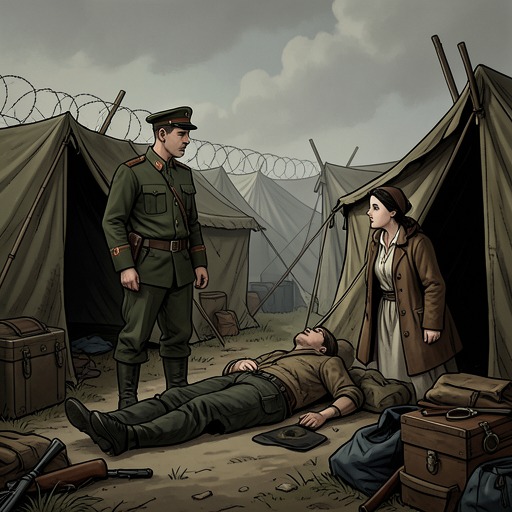
Zhivago’s repeated escape attempts from the partisans
Doctor ZhivagoZhivago’s repeated escape attempts from the partisans mark the point at which his apparent freedom is exposed as coercion: he tries three times to leave, is captured each time, and stops risking another attempt.
The Conditions of Captivity
By the time the episode is described, more than a year has passed since Yurii Andreievich Zhivago was taken prisoner by the partisans. His captivity has no clear physical boundary: there are no walls around him, no guard watches him, and no one formally monitors his movements. The partisan force continually moves through local settlements and countryside, mixing with the people rather than remaining apart from them; Zhivago moves with it.
The lack of visible restraints makes his situation look like freedom he simply fails to use. The narration rejects that appearance: although he is neither chained nor watched, he must submit to a dependence that is difficult to locate and therefore easy to mistake for an illusion. His repeated escapes test that freedom in practice, and their failure reveals the force behind its seeming absence.
Three Attempts and Their Limit
Each of Zhivago’s three attempts to escape ends in capture. The account gives no separate route or circumstances for the attempts, but makes their repeated outcome decisive: he is returned to captivity every time. He suffers no punishment, yet the danger of trying again is clear enough that he does not make a fourth attempt.
The sequence is an escape plot that does not culminate in liberation. Instead, each recapture narrows the possibility of action, until caution replaces another effort. The absence of a penalty does not make the attempts harmless; the repeated capture itself demonstrates that the partisan force can contain him without needing a visible prison or constant surveillance.
The Partisan Chief’s Favor
Zhivago is favored by Liberius Mikulitsyn, the partisan chief, who enjoys his company and has him sleep in his tent. This preference gives the captive a place close to the person in command, but it does not restore his autonomy. Zhivago finds the enforced companionship irksome: personal favor and captivity coexist, and the intimacy of the tent becomes another condition he has not chosen.
The episode thus presents compulsion not only as the power to prevent departure but also as the power to determine the captive’s daily proximity to others. Zhivago’s three failed attempts establish the practical boundary of his freedom; the chief’s favor shows how that boundary can persist even under the guise of personal regard.