
Euclid's Afterlife
ElementsThis flow follows Euclid's role as inherited authority whose ancient geometry is reorganized for a modern visual audience.
increasing Bearing strength in each event
 decreasing
Bearing strength in each eventdecreasingAncient Authority

Ancient Authority
Intellectual Foundation
Euclid is presented as the central figure through whom the Elements became foundational to mathematical science.
His work provides the subject's established architecture.
Cultural Reach
The authority is described as extending across the civilized world.
Schoolbook Standard

Schoolbook Standard
Definitions and Proofs
The work follows the familiar sequence of definitions postulates axioms and propositions.
This continuity assures readers that the new colours do not abandon Euclidean content.
Reframing
The innovation lies in presentation rather than replacement.
Visual Recasting
Visual Recasting
New Surface
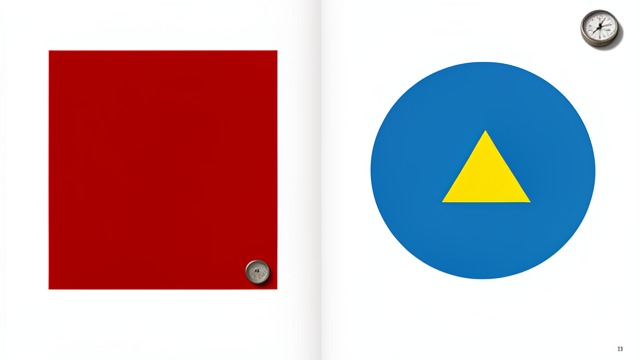
Euclidean constructions are reproduced through coloured shapes and minimal verbal labels.
Their ancient logical relations become visible in a modern page design.
Continuity and Change
The authority of Euclid legitimizes the method even as Byrne changes the reader's experience.
Abstract Extension

Abstract Extension
Proportion
The Euclidean sequence reaches magnitudes ratios and similarity, where verbal abstraction becomes especially demanding.
The coloured system accompanies this transition rather than stopping at elementary figures.
Endurance
Its success depends on remaining useful after visual intuition has become more subtle.
Modernized Classic

Modernized Classic
Completed Inheritance
The first six books remain recognizable as Euclidean geometry.
Yet the page presents them as an experiment in visual learning and educational reform.
Historical Outcome
Euclid survives not as a fixed school ritual but as material for new methods of thought.
in the historical opening of the introduction
at the transition into Book I
during the first five propositions of Book I
during Books V and VI
at the end of Book VI
