
The Marginalized Learner
ElementsThis flow traces the book's imagined response to learners excluded by conventional abstract or auditory instruction.
increasing Bearing strength in each event
 decreasing
Bearing strength in each eventdecreasingThe Discouraged Student

The Discouraged Student
Encounter with Formality
A capable learner may meet geometry through rigid demonstrations and endless repetitions.
The material becomes an exercise of memory rather than inquiry.
Lost Potential
The student's difficulty is treated as a failure of instruction rather than intelligence.
The Visual Learner

The Visual Learner
Immediate Form
The learner identifies the red blue or yellow part before mastering conventional notation.
The figure provides an entry into relations that words alone might conceal.
Access
Visual recognition becomes a route into exact reasoning.
The Blind Learner

The Blind Learner
Tactile Possibility
The introduction suggests that tangible diagrams can provide a medium through which geometry may be taught to blind learners.
The claim expands the method beyond ordinary coloured vision.
Material Knowledge
Geometric structure becomes something that can be encountered through physical form.
The Deaf Learner

The Deaf Learner
Visual Independence
The same system is presented as suited to deaf and mute learners because its information is carried by visible form.
Meaning need not depend entirely on spoken explanation.
Inclusion
The diagram becomes a shared language across sensory differences.
The Recovered Thinker
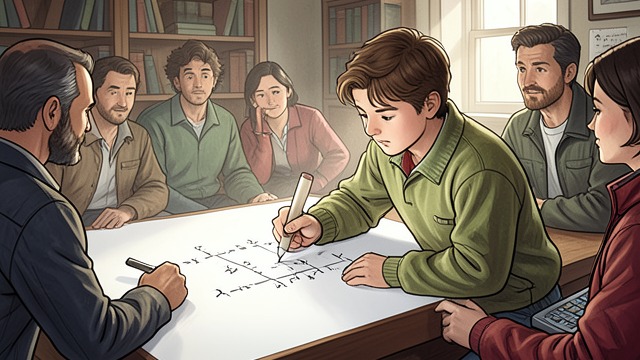
The Recovered Thinker
From Exclusion to Participation
Learners once discouraged by conventional exposition are invited into the common work of proof.
The method treats access as a condition of reasoning rather than a concession.
Intellectual Equality
The ultimate promise is participation in thought.
in the introduction's criticism of formal pedagogy
during the coloured triangle example
during the discussion of tangible diagrams
immediately after the discussion of blind instruction
at the final educational appeal
